
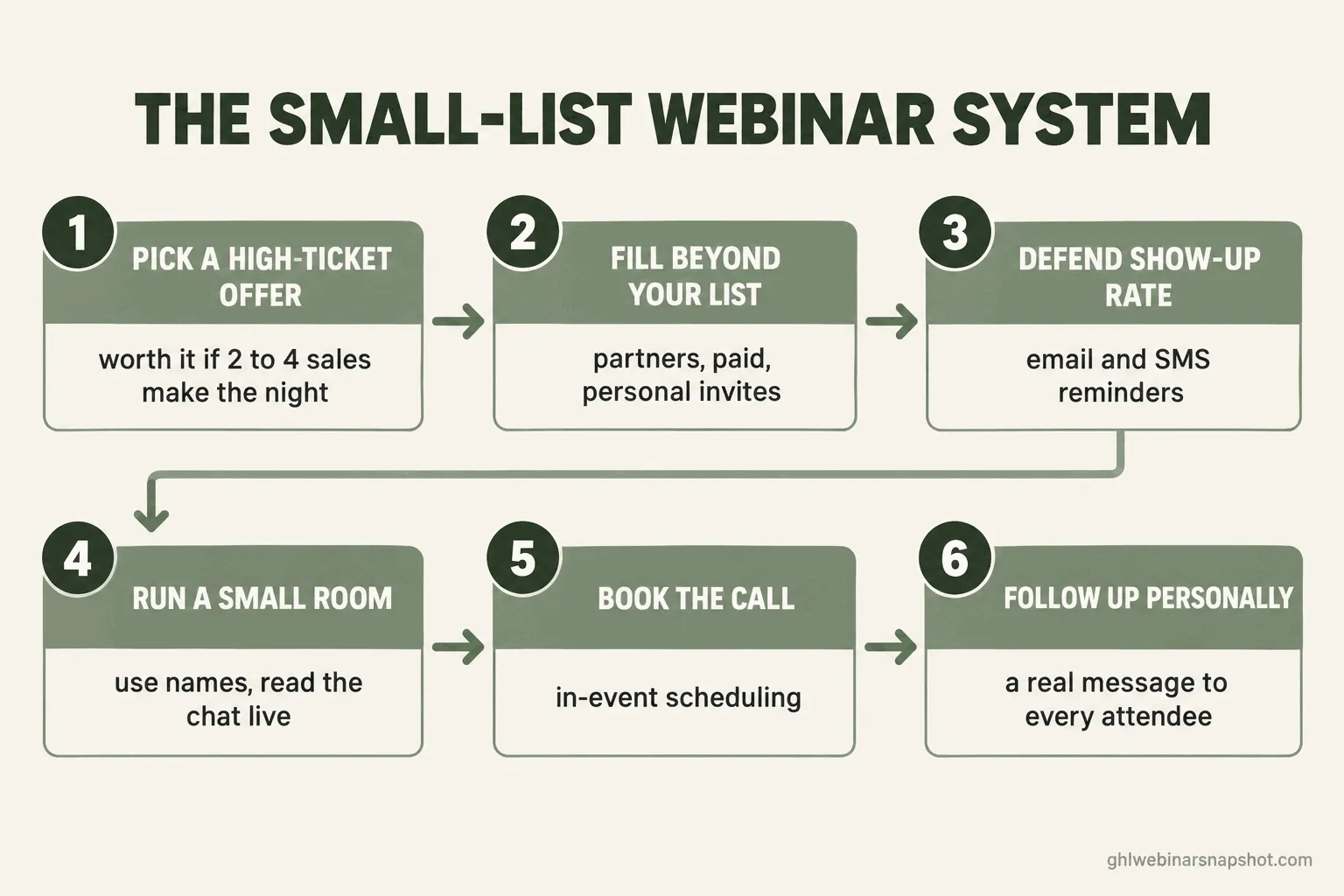
You can run a profitable webinar with a small email list. A list under 1,000 does not cap how much you can sell, it just changes the plan. Smaller rooms show up at a higher rate, convert warmer, and let you follow up with every attendee by name. The move is to stop trying to fill a 500-seat room and run a 30-person room on purpose: pick an offer worth that room, pull registrations from more places than your own list, defend show-up rate with reminders, and treat every lead like it is the only one you get. This is the full system, with the real numbers and the copy you can steal.
It is 9pm on a Sunday. You have a decent offer and a cursor blinking in the registration-page builder. Then you open your email tool and see it: 341 subscribers. Not 34,100. Three hundred forty-one people, and maybe a third of them even open your emails. The little voice starts up. “You need a bigger list before a webinar is worth it. Go build the list first. Come back in a year.”
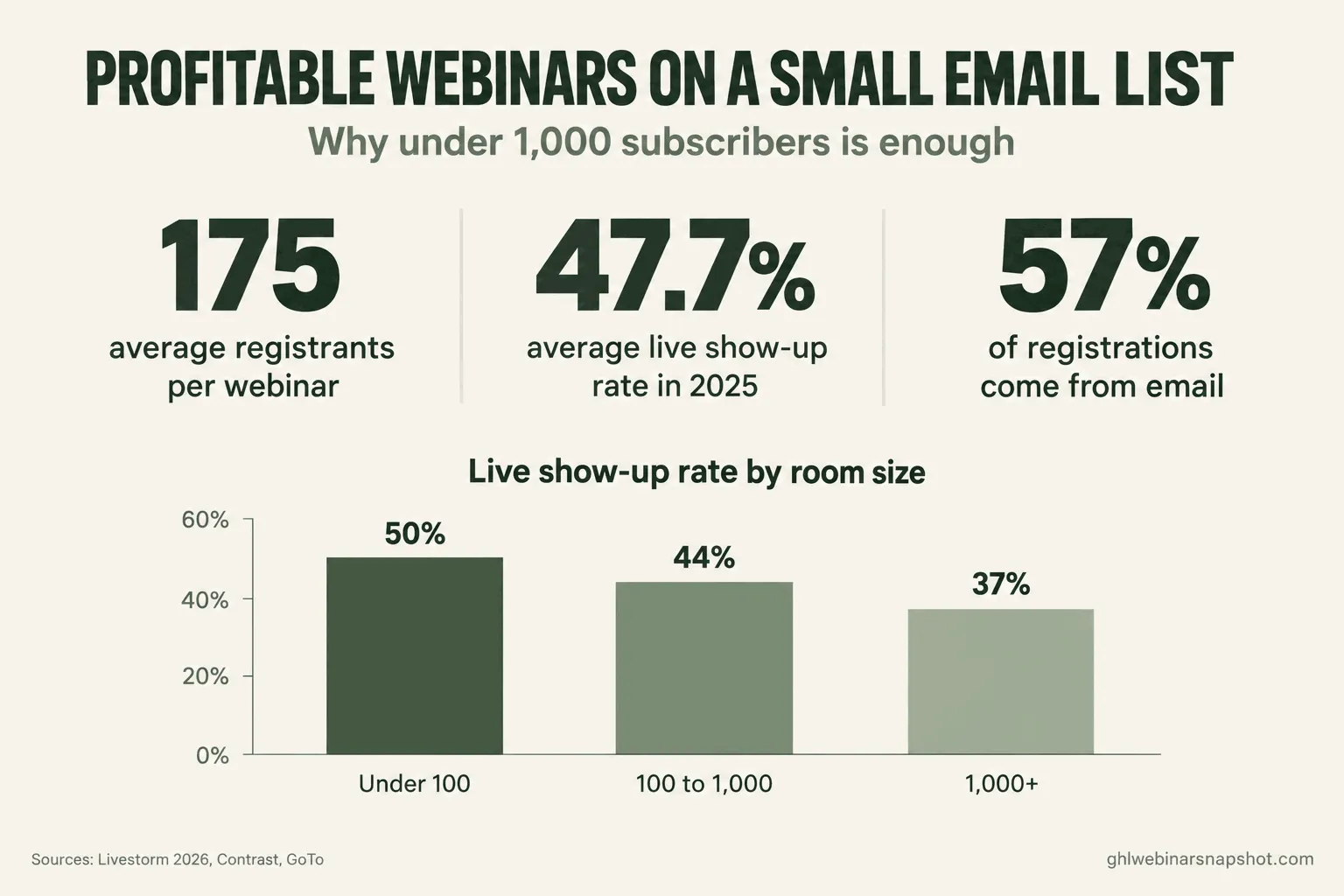
That voice is wrong, and it costs people real money every week. The average webinar in Livestorm’s 2026 dataset had 175 registrants, not thousands. You do not need a crowd. You need a room full of the right people and a system that does not leak them.
Table of contents
- Do you even have enough list to run a webinar?
- Why a small room is an advantage
- Stage 1: Pick an offer worth a small room
- Stage 2: Fill the room from more than your list
- Stage 3: Defend show-up rate
- Stage 4: Run a small room on purpose
- Stage 5: Make the offer and book the call
- Stage 6: Follow up like each lead is the only one
- Stage 7: Turn one live into an evergreen engine
- The same plan at three list sizes
- Compliance you cannot skip at any size
- Objections, answered
- FAQ
Do you even have enough list to run a webinar?
Run the math before you run the webinar. It is simpler than the doubt makes it feel.
Start with how many subscribers will register. A good registration page converts list traffic at roughly 30% to 45%, and Livestorm pegs the average registration-page conversion at about 30%. Warm list traffic sits at the higher end, because these people already said yes to you once. So a 400-person list, emailed well, lands somewhere between 60 and 140 registrants on its own.
Then apply show-up rate. If 100 register and you run a competent reminder sequence, 45 to 55 walk into the live room. Then apply your close rate. Sell a $1,000 offer and close 5% of attendees, and that is two to three sales from one night of work with a list most people would call too small to bother. Sell a $3,000 coaching package and the math gets loud fast.
The number that should stop you is not your list size. It is your offer price and your close rate. A small list with a $2,000 offer beats a big list with a $47 offer on almost every webinar night, because the big list has to fill a stadium to make the same money the small list makes from a living room. If your offer is under a few hundred dollars, a small-list webinar is still worth running, but you lean harder on volume and evergreen, which Stage 7 covers.
Where this breaks: people with small lists assume their 30% registration rate is weak and pile on paid ads before the list has even been asked. Email your own list first and measure the real number. It is almost always warmer than you fear.
Why a small room is an advantage
Here is the part nobody running a 20,000-person list will tell you, because it is not true for them. On the one metric that drives every dollar, smaller is better.
Contrast’s data on live attendance by audience size is blunt about it. Webinars with 100 to 1,000 registrants average 44% live attendance, while 1,000-plus registrants drop to 37%. Rooms under 100 registrants run about 6 points higher still, plus they pull roughly 10% more replay views. The intimacy that feels like a weakness is doing real work: a small room feels personal, people sense they will be noticed, and that pulls them to show up and stay.
Live attendance rate by registrant count. Contrast reports sub-100 webinars run about 6 points above the 44% logged by the 100 to 1,000 band (shown here as ~50%), which in turn beats the 37% of the 1,000-plus band. Source: Contrast webinar statistics.
There is a methodology tell in the big benchmarks too. Livestorm builds its headline numbers from sessions with at least 10 registrants, so the “average webinar” you measure yourself against already skews toward bigger rooms. Your 40-person room is not a failed version of a 400-person room. It is a different game with better odds per head, once you stop apologizing for it.
Stage 1: Pick an offer worth a small room
With a small list, the offer carries the night. You cannot out-volume a weak offer, so price and fit have to do the lifting.
The rule: your offer needs to be worth enough that two to four sales make the webinar a clear win. For most small-list operators that means a high-ticket coaching package, a group program, a done-with-you service, or a premium course in the four-figure range. A $27 ebook does not justify the production. A $2,000 program does.
Match the format to the price. A masterclass or sales webinar that teaches one valuable thing and transitions to a high-ticket offer is the right shape for a small, warm room. Do not run a generic “intro to my topic” session and hope to sell something expensive at the end. Teach the specific transformation your offer delivers, then invite the people who want it faster to buy the fast path.
Where this breaks: operators under-price out of fear, reasoning that a small audience will not pay premium rates. It is backwards. A small, warm, hand-nurtured list is exactly the audience that pays premium rates, because they trust you. Low prices force you back into needing volume you do not have.
Stage 2: Fill the room from more than your list
Your list sends the first wave. It does not have to send the whole room. Since email drives 57% of registrations, roughly 43% of a well-promoted room comes from channels that have nothing to do with how many subscribers you have. That 43% is where small-list operators win or lose.
Four ways to fill seats your list cannot:
- Borrow an audience. Co-host with a peer who serves the same people but sells something different. One partner with a 3,000-person list can double your room with a single email on their end.
- Run a short burst of paid traffic. You do not need a big budget to add 50 registrants. Warm retargeting off your existing buyers converts cheaply, and a small spend to fill a high-ticket room pays for itself with one sale.
- Promote where you already show up. Your LinkedIn feed, a niche community, a podcast you guest on. These reach people who are not on your list yet and cost nothing but the ask.
- Mine your own contacts. Past clients, people who replied to an old email, DMs that went quiet. A personal “I am running this, want in?” to 40 warm contacts outperforms any broadcast.
Where this breaks: people treat “fill the room” as one email to their own list and wonder why 18 people registered. The list is the floor, not the ceiling. Build the promo plan across all four channels two to three weeks out, not the night before.
Stage 3: Defend show-up rate
When the room is small, every no-show is a bigger share of your money. Lose half of 40 registrants and you are presenting to 20. The reminder layer is how you keep the room you worked to fill, and it matters more at small scale, not less.
The mechanics are the same as any webinar, run tighter. A confirmation the instant someone registers, a calendar invite, a day-before email, a morning-of note, and the one that moves the number most, the “we are live” push 10 to 15 minutes before start, sent by both email and text. We break the full cadence down in the webinar SMS reminder guide and the 9-email sequence, and the deeper reasons attendance leaks in why your show-up rate is so low.
On a small list, add the touch big operators cannot: text your 40 registrants the morning of, or at least make it read like you did.
Where this breaks: the sequence fails silently when it is email-only. A reminder email can sit unopened past your start time, while a text gets read in minutes. If you are not texting registrants, you are leaving the back half of your small room on the table. Get the consent right, which the compliance section covers.
Stage 4: Run a small room on purpose
A 500-person webinar and a 25-person webinar are not the same event at different volumes. They are different events. Stop running the small one like a broadcast.
Use people’s names. “Sarah, great question” lands in a 25-person room in a way it never can at scale. Open the chat and read it out loud. Ask questions and wait for answers instead of plowing through slides. The thing a small room gives you is presence, and presence is what converts. People buy from someone who saw them.
Do not fake a crowd. If 22 people are live, do not say “we have hundreds of you here.” Your audience can often see the count, and the moment you inflate it you lose the trust that is your entire advantage. Lean into small: “This is an intimate group today, which is great, it means I can actually get to your specific situations.”
Where this breaks: operators get self-conscious about the count and rush, reading slides like a hostage trying to reach the end. The energy drops and people leave. A small room that feels alive outsells a big room that feels like a recording.
Stage 5: Make the offer and book the call
For a high-ticket offer, the webinar’s job is usually not to close on the spot. It is to book the sales call. A small, warm room is the best possible source of booked calls, because the people in it are pre-qualified by the simple fact that they showed up to a niche session on your topic.
Make the booking the easy next action. Put the scheduler on screen, drop the link in the chat, and offer in-event booking so people grab a time while the energy is high. The warmest moment of the whole funnel is the 90 seconds after your offer. Do not send them to an email they open later. Let them book now.
Where this breaks: the offer is an afterthought, bolted on in the last two minutes with a link nobody can find. Design the close before you design the content. Know exactly what you are asking people to do and make that action one tap away while they are still in the room.
Stage 6: Follow up like each lead is the only one
This is where a small list is a superpower a big list cannot match. With 30 attendees and 15 no-shows, you can send a genuinely personal message to every person. Not a broadcast with a merge tag. A real note.
Attendees who did not book get a short message that references something from the session. No-shows get the replay and a nudge. Bookers get a confirmation so they actually show for the call. On a 10,000-person list this is impossible, so those operators automate it and accept the drop-off. You do not have to. Blend automation for the timing with a human touch for the message.
Speed matters as much as personalization. The lead is warmest in the minutes after the webinar ends and cools fast. Have the follow-up ready to fire the moment the room closes, not the next morning.
Where this breaks: the follow-up is one generic “thanks for attending” email and then silence. On a small list that is a tragedy, because you had the rare ability to reach every person by name and spent it on a template. Do the personal version. It is 15 messages, not 15,000.
Stage 7: Turn one live into an evergreen engine
A small list caps how many people you can invite to any one live event. It does not cap how many times you can run the webinar. This is how small-list operators escape the volume ceiling: record the live session once it is tuned, then run it on evergreen so new subscribers and ad traffic hit the webinar automatically, week after week.
The live version is your lab. Run it live two or three times, watch where people drop and what they ask, tighten the offer and the transition, then set the best version to a just-in-time schedule. Now your 400-person list is not a one-shot audience. Every new subscriber enters the funnel on their own timeline, and the thing you built once keeps selling. The system runs on GoHighLevel, which handles registration, reminders, and booking in one place.
Disclosure: that GoHighLevel link is an affiliate link. If you start an account through it we may earn a commission at no extra cost to you.
Where this breaks: people go evergreen before the live version converts. Evergreen amplifies whatever you feed it, including a broken offer. Prove it live first, then automate the winner.
The same plan at three list sizes
The system flexes with your list. Here is what changes as you grow from almost nothing to the edge of “small.”
No list yet (under 100 subscribers). The webinar is secondary to the relationships. Your job is one great partner co-host who brings the room while you bring the teaching, plus every warm contact you can personally invite. Treat the event as a list-building play as much as a sales play, and price the offer high so a single sale makes it worth it.
Small list (100 to 500). The sweet spot for the full system above. Your own list fills the floor, one or two promo channels top it up, and a strong reminder layer gets you a 40-to-60-person room. Run it live, follow up by hand, and you can reliably book calls and close a few high-ticket sales per event.
Growing list (500 to 1,000). Now you have enough volume to run live monthly and build the evergreen engine in parallel. Keep the personal follow-up as long as you can, and begin automating the parts that no longer scale by hand. This is where you graduate from “can I even do a webinar” to “webinars are a channel.”
What actually changes between a big-list and a small-list webinar
| Feature | Big list (10,000+) | Small list (under 1,000) |
|---|---|---|
| Where the room comes from | Mostly your own email blast | Your list plus partners, paid, and personal invites |
| Winning offer price | Can work low or high ticket on volume | High ticket, where 2 to 4 sales make the night |
| Show-up rate | Fights the 1,000+ band (~37%) | Benefits from smaller-room lift (~50%) |
| Room energy | Broadcast, one-to-many | Intimate, use names, read the chat live |
| Follow-up | Automated, generic by necessity | Personal message to every attendee |
| Scaling path | Run bigger live events | Run live, then go evergreen to lift the ceiling |
Compliance you cannot skip at any size
A small list does not exempt you from the rules. The reminder layer is where small-list operators most often step on a rake, because texting feels casual.
Email. Every reminder and follow-up is a commercial email under CAN-SPAM. It needs a real physical mailing address and a working one-click unsubscribe, on a 40-person send exactly as on a 40,000-person send.
Text. This is the big one. Reminder texts fall under the TCPA, which requires prior express consent before you text someone. A registrant who opted in to that specific webinar with a clear consent checkbox is on solid ground. Texting a list that never agreed to texts is not, and penalties are per message. You also need A2P 10DLC registration through The Campaign Registry before carriers reliably deliver business texts, regardless of volume. Honor STOP instantly and keep a record of who consented and when. The full breakdown lives in the SMS reminder compliance guide.
Objections, answered
“My list is too small for this to be worth it.” Worth it is a function of offer price and close rate, not list size. Two sales of a $2,000 offer from a 25-person room is a $4,000 night. The average webinar has 175 registrants, and plenty of profitable ones have far fewer. Run the math on your actual offer before you decide.
“Won’t a tiny room look embarrassing and kill the energy?” Only if you treat it like a failed big room. A small room that feels alive converts better than a big room that feels like a recording. Smaller webinars show up at higher rates and get more replay views. Use names, read the chat, and lean into the intimacy.
“Should I just build my list for a year first?” No. Running webinars is one of the faster ways to build a list, because partners and paid traffic bring new people into your world every time. Waiting a year to “earn” a webinar means a year of sales you did not make. Start small now and grow the list through the events.
“What if almost nobody shows up live?” Then your replay and follow-up do the selling, which is why the no-show text and the personal follow-up in Stages 3 and 6 matter. A booked call from a no-show who watched the replay spends the same as one from a live attendee.
FAQ
How small is too small for an email list to run a webinar?
There is no hard floor. If you can get even 20 to 40 of the right people in a room and you have a high-ticket offer, a webinar can be profitable. Below about 100 subscribers, lean on a partner co-host and personal invitations to fill the room rather than relying on your list alone.
What is a realistic registration rate from a small email list?
Warm list traffic typically registers at the higher end of the 30% to 45% range, because these people already opted in to hear from you. Livestorm puts the average registration-page conversion around 30%. So a 400-person list, emailed well, usually produces 60 to 140 registrants on its own.
Do small webinars really convert better than big ones?
On attendance, yes. Contrast's data shows webinars under 100 registrants run about 6 points higher on live attendance than the 100 to 1,000 band, which itself beats the 1,000-plus band at 37%. On sales, a small warm room often converts a higher share because the session feels personal and the follow-up can be individual.
How do I fill a webinar if my list is tiny?
Your list sends the first wave, but about 43% of registrations across webinars come from channels other than email. Co-host with a partner who serves the same audience, run a small burst of warm paid traffic, promote where you already show up like LinkedIn or communities, and personally invite past clients and warm contacts.
Should I run live or evergreen with a small list?
Run live first. Live events let you read the room, fix the offer, and build relationships with partners and attendees. Once the live version converts, record the best one and set it to evergreen so new subscribers and ad traffic hit the webinar automatically, which lifts the volume ceiling a small list puts on live events.
Do I still need to worry about SMS compliance for a small send?
Yes. The TCPA and A2P 10DLC rules apply regardless of volume. You need prior express consent to text registrants, A2P 10DLC registration for carriers to deliver your texts, a clear opt-out, and a record of consent. A small send does not fly under the radar, and penalties are per message.
A small list is not the thing standing between you and a profitable webinar. A missing system is. Pick an offer worth the room, pull registrations from more than your own list, defend show-up rate with reminders you would be proud to receive, and follow up with every person by name. Do that, and 341 subscribers stops feeling like a ceiling and starts feeling like a warm, qualified room that buys. Want it built for you instead of built by you? Book a walkthrough and we will map it to your list.