
It is 14 minutes before your webinar goes live. The “we’re starting now” text is scheduled, and you are watching the registration count instead of the delivery report, where 40% of those texts are about to land in a carrier filter and never reach a phone. All you will see is a show-up rate 15 points lower than last time for no reason you can name.
That gap has a name, and it is not your copy or your timing. It is A2P 10DLC, the US carrier registration that decides whether a business can text American phones from a normal 10-digit number. If your SMS reminders are the engine that fills the room, and for most operators they are, the registration that keeps those texts flowing is not paperwork you can skip.
This is the full 2026 walkthrough: how to register your brand and campaign step by step, the opt-in and sample copy reviewers approve, what each stage costs in GoHighLevel, and the exact reasons registrations get rejected so you clear them before they stall you for two weeks.
Table of contents
- Why your reminder texts quietly disappear
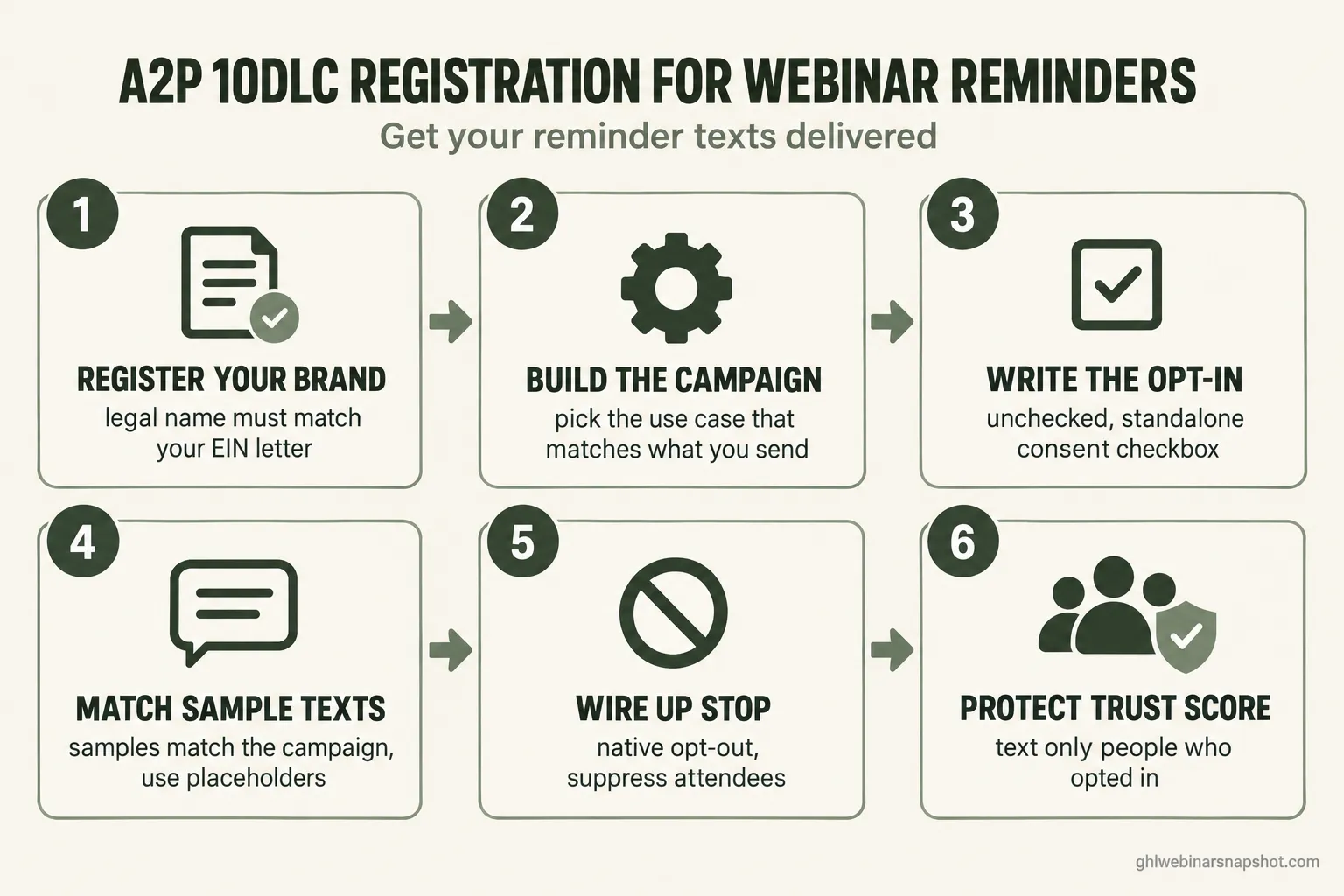
- Stage 1: Register your brand, get the name right
- Stage 2: Build the campaign and pick the right use case
- Stage 3: Write an opt-in a reviewer will approve
- Stage 4: Make your sample messages match the campaign
- Stage 5: Wire A2P into your cadence without tripping STOP
- Stage 6: Protect your trust score after approval
- The same registration at three sizes
- Objections, answered
- FAQ
Why your reminder texts quietly disappear
The carriers do not trust you by default. After years of spam, the US carriers built a registration system to tell a legitimate business from a bad actor. That system is A2P 10DLC, short for Application-to-Person messaging over 10-Digit Long Codes: software texting people from a regular phone number. Skip it and your texts do not bounce. They get silently filtered, delivery sags, the “we’re live” push reaches half the room, and you blame the day of the week.
This matters more for webinars than almost any use case, because your reminders are the mechanism. In the 2026 B2B Content and Marketing Trends report from CMI and MarketingProfs, 82% of B2B marketers said they offer in-person events and 70% offer virtual events. When your model depends on getting people into a live room, a 40% delivery drop is lost pipeline.
Keep two layers straight. A2P 10DLC is the carrier rule that gets your texts delivered. The TCPA is the law that gives you the right to send them. A2P without TCPA consent is a delivered text that is still illegal; TCPA consent without A2P is a legal text that never arrives. The fees are passthrough charges from the carriers and The Campaign Registry with no platform markup; the real cost is time, since a rejection sends you to the back of a queue that has been slow all year.
Monthly A2P 10DLC campaign fee inside GoHighLevel, by use case, in US dollars (passthrough charges, no markup). Source: GoHighLevel A2P 10DLC Messaging Fees.
Stage 1: Register your brand, get the name right
Everything starts with the brand: your business identity as carriers verify it, meaning legal name, tax ID, address, website, and contact. You submit it through your provider, which passes it to The Campaign Registry, the body that vets senders.
Your brand type sets your ceiling. Per Twilio’s A2P 10DLC documentation, the three that matter are Sole Proprietor (no EIN, one campaign, ~1,000 segments a day to T-Mobile), Low-Volume Standard (EIN, up to five campaigns, ~2,000 segments a day), and Standard (EIN, throughput that scales from 2,000 a day upward by trust score).
| Brand type | Tax ID needed | Campaigns | Rough daily cap | GHL one-time fee |
|---|---|---|---|---|
| Sole Proprietor | No | 1 | ~1,000 to T-Mobile | ~$22.50 |
| Low-Volume Standard | Yes (EIN) | Up to 5 | ~2,000 to T-Mobile | ~$22.50 |
| High-Volume Standard | Yes (EIN) | Up to 5+ | 2,000 and up by trust score | ~$64.00 |
Fees from GoHighLevel; rules and caps from Twilio. Caps are daily segments to T-Mobile; other carriers differ.
For almost every webinar host with an EIN, Low-Volume Standard is the right starting point: it unlocks real throughput and costs the same one-time fee as Sole Proprietor.
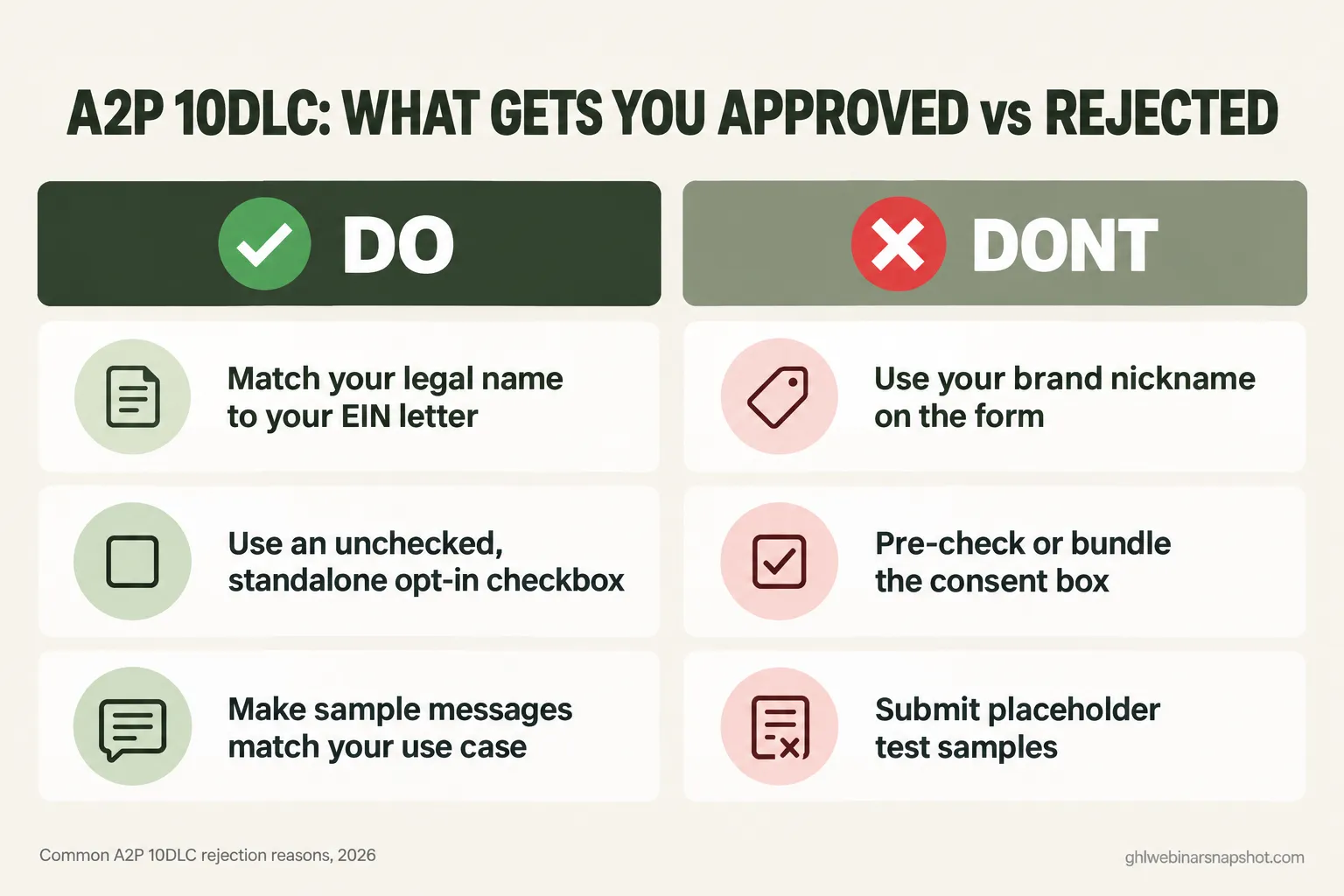
How it breaks: The single most common rejection is a brand identity mismatch. The legal name, EIN, and address have to match IRS records exactly, down to whether your name ends in “LLC” or “Inc.” Operators type a brand name like “Summit Coaching” instead of the registered “Summit Coaching Group LLC,” the automated check fails, and the brand bounces before you reach the campaign. The fix is total: open your EIN confirmation letter (the CP-575) and copy the name character for character. A second killer: carriers check that your brand name, domain, and email point to the same business, so a free Gmail address or a “coming soon” site gets flagged.
Stage 2: Build the campaign and pick the right use case
Once your brand is approved you register a campaign: the specific messaging program you run, and where you tell carriers what you will send. Per Twilio’s process, a campaign describes your use case, how people opt in, opt out, and get help, and the purpose of your messages.
Pick the use case that honestly matches what you send. For webinar reminders plus the occasional promotional follow-up, that is usually a Standard or “Low-Volume Mixed” use case. The mistake is picking a narrow “customer care” use case because it sounds safer, then sending marketing-flavored reminders that do not match. Reviewers catch the mismatch and reject it.
Each new campaign under an approved brand costs a $15 vetting fee in GoHighLevel, and the brand fee is not charged again. Resubmitting a rejected campaign is free, though it resets your spot in the review queue.
How it breaks: A host gets one campaign approved, then months later runs a second webinar series with a different offer on the same campaign. Consent for the first program does not cover the second, and as the content drifts from the registered description, deliverability slips. If your messaging changes shape, register it honestly.
Stage 3: Write an opt-in a reviewer will approve
This stage stalls more operators than any other, and it has nothing to do with technology. Carriers want to see, in writing, exactly how a person agreed to get your texts: not “users opt in on our website,” but the actual checkbox and the words next to it. Your opt-in has to be unbundled (its own checkbox, never pre-checked, never a condition of registering) and specific about what the person is signing up for. “By registering you agree to our terms” does not count, because consent cannot be buried in a terms link.
The line “consent is not a condition of registering” is load-bearing: it keeps the opt-in standing on its own. When you fill in the “how do users opt in” field, describe this flow in plain words and attach a screenshot of the form if your provider allows it. You also need a privacy policy on your live site that specifically addresses SMS; a general one is not enough in 2026, and a missing or generic policy is a documented rejection reason.
For the rest of your compliance posture, our webinar SMS compliance primer and the five webinar laws that can bite you cover the rules that sit alongside A2P.
Disclosure: the link above is an affiliate link. If you start GoHighLevel through it, we may earn a commission at no extra cost to you. We only recommend the platform our own system runs on.
Stage 4: Make your sample messages match the campaign
When you register a campaign you submit sample messages that show carriers the kind of texts you will send, and a surprising number of registrations die here. The rule: samples must match your use case and look like the real thing. Two mistakes dominate. The first is a generic placeholder (“Hello, this is a test message”) that reads as a sender who does not know what they will send. The second is putting real customer names or numbers in the samples, where those fields should use placeholders like [Name] and [link]. Write samples that are concrete about your webinar but use brackets for anything personal.
Every sample names the business and ends with STOP, because carriers want the opt-out in the messages themselves, not just promised in the opt-in.
How it breaks: A coach registers a campaign described as “appointment reminders” but submits a sample reading “Spots are filling fast for my $2,000 masterclass, grab yours now.” The marketing tone does not match the use case, and the reviewer rejects it.
Stage 5: Wire A2P into your cadence without tripping STOP
Approval is not the finish line. Carriers watch behavior after approval, not just your paperwork, so your reminder sequence has to behave.
For the full reminder cadence copy and timing, see the webinar SMS reminder cadence guide. The A2P-specific rules on top are three. First, honor STOP instantly and automatically. Your platform handles the STOP, HELP, and START keywords, so do not catch them in your own workflow logic; a missed opt-out is both a TCPA violation and a trust-score hit. Second, suppress people who already attended or converted, so the “we’re live” text does not hit someone already in the room. High unsubscribe rates are exactly the signal carriers use to flag a spammer. Third, respect quiet hours: no marketing texts between 9pm and 8am in the contact’s local time. The “we’re live” push fires when the event starts, but promotional follow-ups keep daytime hours.
How it breaks: An operator builds STOP handling into a custom workflow instead of using native keyword handling, a branch has a bug, and three contacts who texted STOP keep getting reminders. One screenshots it. That is the TCPA exposure and the carrier-trust problem in one avoidable mistake.
Stage 6: Protect your trust score after approval
Standard brands get a trust score from 0 to 100 through vetting, and that score sets how many messages you can send per day. You do not see the formula, but you control the behavior that moves it: text only people who opted in, match messages to what people signed up for, and never blast a cold or purchased list. Carriers reward senders whose recipients engage and throttle the ones who spray.
One structural move helps more than any tactic: keep all your contacts and consent in one system, so an opt-out is honored in one place, not chased across three tools. That single CRM of record is why connecting your webinar platform to your CRM is worth doing, and if you want all of it pre-built rather than wired by hand, that is what our SMS automation feature ships inside the Webinar Snapshot.
The same registration at three sizes
The process is identical for everyone, but which parts bite hardest changes with your size.
The solo coach doing $2k to $50k a month. You are the brand, and your biggest risk is the identity mismatch. Register as Low-Volume Standard if you have an EIN (most solo operators who formed an LLC do), and spend your effort getting the legal name right and the opt-in checkbox clean. Volume is not your worry; a two-week rejection landing the week of your launch is. Register a month early.
The mid-size B2B team, 20 to 500 people. You send more and reach further, so throughput and consent documentation both matter. Register as a Standard brand to let your trust score lift your caps, keep a locked-down opt-in that marketing cannot quietly “optimize” into a pre-checked box, and keep one CRM of record.
The larger operation running evergreen at scale. Now everything is a volume problem that turns a small per-message issue into a big delivery issue. Prioritize a high trust score through clean sending, audited consent capture with timestamps, and a real deletion process. Your reminders fire every day across time zones, so quiet-hours logic and suppression of already-converted contacts become the difference between a healthy reputation and a throttled one.
Across all three the throughline is the same: A2P registration is a posture, not a form you file and forget. Register honestly, text only people who asked, and honor STOP instantly.
Objections, answered
“I use GoHighLevel or Twilio. Doesn’t the platform handle this for me?” It gives you the registration interface and native STOP handling, but it cannot invent your consent flow or match your legal name to your EIN. You still fill in the brand details, write the opt-in, and submit the samples. The platform makes it faster, not automatic.
“I only have a small list. Do I really need to register?” Yes. A2P 10DLC is about the sender, not the list size. An unregistered number sending even a few hundred texts gets filtered the same way a big one does, and a small operator feels it more: one filtered “we’re live” push to a 200-person room is a visible chunk of your show-up.
“Registration got rejected and I don’t know why.” Work the checklist before you resubmit, because each correction resets your place in the queue. Check the legal name against your EIN letter, confirm your site is live with an SMS-specific privacy policy, make sure your opt-in shows the actual checkbox flow, and confirm your samples match your use case.
FAQ
What is A2P 10DLC in plain English?
It is the US carrier registration for business texts sent from a normal 10-digit number. You register your business (the brand) and your messaging program (the campaign) so carriers know you are a legitimate sender. Without it, your texts get filtered or blocked.
Is A2P 10DLC the same as the TCPA?
No. A2P 10DLC is a carrier rule that controls delivery. The TCPA is the federal law that controls your right to send marketing texts at all, at $500 to $1,500 per message. You need both.
How much does A2P 10DLC cost in GoHighLevel?
A Sole Proprietor or Low-Volume Standard brand is about $22.50 one-time, a High-Volume Standard brand about $64, plus roughly $1.50 to $10 a month by use case. These are passthrough charges with no markup, and a new campaign under an approved brand adds a $15 vetting fee.
Why does my A2P 10DLC campaign keep getting rejected?
Usually a legal name or EIN that does not match IRS records exactly, a vague opt-in that does not show how people consent, a site with no live SMS-specific privacy policy, or samples that do not match the use case. Fix all of them before resubmitting, since each resubmission restarts the review.
Do I need an EIN to register for A2P 10DLC?
For a Standard or Low-Volume Standard brand, yes. Without an EIN you register as a Sole Proprietor, which caps you at one campaign and about 1,000 segments a day to T-Mobile.
A2P 10DLC is not the exciting part of running webinars. But if your reminder texts fill the room, the registration that keeps them delivering is not optional. Get it right once and your “we’re live” push reaches the people who meant to be there.
About the author
Derek Haywood is a GoHighLevel Automation Engineer based in Denver, CO. A former B2B SaaS sales engineer, he builds the plumbing behind webinar funnels: the triggers, tags, consent capture, A2P registration, and reminder cadences that keep a launch compliant and delivering. He has a low tolerance for broken automations and an even lower one for vague compliance hand-waving.
Related reading
- Webinar SMS Reminders: The Text Cadence That Gets People to Show Up
- SMS Reminder Compliance for Webinars (TCPA + A2P 10DLC, Plain English)
- Webinar Compliance in 2026: The 5 Laws That Can Bite You
- How to Connect Your Webinar Platform to Your CRM
- Webinar No-Show Recovery: Win Back the Registrants Who Didn’t Attend
Sources
- GoHighLevel, A2P 10DLC Messaging Fees: Registration, Monthly and Carrier Costs.
- Twilio, A2P 10DLC Compliance Documentation.
- Twilio, A2P 10DLC Campaign Approval Requirements.
- Cornell Legal Information Institute, 47 U.S.C. § 227 (TCPA).
- MessageDesk, Twilio A2P 10DLC Registration: Fix What Gets Rejected.
- Content Marketing Institute / MarketingProfs, B2B Content and Marketing Trends: Insights for 2027.
- Livestorm, 2026 Webinar Benchmark Report.