
It is the second week of August and you are staring at a registration page that will not move. Same offer that filled a room in February, same ad creative, same list, same cost per registration. And on the day, 43 people out of 100 showed up instead of the 50 you were used to. You spend the afternoon wondering what you broke. You broke nothing. You launched into the slowest month of the webinar year.
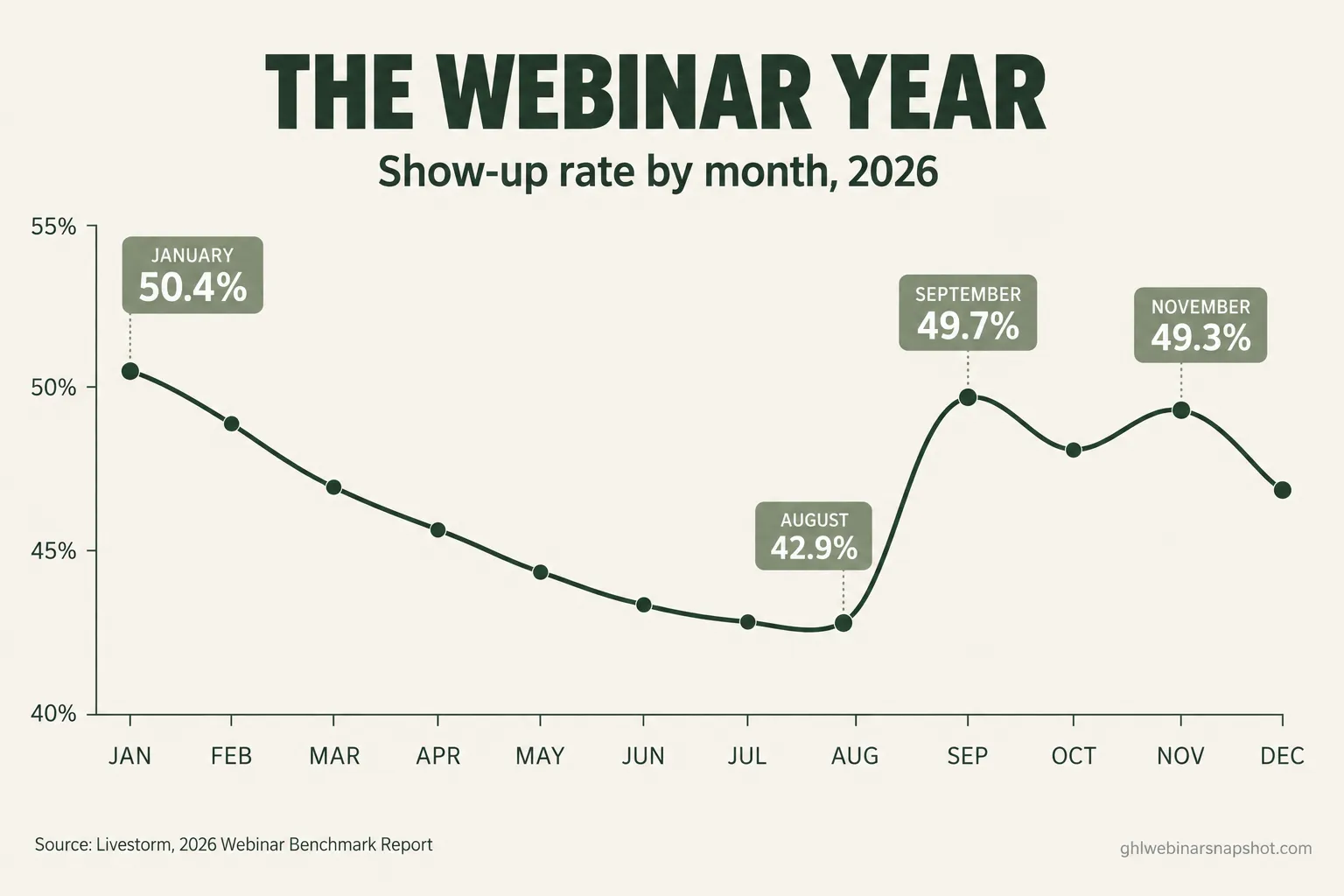
Webinar attendance is seasonal, and the swing is big enough to change your revenue without you changing a single thing in the funnel. On Livestorm’s 2026 benchmark data, January show-up rate peaks at 50.4% and August bottoms at 42.9%: a 7.5-point gap between your best month and your worst, on the same registrations, the same reminders, the same deck. This is the month-by-month playbook for when to go live, when to lean on evergreen, what to send in each season, and how each stage quietly breaks.
Table of contents
- What the seasonal swing actually costs you
- The webinar year is four seasons, not twelve months
- Q1: the January surge
- Q2: the spring steady state
- Summer: the trough and the evergreen window
- September: the second peak
- Q4: the budget-flush push and the December wind-down
- The same year at three sizes
- Keep it compliant as your list grows
- Objections, answered
- FAQ
What the seasonal swing actually costs you
Webinars are not a side channel. In the 2026 B2B content marketing report from CMI and MarketingProfs, 52% of marketers rated webinars and speaking events among their most effective channels, second only to in-person events. One live masterclass can carry a coach a month of sales calls; one demo webinar can seed a B2B team a quarter of pipeline. A channel that moves this much deserves a calendar.
Now the swing. Livestorm analyzed more than 7 million registrations across 33,786 sessions for its 2026 Webinar Benchmark Report, and the month-by-month show-up rate is not flat. January sits at 50.4%, September at 49.7%, November at 49.3%. August drops to 42.9%. The overall 2025 average landed at 47.7%, down slightly from 48.9% the year before.
Webinar show-up rate by month, the months Livestorm published figures for, against the 2025 yearly average. Source: Livestorm, 2026 Webinar Benchmark Report (7M+ registrations, 33,786 sessions).
Put a number on it. Say you drive 1,000 registrations for a launch. In January, 504 walk into the live room. In August, 429 do. That is 75 fewer humans hearing your offer live, for the same ad spend and the same list. You did not get worse at marketing. You picked the wrong eight weeks. Show-up rate is the metric every other number scales off, which is why we argue it is the only webinar metric that compounds. Seasonality moves that lever for free, in both directions.
The webinar year is four seasons, not twelve months
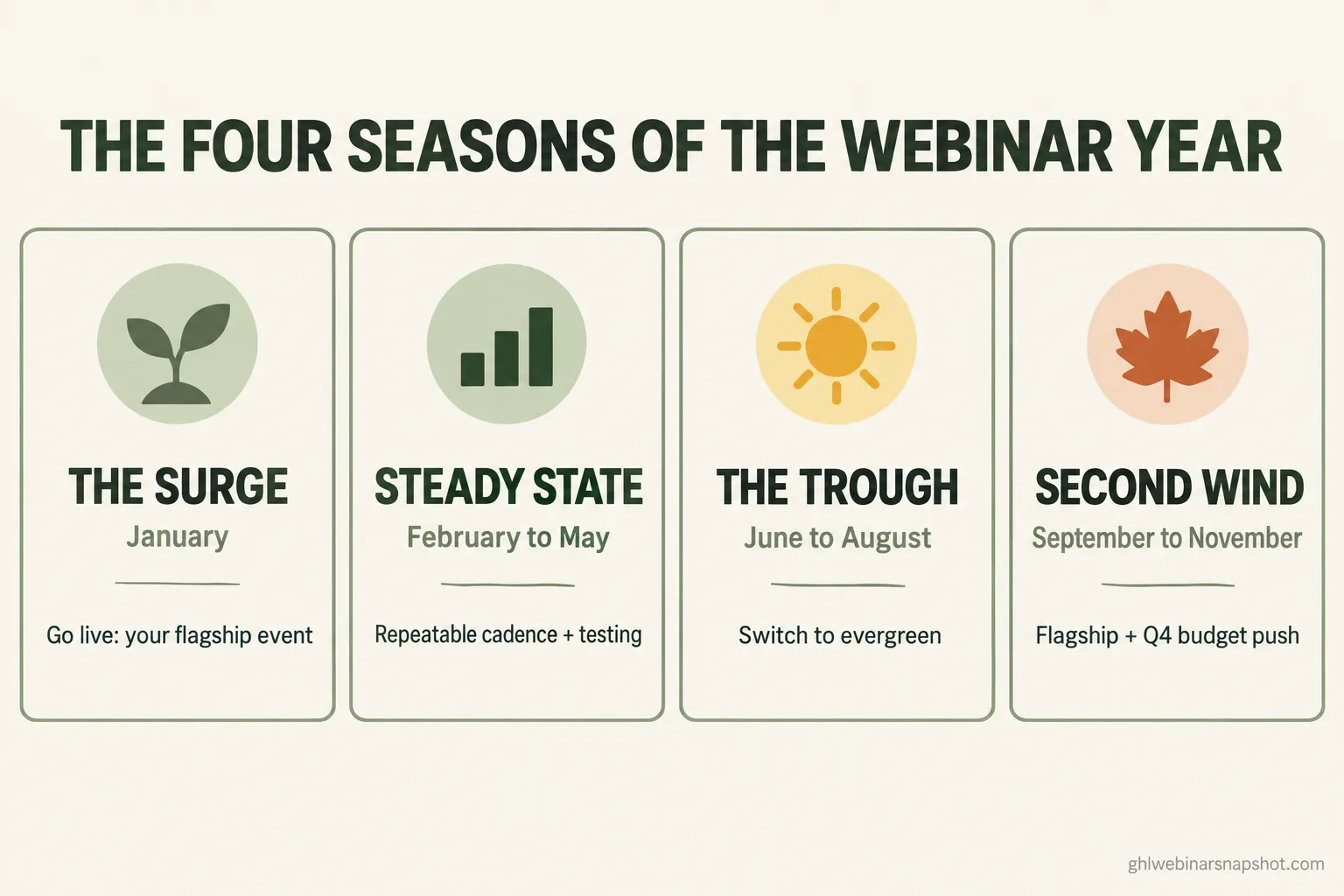
Do not memorize twelve monthly numbers. Group the year into four behaviors, because that is how your audience actually lives.
- The surge (January). Resolutions, fresh budgets, a clean calendar. Attention is as high as it gets all year. Your flagship live event goes here.
- The steady state (February through May). Reliable, workmanlike attendance. The season for your repeatable cadence, testing, and mid-tier launches.
- The trough (June through August). Vacations and out-of-office replies. Live attendance sags to its yearly low. Switch the engine rather than fight the calendar.
- The second wind (September through November). Back-to-work energy, then a B2B budget-flush in October and November. Two of your three strongest months live here.
December is its own short story, handled at the end. Live events ride the surge and the second wind, evergreen covers the trough, and the details are where the money leaks.
Q1: the January surge
January is the best month you get. It tops the year at 50.4% show-up, and the reason is behavioral: your audience has a new budget, a new year’s worth of intentions, and an empty calendar they want to fill with the right things. Be one of them.
What to run. Your biggest live webinar of the year: the high-ticket masterclass, the flagship demo, the signature workshop. Build registration through the back half of December so you open January with a full list, then run the event in the second or third week once people are back at their desks. Host on a Tuesday at 11am or 2pm ET, the strongest day and times in the data.
The copy to steal. January rewards a clean “new start” frame over a hype frame. Here is a re-engagement email to wake a list that has been quiet over the holidays:
How it breaks. The classic January mistake is launching in the first three days of the month, when half your audience is still traveling. The second is treating January like a finish line: teams burn their whole list on one event, book nothing for February, and give back the momentum. Put the flagship in week two or three, and schedule the next event before the January one even airs.
Q2: the spring steady state
February through May is the dependable middle of the year: solid attendance without the spikes, which makes it the right season for repeatable work rather than tentpole bets. Run a predictable live webinar on your strongest day and use the clean, holiday-free data to test one variable at a time: headline, reminder timing, offer sequence.
How it breaks. Spring’s danger is autopilot. Because attendance is reliable, operators stop optimizing and let the reminder cadence go stale. A list decays fast, and a cadence that worked in February feels tired by May. Keep the reminder sequence earning its send. Spring is for tightening the machine before the summer stress test.
Summer: the trough and the evergreen window
Here is the part most operators get wrong. Live attendance hits its yearly floor in summer, with August at 42.9% show-up, more than seven points under January. People are on vacation, out-of-office replies are everywhere, and the buyers who do register are more likely to catch the replay than show up live. The instinct is to push harder with more emails and ad spend. That is the trap. You cannot out-market a calendar, so you change the engine, not the throttle.
What to run: evergreen. Summer is the season your evergreen webinar funnel earns its build. It runs on the viewer’s schedule, not yours, so vacation timing stops working against you. The person who would have no-showed your live Tuesday session watches your automated one at 9pm from a hotel room, and you keep booking calls through the months your competitors go dark.
The copy to steal. Summer nurture should acknowledge the season:
How it breaks. The summer failure mode is launching a flagship live event in July or August anyway, usually because the quarter needs a number. You get a soft room, read it as a dud offer, and kill a webinar that would have crushed in September. The second failure is letting the evergreen funnel run unattended with a broken reminder or a dead link, bleeding registrations for six weeks. Audit the evergreen path before summer, not during it.
September: the second peak
September is January’s quieter twin. At 49.7% show-up it is the second-strongest month, driven by the same behavior: people are back from summer, calendars reset, and attention snaps back to work. For B2B especially, September is when buying committees reconvene and projects that stalled in July suddenly have urgency again.
What to run. This is your second flagship slot. If January is the coaching peak, September also lights up B2B pipeline. Relaunch your best live webinar, open a new cohort, or run the demo that seeds Q4 deals. Build registration across the last two weeks of August using the evergreen funnel you were already running, then flip to a live event the week after Labor Day.
The copy to steal. September wants a “doors are open again” frame.
How it breaks. The September mistake is starting promotion too late. Because summer felt dead, teams forget to warm the list in late August and open September cold, and by the time they start promoting, the first strong week is gone. Warm the list in the last two weeks of August so you can run live in the first full week of September.
Q4: the budget-flush push and the December wind-down
October and November carry the third peak, with November at 49.3% show-up. For B2B, the driver is money: teams spend remaining annual budget before it resets, and “use it or lose it” is a genuine deadline. For coaches, Q4 is the last real window before the holidays swallow attention.
What to run. Urgency-driven live events tied to a real deadline: a January cohort, a year-end price change, an expiring bonus. The deadline does the persuasion, so your job is to make it believable and specific.
The copy to steal. A Q4 urgency SMS that names a real deadline instead of a fake one:
December is two different months. The first three weeks are the deadest live window of the year outside August, so do not launch a flagship into mid-December. Instead, run evergreen to catch the year-end buyers who are quietly shopping, and use the quiet to plan next year’s calendar. The operators who dominate January are the ones who built the list in December.
How it breaks. The Q4 failure is manufacturing fake urgency. A “deadline” your audience has seen three times this year does not convert, it erodes trust. Use real deadlines only. The December failure is the opposite: going dark, giving back your September-November momentum, then scrambling in January with a cold list.
The same year at three sizes
The calendar is the same. What you do with it depends on who you are:
The solo coach or course seller (list under 1,000, high-ticket). You do not have the bandwidth for a monthly live event, and you do not need one. Run two or three big live launches a year, timed to the peaks: a flagship in January, a second in September, maybe an urgency push in November. Let an evergreen funnel carry every other month. Your edge is timing, not volume. One well-placed January launch into a warm list beats six scattered events into a cold one.
The mid-size B2B team (list 1,000 to 10,000, pipeline goal). You run a steadier cadence because pipeline needs a constant feed, so your seasonality play is where you concentrate effort. Lean hardest into September and the October-November budget-flush, when buying committees have both attention and money. Keep a lighter cadence through summer rather than stopping, but move your flagship, deadline-driven events out of the trough. Make sure registrants actually connect to your CRM so you can attribute Q4 pipeline back to the webinar that seeded it.
The large or multi-host program (list 10,000+, always-on). At your volume, seasonality matters less month to month because sheer numbers smooth the dip, but it matters enormously for tentpole events. Keep the always-on program running every week, troughs included. Reserve January, September, and November for the flagship, company-level events where you want the biggest possible live room.
Keep it compliant as your list grows
Seasonality means your list grows in bursts, especially around the January and September peaks. Every new registrant is a compliance obligation before they are a lead, and the SMS reminder sequence is where operators get careless when they move fast.
Three rules carry most of the weight. Marketing texts in the US require prior express written consent under the TCPA, and sending from a 10-digit number at scale means registering an A2P 10DLC campaign with documented consent before the surge, not during it. Reminder and follow-up emails fall under CAN-SPAM: a real physical address and a working one-click unsubscribe on every send. And if your webinars make earnings or results claims, the FTC’s Business Opportunity Rule (16 CFR 437) expects those claims to be substantiated. A broader standalone earnings-claims rule was proposed in 2022 but was not final as of the last verified guidance, so check its status before you rely on it.
This is operational guidance, not legal advice. Rules change, so clear anything real with counsel before you launch.
Objections, answered
“I run evergreen, so seasonality does not apply to me.” It applies less, which is the point of running evergreen in the trough, but it does not vanish. Registration volume still rises and falls with your audience’s attention, and your ad costs still climb when everyone competes for the September rush. Evergreen is the floor, seasonal live events are the spikes, and the two work together.
“I cannot choose my launch date. My product or client dictates it.” Then you plan around it rather than skip it. If you are forced to launch in August, lean harder on evergreen to cushion the dip, and set expectations to the 43% August reality instead of the 50% January one so you do not misread a soft room as a bad offer. Knowing the number is low is itself the win, because it stops you from killing a good webinar for a seasonal reason.
“Is August just a lost month, then?” No. It is a bad month for live events and a fine month for evergreen registration, list-building, and nurture. Operators who treat the trough as a build season (growing the list, testing the evergreen funnel, prepping the September flagship) come out of August stronger than they went in.
FAQ
Webinar seasonality, answered
What is the best month to run a webinar?
January, on Livestorm's 2026 benchmark, with a 50.4% show-up rate, the highest of any month. September (49.7%) and November (49.3%) are close behind. All three line up with fresh-start moments when audiences have attention and, for B2B, budget.
What is the worst month for webinar attendance?
August, at 42.9% show-up on the same dataset, more than seven points below January. The broader June-through-August summer window is the yearly low because of vacations and out-of-office time. It is a weak month for live events but a good one for evergreen registration.
Does webinar seasonality apply to evergreen webinars?
Less, but not zero. Evergreen webinars run on the viewer's schedule, so they sidestep the live-attendance dip that hurts scheduled events in summer. Registration volume and ad costs still move with the season, so time your biggest promotions to the peaks and lean on evergreen to carry the trough.
What is the best day and time to host a webinar?
Tuesday at 11am or 2pm ET, on Livestorm's 2026 data, where Tuesday leads at 51.7% show-up with Monday close behind. Thursday and Friday show the lowest weekday engagement, and Sunday performs worst. Pair the best day with the best month.
How far ahead should I plan my webinar calendar?
At least a quarter. The two highest-impact moves both happen before the month you care about: building and warming your list in December for the January surge, and registering your A2P 10DLC SMS campaign before your list fills, since approval can take days to weeks.
Do B2B and coaching webinars follow the same seasonal pattern?
They share the same peaks and trough, but the drivers differ. Coaching audiences peak hardest in January on fresh-start intent. B2B peaks again in October and November on year-end budget flush. Both sag in summer. A B2B team should weight Q4 heavily; a solo coach should weight January and September.
It is the second week of August again, but this time you are not staring at a stuck registration page. You moved the flagship to September, flipped the evergreen funnel on for the summer, and spent the quiet afternoon mapping January while your automated webinar booked two calls without you touching it. The 7-point swing did not disappear. You stopped paying it and started using it.
For the day-and-time layer that pairs with this month-by-month view, read our guide to the best time to host a webinar. To win back registrants who miss a live date in any season, see webinar no-show recovery.