
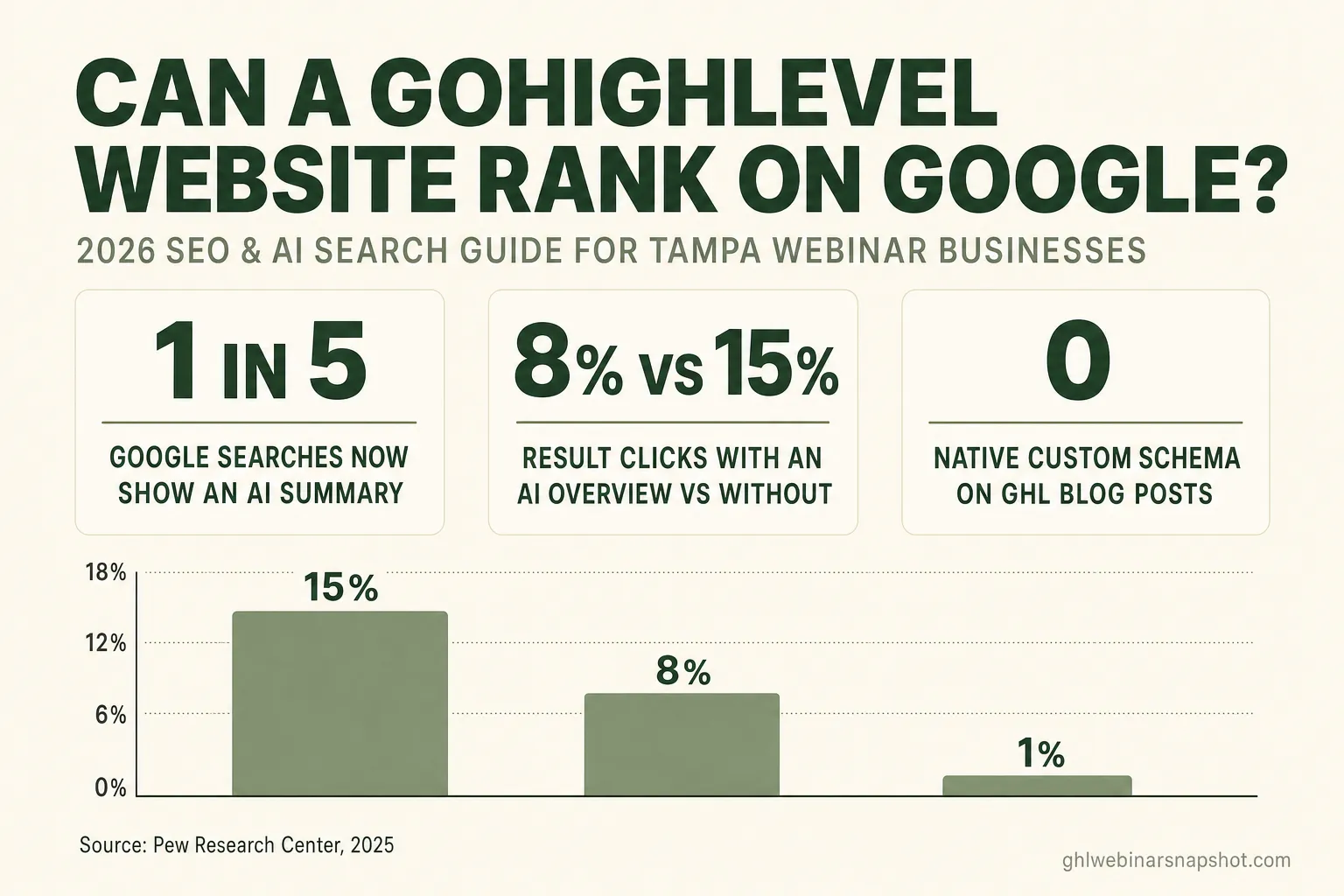
Yes, a GoHighLevel website can rank on Google — but not as easily or as far as a purpose-built site, and that gap is widening as search shifts toward AI answers. GoHighLevel gives you the basic on-page SEO controls (slug, title, meta description, canonical, image alt text) and a working blog, so a GHL page is not invisible to Google. What it does not give you is per-post custom schema (JSON-LD), a native llms.txt at your root domain, or the pre-rendered, near-instant page speed that Core Web Vitals and AI search engines reward — the exact primitives that decide whether you earn rich results and get cited in an AI Overview. For a Tampa coach or course creator whose whole pipeline runs on webinars, that is the difference between free, compounding search traffic and paying for every seat forever.
This is not a case against GoHighLevel. GHL is one of the best tools on the market for the conversion layer of a webinar business — the funnels, forms, reminders, pipelines, and booking. The honest problem is architectural: GHL was built to convert traffic you already have, not to be the fastest, most crawlable, most AI-readable public marketing site on the internet. This guide breaks down exactly where a GHL website can and can’t rank in 2026, why it matters more this year than last, and the setup most Tampa webinar hosts should actually run.
Table of contents
- Can a GoHighLevel website rank on Google?
- What GoHighLevel does well for SEO
- The four SEO and AEO gaps that hold GHL sites back
- Why 2026 raised the stakes: AI search is eating the click
- GoHighLevel funnel site vs a custom Astro site
- What this means for Tampa webinar businesses
- The setup that wins: Astro out front, GoHighLevel behind it
- FAQ
Can a GoHighLevel website rank on Google?
A GoHighLevel website can rank on Google — GHL pages are crawlable, indexable, and carry the standard on-page SEO fields — but they rank at a structural disadvantage against sites built for search, and that disadvantage is largest exactly where 2026 search is heading: page speed, structured data, and AI-answer citation. So the honest answer is not “no.” It is “yes, up to a ceiling you will hit fast if organic traffic is a real channel for you.”
Here is why the distinction matters. Ranking is not one switch. It is dozens of signals, and Google has been explicit that page experience — including Core Web Vitals — feeds its ranking systems, while valid structured data is what makes a page eligible for the enhanced, click-winning results. GoHighLevel lets you fill in the basics but caps the advanced primitives. A page-builder platform can get you indexed; it struggles to get you chosen.
For a webinar business, the stakes are specific. Organic search is not a vanity metric — it is the channel that lowers your blended cost per registrant over time. BrightEdge’s channel research puts organic search at an average 53.3% of all website traffic, and 64.1% for B2B sites. If your registration pipeline depends entirely on paid ads, the moment you stop spending, the pipeline stops. A site that ranks keeps filling seats between launches.
What GoHighLevel does well for SEO
GoHighLevel is genuinely competent at the on-page basics, and it would be unfair — and inaccurate — to call a GHL site un-rankable. Before the critique, give the platform its due, because knowing exactly what it does and doesn’t do is how you decide where to put your public site.
Out of the box, a GoHighLevel website or blog post lets you set:
- A clean URL slug for each page.
- An SEO title and meta description — the two fields that shape your search snippet.
- A canonical link, so duplicate URLs don’t split your ranking signals.
- Target keywords and image alt text, the standard on-page hygiene Google expects.
- A native blog whose posts can rank like any CMS blog and emit basic Article metadata such as publish date and author (GoHighLevel’s own technical-SEO guide).
For a lot of businesses, that is enough to show up for their own brand name and a handful of low-competition terms. If your only goal is a simple site that a returning visitor or a name-search can find, GHL clears the bar. The trouble starts when search is a growth channel — when you want to rank for the topics you teach, win rich results, and get named by an AI assistant. That is where the gaps show.
The four SEO and AEO gaps that hold GHL sites back
GoHighLevel’s SEO ceiling comes down to four documented limitations: no per-post custom schema, blocked script/JSON-LD injection, no native root-level llms.txt, and no site-wide technical-SEO scaffolding — compounded by the page speed cost of a client-rendered builder. None of these means a GHL page is penalized. Each one means a control that a search-first site uses is missing or manual.
1. No per-post custom JSON-LD schema
Structured data is not decorative. Google’s own structured-data documentation reports that Rotten Tomatoes saw a 25% higher click-through rate on pages with structured data, and Nestlé measured an 82% higher CTR on pages that show as rich results. Rich results — FAQ expanders, event details, breadcrumbs, review stars — are what make a listing eligible to take up more space and earn more clicks.
The catch: adding custom JSON-LD per blog post is an open, unfulfilled feature request on GoHighLevel’s own Ideas board (see the request). You can’t hand-author an Event, Course, or FAQPage schema block on a GHL post the way you can on a purpose-built site. For a webinar business — whose pages are literally events, courses, and FAQs — that is the single most valuable schema you’re missing.
2. Scripts and schema get stripped inside content
The obvious workaround — paste a <script type="application/ld+json"> block into the page body — doesn’t hold. Script tags added inside GHL blog content or custom-code blocks are commonly stripped or blocked from rendering (GHLRated’s teardown). So even a manual schema fix is fragile. You end up fighting the platform to do something a search-first CMS does by default.
3. No native llms.txt at your root domain
llms.txt is the emerging standard for telling AI crawlers how to read your site — the AEO equivalent of a sitemap. Hosting it at your root domain is another open request on GoHighLevel’s Ideas board (the request), because of how GHL routes media assets. Operators work around it with an external host and a redirect, or a third-party marketplace app. It works, but it’s a patch on a file that should just live at /llms.txt.
4. No site-wide technical-SEO scaffolding, and a speed penalty
GoHighLevel has no built-in rank tracking, keyword research, backlink analysis, or automated site audits, and advanced schema and site architecture require custom code (E2M Solutions). On top of that, a page-builder that renders in the browser and pulls third-party scripts is architecturally slower than a pre-rendered static page served from a CDN — and speed is a ranking and conversion factor, not a nicety.
The speed math is well documented, even if the GHL-specific benchmark isn’t. Google’s research found that as mobile load time goes from 1 second to 3 seconds, bounce probability rises 32% — and keeps climbing from there:
Every one of those bounces is a registrant you already paid an ad platform to send. On a webinar page — where the traffic is usually cold and paid — page speed isn’t a technical footnote, it’s your registration rate. We go deeper on the raw numbers in our webinar landing page speed comparison.
Why 2026 raised the stakes: AI search is eating the click
In 2026, ranking beneath an AI answer is worth far less than being cited inside it — and GoHighLevel’s schema and llms.txt gaps are exactly the primitives that decide whether AI engines can read and quote your pages. This is the shift that turns GHL’s SEO ceiling from a minor annoyance into a real growth cap.
The data is stark. Pew Research Center found that when a Google AI Overview appears, users click a traditional search result only 8% of the time, versus 15% when there’s no AI summary — and they click a link inside the AI summary just 1% of the time (Pew, July 2025). Meanwhile, AI Overviews are no longer rare: Semrush tracked them growing from 6.49% of keywords in January 2025 to a peak of 24.61% in July 2025, and about 58.5% of US searches ended without a click to the open web in 2024 (SparkToro/Datos).
Read those two facts together and the strategy is obvious. The old game was “rank in the blue links.” The new game is “be the source the AI Overview quotes,” because the click is increasingly happening inside the answer or not at all. Gartner has even projected that traditional search-engine volume could fall 25% by 2026 as users shift to AI assistants — a forecast, not a measured result, and one that’s been debated, but the direction of travel is not in doubt.
Getting cited by an AI engine is answer engine optimization (AEO), and it runs on clean, fast, well-structured HTML: self-contained answers, correct heading structure, valid schema that tells the machine what each entity is, and an llms.txt that guides AI crawlers. Those are precisely the four primitives GoHighLevel either strips, caps, or can’t host natively. If you want the mechanics of getting found in AI search, we cover them in how to get your webinar found in AI search.
GoHighLevel funnel site vs a custom Astro site
For the public marketing site, a custom Astro build beats a GoHighLevel funnel site on every SEO and AEO dimension that matters in 2026 — speed, schema, AI-readability, and site architecture — while GoHighLevel remains the better tool for everything behind the form. This isn’t Astro versus GHL as an either/or. It’s the right tool for each job.
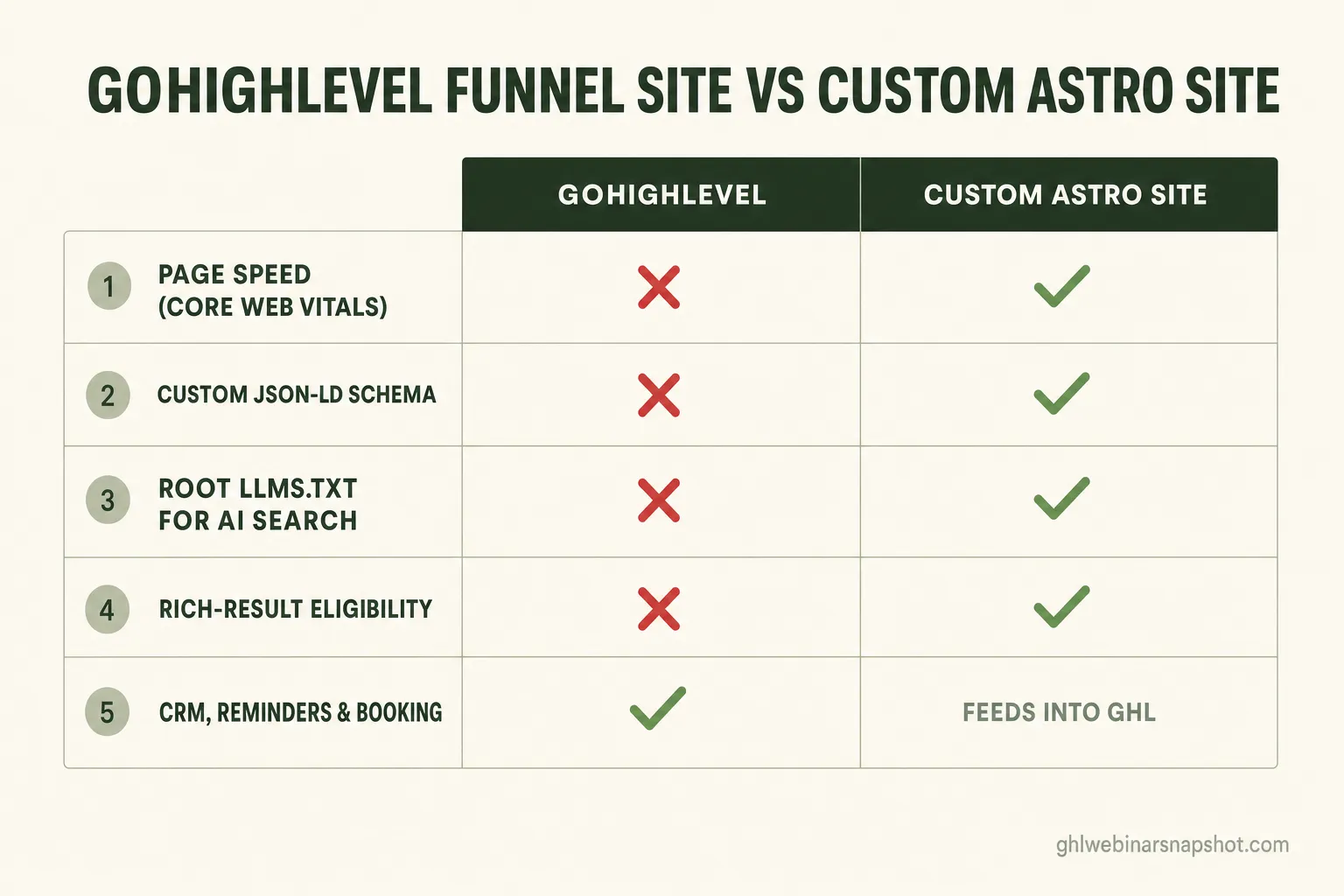
Where each platform actually wins
| Feature | Custom Astro site | GoHighLevel funnel/website |
|---|---|---|
| On-page SEO (slug, title, meta, canonical) | Full control | Supported |
| Page speed / Core Web Vitals | Pre-rendered, CDN — built for 90+ | Browser-rendered builder, heavier |
| Per-page custom JSON-LD schema | Any schema, hand-authored | Not native (open feature request) |
| Rich-result eligibility (Event, Course, FAQ) | Yes | Limited to basic Article metadata |
| Root-level llms.txt for AI crawlers | Shipped at /llms.txt | Not native (workaround required) |
| Topic, program & location pages | Unlimited, structured | Manual, funnel-oriented |
| CRM, forms, reminders, booking | Feeds into GHL | Best-in-class |
| Editing a live date before launch | Managed revision, fast | You self-serve in the builder |
The pattern is consistent: Astro wins the discovery layer (be found, be fast, be cited), and GoHighLevel wins the conversion and operations layer (capture, remind, book, automate). Trying to force GHL to be your search-optimized public site means fighting its architecture; trying to rebuild GHL’s automation in a static site means rebuilding a CRM. Neither is a good use of your week. This is the same conclusion we reached looking at when off-the-shelf webinar tools start costing you sales.
What this means for Tampa webinar businesses
In a market as dense as Tampa’s, organic visibility is a real competitive edge — and if your site can’t win rich results or AI citations, you’re leaving that edge to the competitor whose site can. Florida has roughly 3.5 million small businesses, 99.8% of all businesses in the state, employing about 39.6% of the state’s private workforce (SBA Office of Advocacy). A lot of them are coaches, consultants, agencies, and founders running the same webinars, buying the same ads, chasing the same registrants.
Two Tampa-specific realities make the platform choice concrete:
- Paid traffic here is competitive and getting pricier. When everyone in your niche is bidding on the same webinar keywords, the operator with a free organic and AI-search channel wins on blended cost per registrant. That channel only exists if your site can actually rank and get cited — which is a technical-SEO and AEO question, not a copywriting one.
- Your buyers are searching in AI tools now. When a Tampa business owner asks ChatGPT or Google’s AI mode “where can I learn [your topic],” the answer is assembled from sites the model can read cleanly. A page that can’t emit
Course/Event/FAQPageschema or host anllms.txtis harder to quote — so it doesn’t get named.
None of this means ripping out GoHighLevel. It means not asking GHL to be the one thing it wasn’t built to be: your fast, crawlable, AI-readable public front door.
The setup that wins: Astro out front, GoHighLevel behind it
The setup most Tampa webinar hosts should run is a fast custom Astro marketing site as the public front door — built to rank and get cited — feeding every registration straight into GoHighLevel for reminders, tagging, and booking. You keep everything GHL is great at, and you stop asking it to do the one job it’s structurally worst at.
That’s exactly what our Get a Website service is built for. We build your webinar site on Astro with a guaranteed 90+ Google PageSpeed score (often a perfect 100), a dedicated page for every webinar, masterclass, program, topic, and market you teach into, proper schema and meta for rich results and AI Overviews, and a correct sitemap, robots.txt, and llms.txt so both search crawlers and AI crawlers index you cleanly. Registrations are pushed into GoHighLevel (or any CRM) by API, Zapier, or Make, so every sign-up flows into your reminder cadence and booking automation instantly.
Pricing is straightforward: from $97/month plus a one-time $447 build fee, fully managed — hosting, SSL, patches, uptime, and five revisions a month included, with launch-week date changes usually turned around same-day. If you’d rather connect and migrate the pieces yourself, our GoHighLevel development team can wire the integration; and if you’re moving off a legacy stack, start with how to migrate your webinar funnel to GoHighLevel.
The takeaway for a Tampa webinar business: don’t judge GoHighLevel by whether its funnel pages can rank — judge it by what it’s for. Let GHL run the pipeline. Put a site built for search and AI in front of it, so the seats keep filling between launches, not just while your ad budget is live. For the wider picture on what a filled room is actually worth, see our 2026 webinar benchmarks and the anatomy of a registration page that converts.
FAQ
Can a GoHighLevel website rank on Google?
Yes — GoHighLevel pages are crawlable and indexable, and the platform supports the core on-page SEO fields (URL slug, SEO title, meta description, canonical link, and image alt text) plus a native blog that can rank like any CMS blog. What GHL lacks is the advanced layer: per-post custom JSON-LD schema, script injection that isn't stripped, a native root-level llms.txt, and site-wide technical-SEO scaffolding. So a GHL site can rank for low-competition and brand terms, but it hits a ceiling on competitive terms, rich results, and AI-search citations.
Why can't I just add schema markup to my GoHighLevel blog?
Adding custom JSON-LD structured data per blog post is an open, still-pending feature request on GoHighLevel's own Ideas board, and script tags pasted into blog content or custom-code blocks are commonly stripped or blocked from rendering. Because valid structured data is what makes a page eligible for rich results — Google reports 25% to 82% higher click-through on pages with structured data — this is a meaningful gap for webinar pages, which are essentially events, courses, and FAQs that benefit most from schema.
Does GoHighLevel support llms.txt for AI search?
Not natively at your root domain. Hosting an llms.txt file at the domain root is an open request on GoHighLevel's Ideas board due to how GHL routes media assets. Operators work around it with an external host and a redirect or a third-party marketplace app. A purpose-built site simply ships the file at /llms.txt, which is cleaner for AI crawlers that use it to understand your content.
Is a custom Astro site better than GoHighLevel for SEO?
For the public marketing and content site, yes. Astro is a static-first framework that pre-renders pages and serves them from a CDN, so it's built to score 90+ on Core Web Vitals, and it lets you hand-author any schema and ship a proper llms.txt — the primitives that win rich results and AI citations. GoHighLevel remains the better tool for the conversion layer: CRM, forms, reminders, pipelines, and booking. The strongest setup uses both, with Astro out front feeding leads into GHL.
Do I have to leave GoHighLevel to get a site that ranks?
No. The recommended setup keeps GoHighLevel for everything it's best at and puts a fast, rankable Astro site in front of it as the public front door. Registration forms on the Astro site push straight into GoHighLevel via native integration, Zapier, Pabbly, or Make, so every sign-up still triggers your reminder cadence, tagging, and booking automation within seconds. You gain the SEO and AI-search reach without losing any automation.
How much does a fast, rankable webinar website cost?
Our Get a Website service starts at $97/month plus a one-time $447 build fee, fully managed — including Cloudflare edge hosting, SSL, patches, uptime monitoring, backups, and five revision requests per month. It ships with a guaranteed 90+ PageSpeed score, dedicated pages for every webinar, program, and topic, schema and meta for rich results and AI Overviews, and a correct sitemap, robots.txt, and llms.txt, with registrations wired into your GoHighLevel or any CRM.
About the author
Derek Haywood is a GoHighLevel Automation Engineer based in Denver, CO. A former B2B SaaS sales engineer, he moved into GoHighLevel implementation and now spends his days in the plumbing behind webinar funnels — tags, triggers, lead scoring, integrations, and the technical-SEO decisions that decide whether a webinar business gets found. He has a low tolerance for broken automations and an even lower one for vague, un-sourced platform claims.
Related reading
- Webinar Landing Page Speed in Austin: Astro vs WordPress vs Wix (2026 Comparison)
- Local SEO for Dallas Coaches: How to Get Your Webinar Found in AI Search (2026)
- Custom Webinar Software for NYC Coaches: When Off-the-Shelf Tools Start Costing You Sales (2026)
- How to Migrate Your Webinar Funnel to GoHighLevel (2026 Step-by-Step)
- Webinar Benchmarks 2026: Show-Up Rates & Conversion Data
Sources
- Google Search Central — Understanding page experience & Core Web Vitals
- Google Search Central — Intro to structured data (Rotten Tomatoes +25%, Nestlé +82% CTR)
- Think with Google — Mobile Page Speed New Industry Benchmarks (bounce vs load)
- Think with Google — 53% of mobile visits abandoned after 3 seconds
- web.dev — Milliseconds Make Millions (Deloitte/Google)
- BrightEdge — Organic search share of traffic
- Pew Research Center — Google users are less likely to click when an AI summary appears
- Semrush — AI Overviews study (prevalence 2025)
- SparkToro / Datos — 2024 Zero-Click Search Study
- Gartner — Search engine volume projected to drop 25% by 2026
- SBA Office of Advocacy — Florida 2025 State Profile (PDF)
- GoHighLevel Ideas — Enable JSON-LD structured data per blog post (open request)
- GoHighLevel Ideas — Add llms.txt to root domain (open request)
- GoHighLevel — A practical guide to technical SEO for GHL websites
- GHLRated — GoHighLevel blogging & SEO review
- E2M Solutions — GoHighLevel technical SEO gaps