
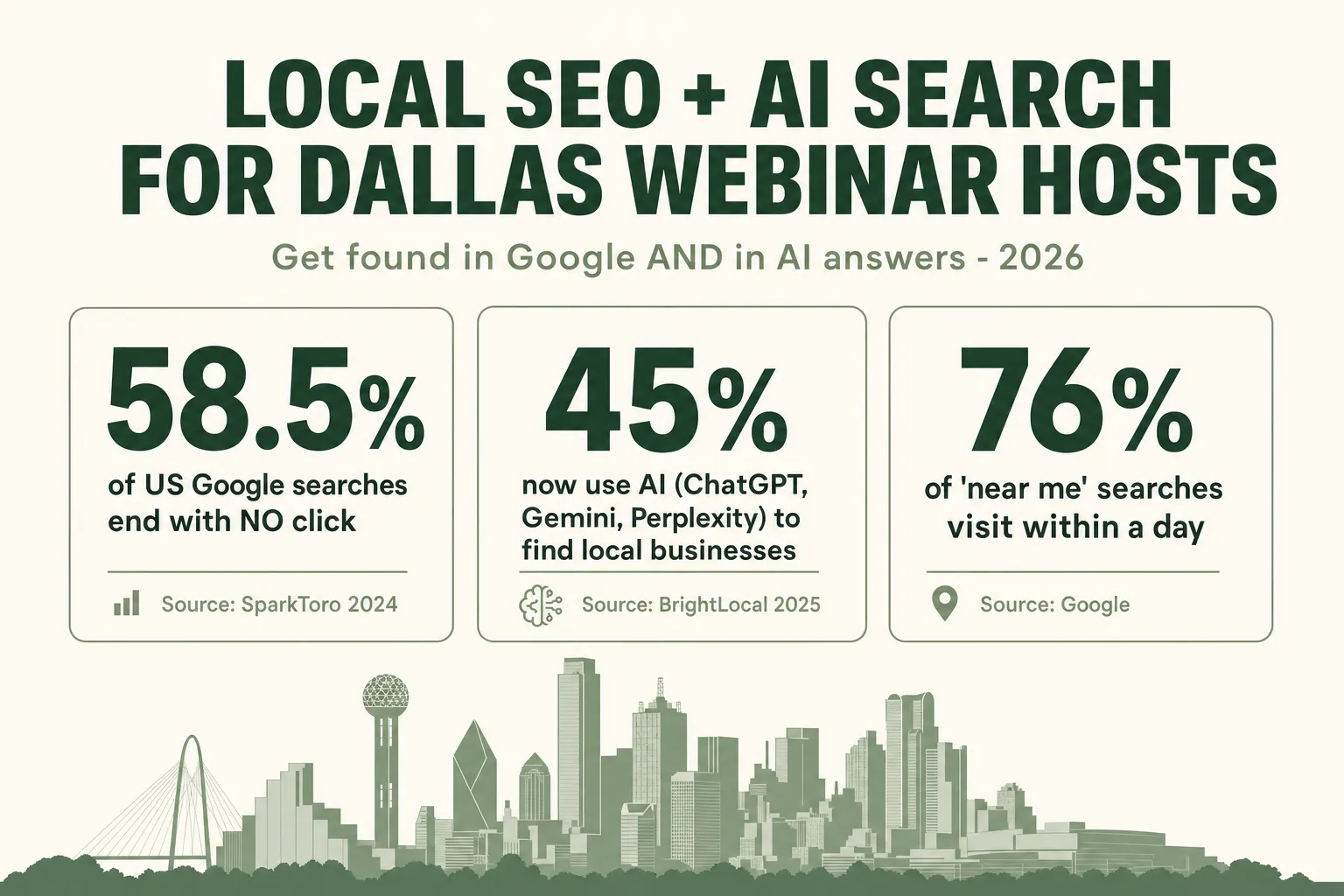
For a Dallas coach or course creator, “getting found” in 2026 means two things at once: ranking in local Google results and being the source an AI answer engine quotes when someone asks it for help — and most webinar businesses in Dallas are invisible on both, because their site has no location pages, no schema, and no structure an AI can read. You can run a great webinar and still have an empty registration page, not because your offer is weak, but because the person searching “business coaching webinar Dallas” or asking ChatGPT “who runs marketing masterclasses in DFW” never sees you. Search stopped being ten blue links. This post explains what changed, why it’s quietly costing you registrations, and the concrete levers that put a Dallas webinar business back in front of the people already looking — every figure sourced.
Table of contents
- What “getting found” actually means in 2026
- Why Dallas webinar businesses are invisible right now
- The shift: people find your webinar in AI answers, not just blue links
- The 6 levers that get a Dallas webinar business found
- Local SEO vs AI search (GEO): what’s the same, what’s different
- Found is step one; converting is step two
- FAQ
What “getting found” actually means in 2026
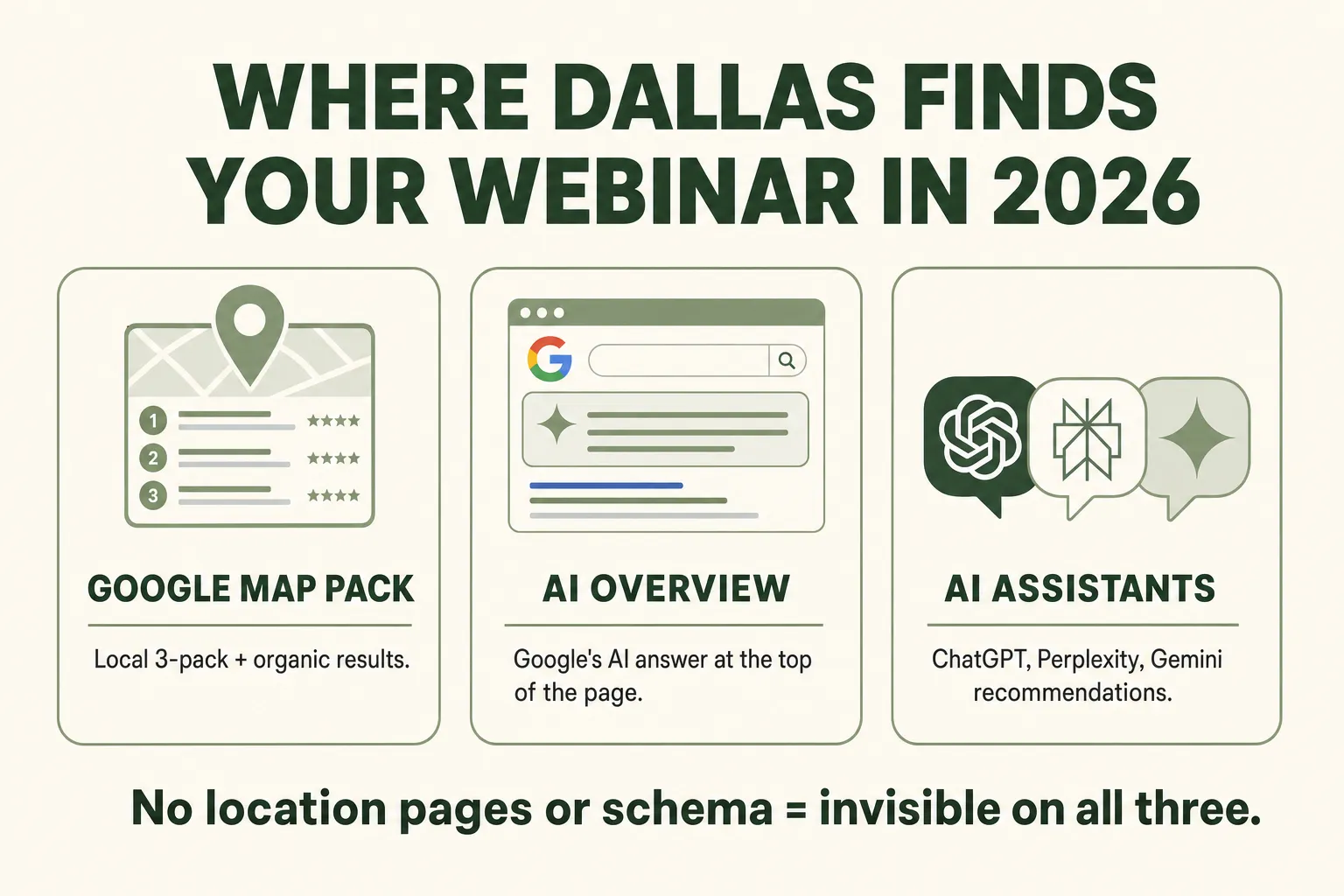
Getting found today is the sum of local SEO and GEO — local SEO gets your webinar into Google’s map pack and organic results for Dallas-area searches, while GEO (generative engine optimization, also called AEO) gets your business quoted inside AI answers from Google AI Overviews, ChatGPT, and Perplexity. They overlap, but they’re not the same job, and a webinar business that optimizes for one and ignores the other leaves half its audience on the table.
Here’s the plain-language split:
- Local SEO is everything that helps Google decide you’re relevant to a place: a real Google Business Profile, location pages for Dallas and the DFW metro, local keywords in your titles and content, reviews, and consistent name-address-phone details. It wins you the map pack and the “coaching webinar Dallas” organic result.
- GEO / AEO is everything that helps a machine understand and trust your content well enough to repeat it: clean structured data (schema), answer-first writing, a crawlable site, and an
llms.txtfile that tells AI crawlers what your business is and does. It wins you a mention when someone asks an AI assistant for a recommendation instead of typing into a search bar.
The reason both matter now is simple: the search results page changed shape. It used to be a list of links. Now the top of the page is often an answer — a map pack, a featured snippet, or an AI Overview — and the link list has been pushed down or replaced. If your content isn’t structured to feed those answer boxes, you don’t just rank lower; you can be absent from the part of the page people actually read.
Why Dallas webinar businesses are invisible right now
Most webinar operators in Dallas are invisible because they built their registration page inside a tool that was never designed to rank — a page builder or an all-in-one funnel app that ships bloated, thin, location-blind pages Google and AI crawlers can barely parse — and then they poured everything into paid ads instead of fixing it. The result is a business that only exists when it’s paying to be seen. The moment the ad budget stops, the pipeline stops.
Two structural shifts make that fragility worse every quarter.
First, the zero-click reality. The open web is getting a shrinking slice of search. In SparkToro’s 2024 clickstream study, 58.5% of US Google searches ended without a click to any outside website — for every 1,000 searches, only about 360 clicks reach a site you don’t own. The rest are answered on Google itself or bounce back to another search.
Second, AI Overviews. When Google shows an AI-generated answer at the top of the page, it cuts click-through to the results below by nearly 60%, and those Overviews now appear on more than one in five US searches (SparkToro, 2024). If your Dallas webinar page isn’t structured cleanly enough to be one of the sources that Overview pulls from, the AI answers the question using someone else’s content — and your would-be registrant never has a reason to click you.
None of this means search is dead. It means the unstructured, location-blind page is dead. High-intent local search still converts hard: 76% of “near me” phone searches lead to a visit within a day, and 28% of local searches end in a purchase (Google). The demand is there. The question is whether your site is built to capture it.
The shift: people find your webinar in AI answers, not just blue links
The single biggest change for a Dallas webinar business is that a large and growing share of your audience now asks an AI assistant for a recommendation instead of scrolling a results page — and the AI answers using whatever content it can read and trust, which is usually a business’s own website. If ChatGPT can’t parse your site, you’re not in the running.
The adoption curve is steep. 45% of consumers now say they’ve used AI tools like ChatGPT, Gemini, or Perplexity to find a local business in the past year — a jump large enough that BrightLocal’s 2025 research ranks AI as the third most-used channel for discovering local businesses, ahead of Yelp and TripAdvisor and behind only Google and Facebook. For a coach or course creator whose buyers skew toward the 30–44 age band that’s leading AI adoption, that channel isn’t a novelty; it’s where a meaningful chunk of your future registrants are starting their search.
The uncomfortable implication: you can have a beautiful funnel and still be invisible to AI search, because the things AI relies on — clean HTML, schema markup, answer-first copy, a crawlable structure, an llms.txt file — are exactly the things that page builders and all-in-one funnel tools tend to do worst. Winning here isn’t about writing more; it’s about being legible to both Google and the models.
The 6 levers that get a Dallas webinar business found
Getting found is not one trick — it’s six levers working together: a fast site, real location pages, structured data, a Google Business Profile, AI-readable content, and fresh proof. Here’s what each one does and why it matters for a webinar operator specifically.
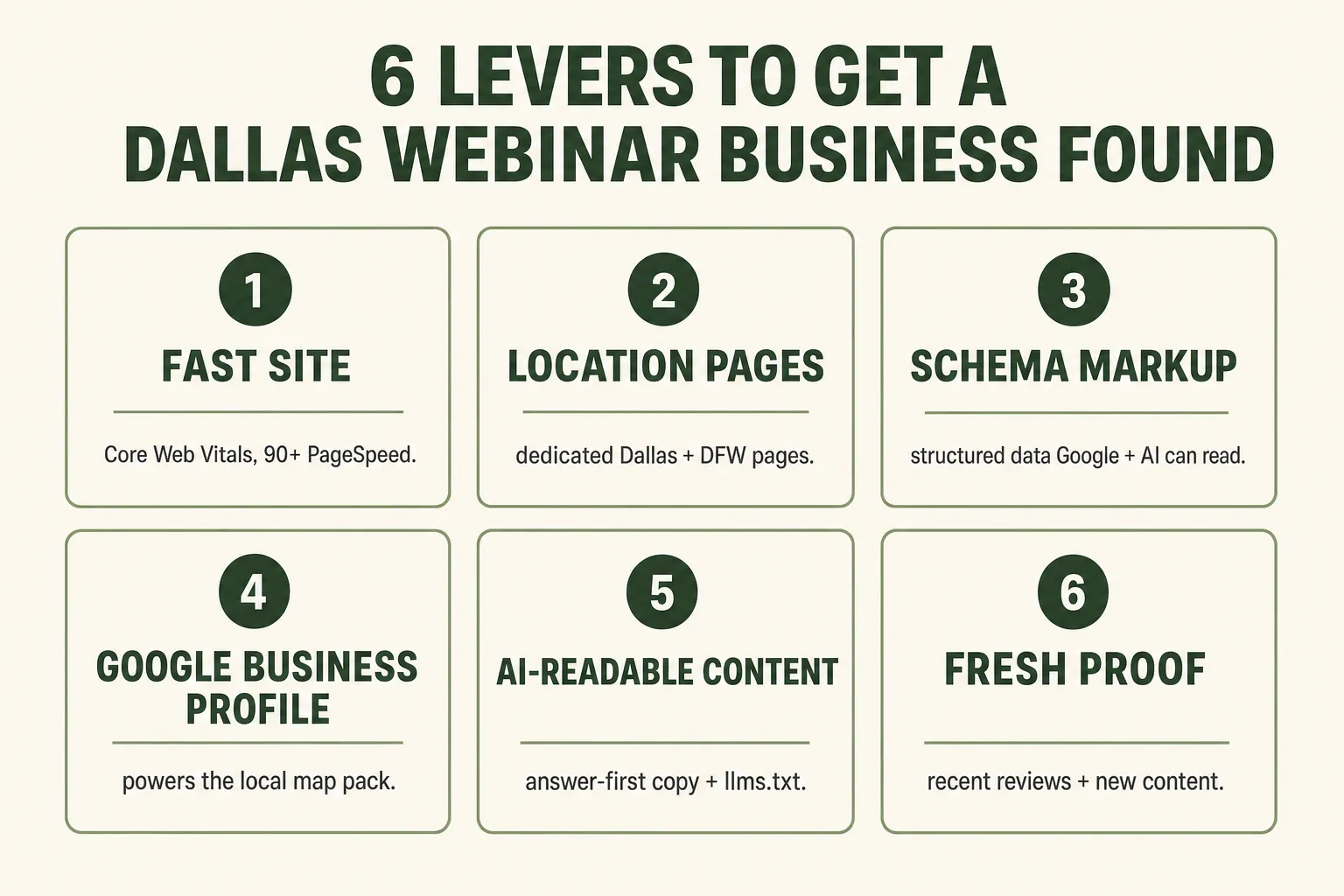
1. A genuinely fast site (Core Web Vitals)
Speed is a ranking input and a conversion input at the same time. Google uses Core Web Vitals in its ranking systems, and a slow registration page bleeds the paid clicks you already bought. This is where the platform you build on decides your ceiling — a static-first framework like Astro clears the speed bar by default, while plugin-heavy builders fight gravity to get there. We went deep on this in Astro vs WordPress vs Wix for webinar page speed; the short version is that speed is the cheapest ranking and conversion lever you can buy.
2. Real Dallas + DFW location pages
A single “Home” page can’t rank for a place. Individually-optimized location pages — Dallas, and separate pages for the suburbs and metro areas you actually teach or sell into — are how local coaches and B2B hosts win their map. Each page answers the local version of the question (“webinar strategy coaching in Dallas”) with its own title, copy, and schema, instead of hoping one generic page ranks everywhere.
3. Structured data (schema markup)
Schema is how you hand a search engine and an AI crawler the facts in a format they can’t misread: what your business is, what service you offer, where you serve, your events, your FAQs. It’s the difference between hoping Google infers your webinar and telling it — and it’s a direct input to rich results and AI answers.
4. A claimed, active Google Business Profile
For local intent, your Google Business Profile is the front door: it powers the map pack, collects reviews, and feeds Google the location signal that organic pages alone can’t. Claim it, fill it out completely, and keep it active. It’s free, and it’s often the single highest-leverage local SEO move a Dallas operator hasn’t finished.
5. AI-readable content (AEO/GEO)
This is the newest lever and the one most operators miss. To be quotable by AI answer engines, write answer-first (lead every section with the direct answer, then explain), keep passages self-contained, use question-shaped headings, and ship a correct sitemap.xml, robots.txt, and llms.txt so AI crawlers can index your webinar and course content cleanly. Structured, citation-ready copy is what gets you into the AI Overview instead of buried beneath it.
6. Fresh proof (reviews + content)
Both Google and AI models weight freshness and trust. A steady drip of recent reviews and new, on-topic content signals that you’re an active, credible business — not a dormant page. Automating the ask after every session keeps that proof compounding; here’s the review-harvesting playbook we use to do it without nagging attendees.
Local SEO vs AI search (GEO): what’s the same, what’s different
Local SEO and GEO share a foundation — a fast, crawlable, well-structured site with clear location signals — but they optimize for different judges: local SEO optimizes for Google’s ranking algorithm, while GEO optimizes for a language model deciding whether your content is trustworthy enough to repeat. Here’s how the priorities line up.
Local SEO vs GEO for a Dallas webinar business
| Feature | Classic Local SEO | AI Search / GEO (AEO) |
|---|---|---|
| Who you're optimizing for | Google's ranking algorithm + the map pack | AI answer engines: Google AI Overviews, ChatGPT, Perplexity |
| What wins | Local keywords, location pages, reviews, GBP | Answer-first copy, self-contained passages, entity clarity |
| The structure that matters most | Titles, meta, internal links, NAP consistency | Schema, clean HTML, sitemap + robots + llms.txt |
| The unit of visibility | A ranked link in the results | A quoted mention inside the AI's answer |
| How you measure it | Rankings, map-pack position, organic clicks | Whether the AI names you when asked your topic |
| Shared foundation | Fast, crawlable, structured site | Fast, crawlable, structured site |
The takeaway isn’t “pick one.” It’s that the foundation — a fast, structured, location-aware website — serves both, and everything else is a layer on top. Build the foundation wrong (on a slow, unstructured page builder) and you cap your ceiling on both channels at once. Build it right and a single site earns you map-pack rankings and AI citations from the same content.
A Dallas webinar business, before and after
Registration page lives inside a page builder. No Dallas page, no schema, slow on mobile. Invisible in the map pack, buried under the AI Overview, never quoted by ChatGPT. The pipeline only moves when ads are running.
Fast Astro site with dedicated Dallas + DFW pages, full schema, answer-first copy, and llms.txt. Ranks locally, feeds the AI answer boxes, and gets named when someone asks an assistant for a recommendation — sending registrations without paying per click.
Found is step one; converting is step two
Ranking and getting quoted only fill the top of the funnel — the registration, reminder, and booking system is what turns a found visitor into an attendee and a sales call, and without it, better visibility just means more people leaking out of a funnel that doesn’t hold them. Discovery and conversion are two different jobs, and winning one without the other is how operators end up with “good traffic, no revenue.”
The math is unforgiving on the conversion side. Even after you’ve done the work to get found, the average webinar show-up rate is 47.7% (Livestorm, 2026) — meaning more than half of the registrants you worked to attract won’t attend live unless a reminder system pulls them back. And when a genuinely interested prospect reaches out, speed decides the outcome: contacting a lead within an hour makes you about 7x more likely to qualify it than waiting even one hour longer (Harvard Business Review, 2011). No solo operator hits that window by hand.
That’s why the smart architecture is to let each system do its job: a fast, structured Astro website to get found, an AI chat widget to answer and register visitors the moment they land, and a GoHighLevel automation layer to run the reminder cadence and booking flow behind it. Getting found is the lever this post is about — but it only pays off when the conversion funnel behind it is built to catch what you attract. If your social presence is also part of how people (and AI) discover you, a done-for-you social system keeps that surface active and consistent, which feeds both channels.
Being visible is worth doing precisely because the demand is real and high-intent. The Dallas coach who shows up in the map pack, the organic result, and the AI answer — with a site fast and structured enough to convert the click — stops renting attention from ad platforms and starts owning a pipeline that compounds.
FAQ
What is the difference between local SEO and GEO for a webinar business?
Local SEO optimizes your site so Google ranks it for location-based searches — think the map pack and the 'webinar coaching Dallas' organic result — using location pages, local keywords, reviews, and a Google Business Profile. GEO (generative engine optimization, also called AEO) optimizes your content so AI answer engines like Google AI Overviews, ChatGPT, and Perplexity can read, trust, and quote it, using schema, answer-first writing, and a crawlable structure with an llms.txt file. They share a foundation — a fast, structured site — but they win you two different things: a ranked link versus a quoted mention inside an AI answer.
Do Dallas coaches really need to worry about AI search yet?
Yes. BrightLocal's 2025 research found 45% of consumers have already used AI tools like ChatGPT, Gemini, or Perplexity to find a local business in the past year, making AI the third most-used local discovery channel behind Google and Facebook. Adoption is highest in the 30–44 age band, which is squarely the buyer profile for most coaching and course webinars. Waiting until it's mainstream means arriving after your competitors are already the cited source.
Why is my current registration page invisible in search?
Usually because it was built inside a page builder or all-in-one funnel tool that ships slow, thin, location-blind pages with little to no schema — exactly the structure Google and AI crawlers struggle to rank or quote. Add the zero-click reality (58.5% of US searches end without a click, per SparkToro) and AI Overviews that cut click-through by nearly 60%, and an unstructured page simply never surfaces where people look. The fix is a fast, structured site with real location pages, not more ad spend.
What is an llms.txt file and does my webinar site need one?
An llms.txt file is a plain-text file at the root of your site that tells AI crawlers what your business is, what you offer, and where to find your key content — the AI-era companion to robots.txt and sitemap.xml. It helps answer engines index your webinar and course pages cleanly so they can cite you accurately. For a webinar business that wants to show up in AI answers, it's a small, high-leverage addition that most page builders don't generate for you.
Can I keep GoHighLevel and still fix my SEO and AI visibility?
Yes, and that's usually the best setup. GoHighLevel is excellent for CRM, reminders, and booking automation, but public registration pages are better served by a fast, static-first site built to rank. The clean split is a structured Astro website for discovery and conversion on the front end, piping leads straight into GoHighLevel for the reminder cadence, replay tracking, and sales-call booking behind it. You keep your automation and fix the visibility ceiling at the same time.
How long does it take to start ranking in Dallas after fixing this?
With fast pages, proper location pages, schema, and clean sitemap/robots/llms files, most local businesses start seeing ranking movement within roughly 3–5 months — anyone promising day-one rankings isn't being honest. AI visibility can move faster because it depends on how readable and trustworthy your content is rather than on accumulated domain authority, but both compound over time as reviews and content freshness build up.
About the author
Mara Delgado is a Webinar Funnel Strategist based in Austin, TX. She has spent the better part of a decade turning empty registration pages into packed live rooms, first producing launch webinars for coaches and then going all-in on GoHighLevel automation — where she learned that show-up rate, not opt-in cost, is the metric that actually compounds. She writes about registration funnels, reminder cadences, and the small structural tweaks that decide whether a webinar business gets found and fills seats.
Related reading
- Webinar Landing Page Speed: Astro vs WordPress vs Wix (2026 Comparison)
- Webinar Chatbot: How to Fill Seats and Book Sales Calls With AI
- Review Harvesting: How to Automate Webinar Testimonials in GoHighLevel
- Webinar Benchmarks 2026: The Numbers That Actually Matter
- Why Show-Up Rate Is the Only Webinar Metric That Compounds
Sources
- SparkToro — 2024 Zero-Click Search Study (58.5% of US searches end without a click; ~360 of 1,000 clicks reach the open web; AI Overviews cut CTR ~60%)
- BrightLocal — Consumer Search Behavior 2025 (45% used AI to find a local business; AI is the 3rd most-used local discovery channel)
- Google, via Retail Dive — Local/mobile search behavior (76% of “near me” searches lead to a visit within a day; 28% of local searches lead to a purchase)
- Google Search Central — Core Web Vitals as a ranking signal
- Livestorm — Webinar Benchmark Report 2026 (47.7% average show-up rate)
- Harvard Business Review — The Short Life of Online Sales Leads (contacting within 1 hour ≈ 7x more likely to qualify)