
It is 9:52am and you are eight minutes from going live on a retirement-planning webinar for 180 registrants. Then your compliance officer pings you: “Did a principal approve those slides before you sent the invite?” You do not actually know. You hit start anyway, because 180 people are waiting. That gap between “I think we’re fine” and “I can prove we were compliant” is where a financial advisor gets hurt.
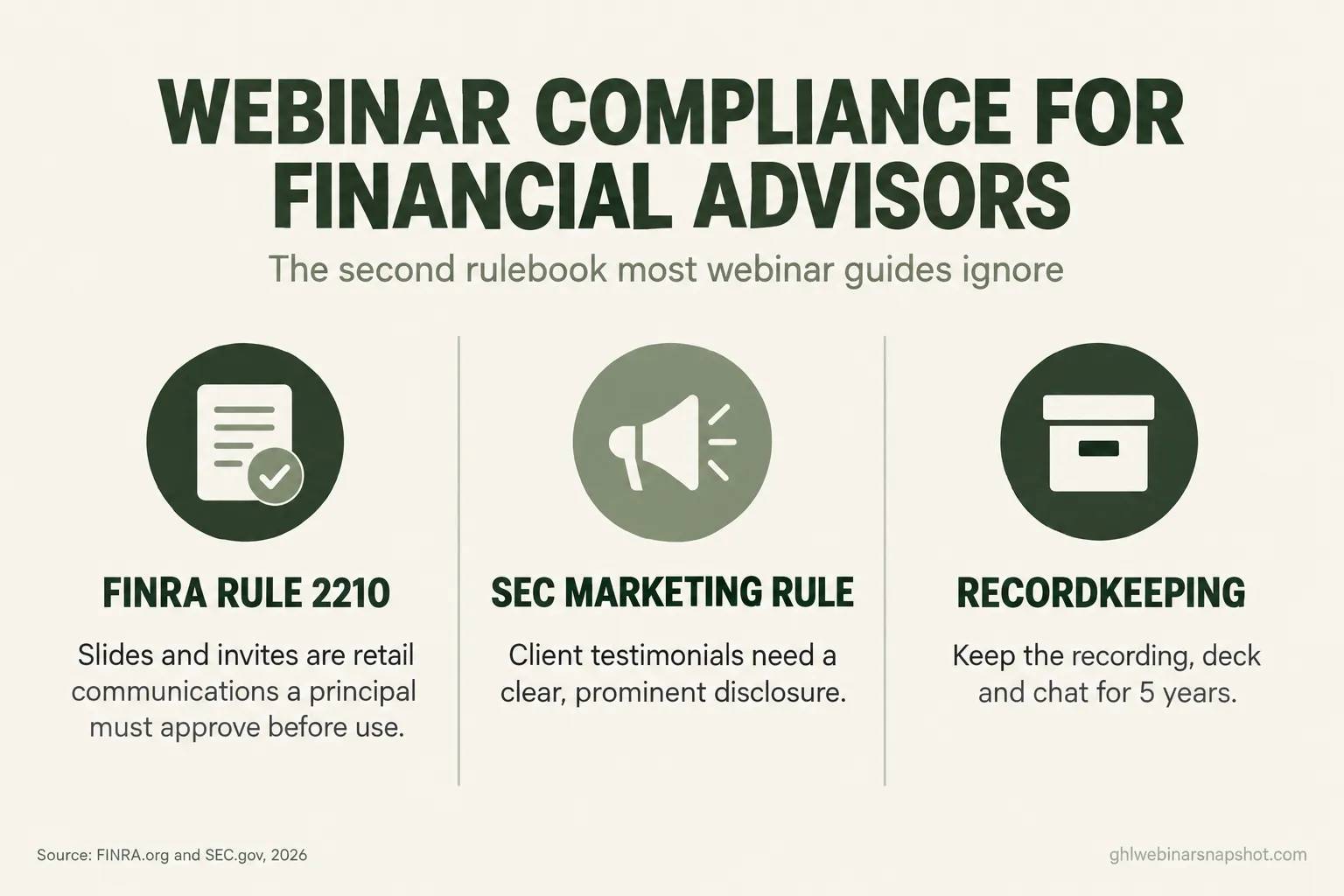
Every webinar guide covers show-up rate and reminder sequences. Almost none tell you that if you hold a license, a second rulebook sits on top of all of it: FINRA Rule 2210 for broker-dealer reps, the SEC Marketing Rule for RIAs, “fair and balanced” performance standards, and recordkeeping rules that treat your recording, slides, and chat log as business records you keep for years. This guide walks each in plain English, shows how it breaks on a real webinar, and hands you disclosure copy to paste in today.
Table of contents
- What getting this wrong actually costs
- Rule 1: Is your webinar a public appearance or a retail communication?
- Rule 2: Testimonials and endorsements in the chat
- Rule 3: Performance, projections, and “fair and balanced”
- Rule 4: Your recording and chat log are records
- Rule 5: The reminder layer still applies
- The same rules at three sizes
- Objections, answered
- FAQ
What getting this wrong actually costs
Webinars are worth protecting. In the 2026 B2B content marketing report from CMI and MarketingProfs, marketers rated webinars their second most effective channel, behind only in-person events. For a financial advisor, one retirement webinar can fill a month of consultations. That is why regulators watch it.
Share of B2B marketers rating each channel among their most effective for distribution. Source: CMI / MarketingProfs, B2B Content Marketing 2026.
The cost is not theoretical. The SEC’s 2024 sweep over Marketing Rule violations hit nine advisers for a combined $1.24 million, largely for unsubstantiated claims or testimonials missing disclosures. On December 16, 2025, the SEC’s Division of Examinations issued another risk alert flagging the same problem. On the broker-dealer side, an unapproved retail communication or a misleading performance claim is a supervision finding that lands on your firm first, you second.
None of this means avoid webinars. It means running them on a system that approves, discloses, and archives by default.
Rule 1: Is your webinar a public appearance or a retail communication?
First, know which regulator owns your webinar. A registered investment adviser (RIA or IAR) advertises under the SEC Marketing Rule; a broker-dealer representative makes a “communication with the public” under FINRA Rule 2210. Many advisors are dually registered, so both apply and the stricter one wins. Either way, the distinction hangs on one thing: your slides.
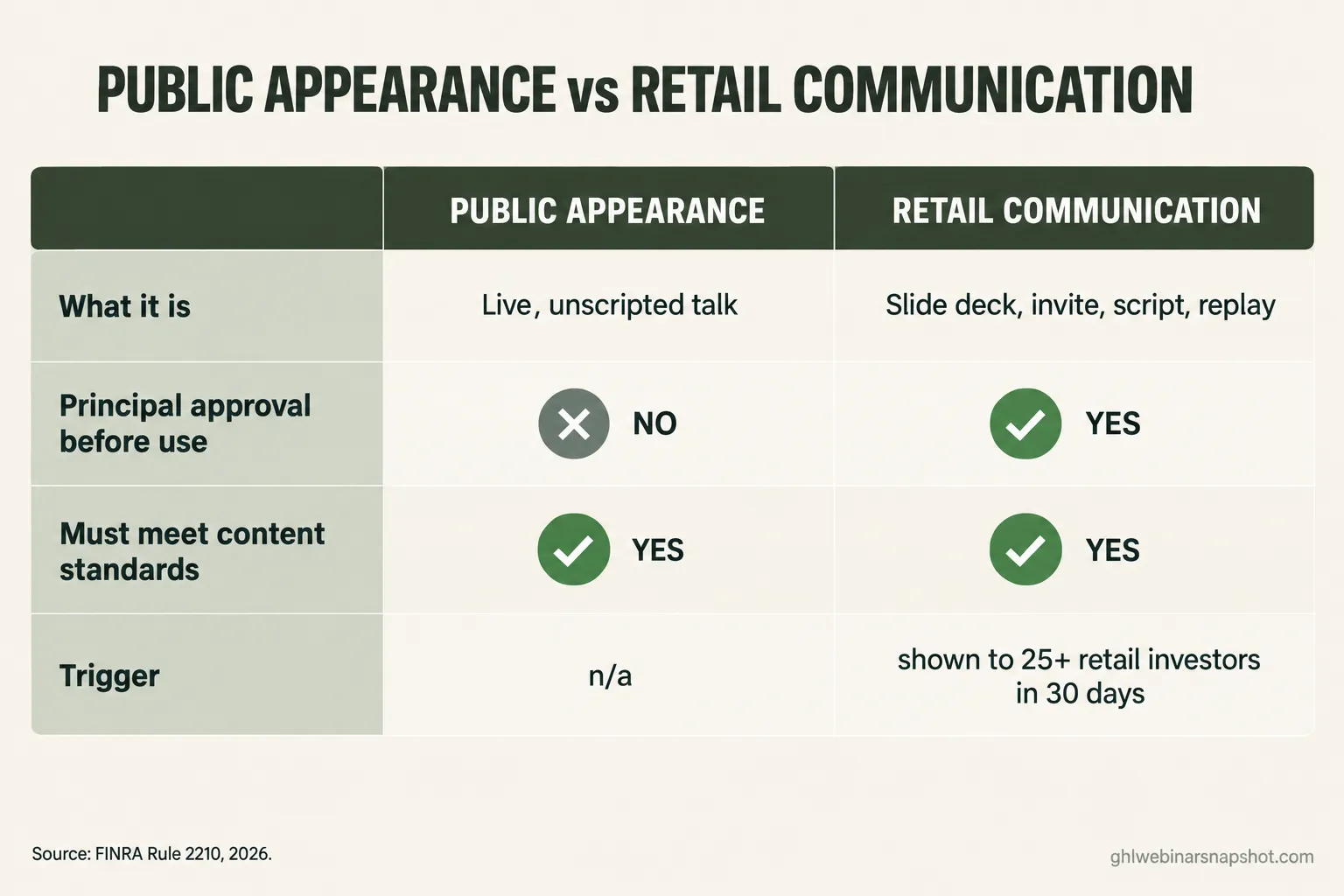
Under FINRA Rule 2210, a live, unscripted webinar or seminar is generally a public appearance. A principal need not approve it before you speak, but what you say must meet the rule’s content standards and your firm must supervise these events under written procedures.
Add a script or a slide deck shown to more than 25 retail investors within any 30 calendar-day period and that material becomes a retail communication under Rule 2210(a)(5). Retail communications must be approved by a registered principal before first use (Rule 2210(b)(1)), and some must be filed with FINRA. FINRA’s advertising FAQ confirms seminar scripts and slides need pre-use approval.
So the invite, the registration page, the deck, and the replay you post are all retail communications. The off-the-cuff answer in live Q&A is closer to a public appearance. Same webinar, two compliance paths at once.
Rule 2: Testimonials and endorsements in the chat
The old Advertising Rule banned adviser testimonials outright. That changed with the SEC Marketing Rule, Rule 206(4)-1, in force since its compliance date of November 4, 2022. RIAs can now use testimonials, but only with conditions, and a webinar is where advisors trip the wire.
A testimonial need not be a polished video. If a happy client types “working with you doubled my confidence about retirement” into your chat and you leave it up, screenshot it, or quote it later, you are using a testimonial. The Marketing Rule requires a clear and prominent disclosure, at the time it is shown, of whether the speaker is a current client and whether they were compensated. The SEC’s December 2025 risk alert found the most common failure was exactly this: a disclosure missing, buried, or hidden behind a hyperlink.
Two more traps are specific to live events. A guest speaker or affiliate who praises your firm can be an endorsement. And if you pay a promoter or referral partner to bring registrants, you generally need a written promoter agreement, unless they fall under the de minimis exception of $1,000 or less over the prior twelve months.
Rule 3: Performance, projections, and “fair and balanced”
Both regimes share a spine: communications must be fair and balanced, and may not be false, misleading, or exaggerated. FINRA Rule 2210(d) says it for broker-dealers; the Marketing Rule’s general prohibitions say it for advisers. On a live webinar, this is the easiest rule to break by accident.
The dangerous words are the confident ones: “guaranteed,” “safe,” “you can’t lose,” “we beat the market every year.” Any performance must be presented fairly, with the time periods and context that keep it from misleading, and you cannot cherry-pick your best account or quarter. Hypothetical and projected performance carry heavy conditions under the Marketing Rule, which is why many compliance teams simply ban projected numbers from open webinars.
Rule 4: Your recording and chat log are records
Most advisors think the compliance work ends when the webinar does. It does not: the recording is a business record.
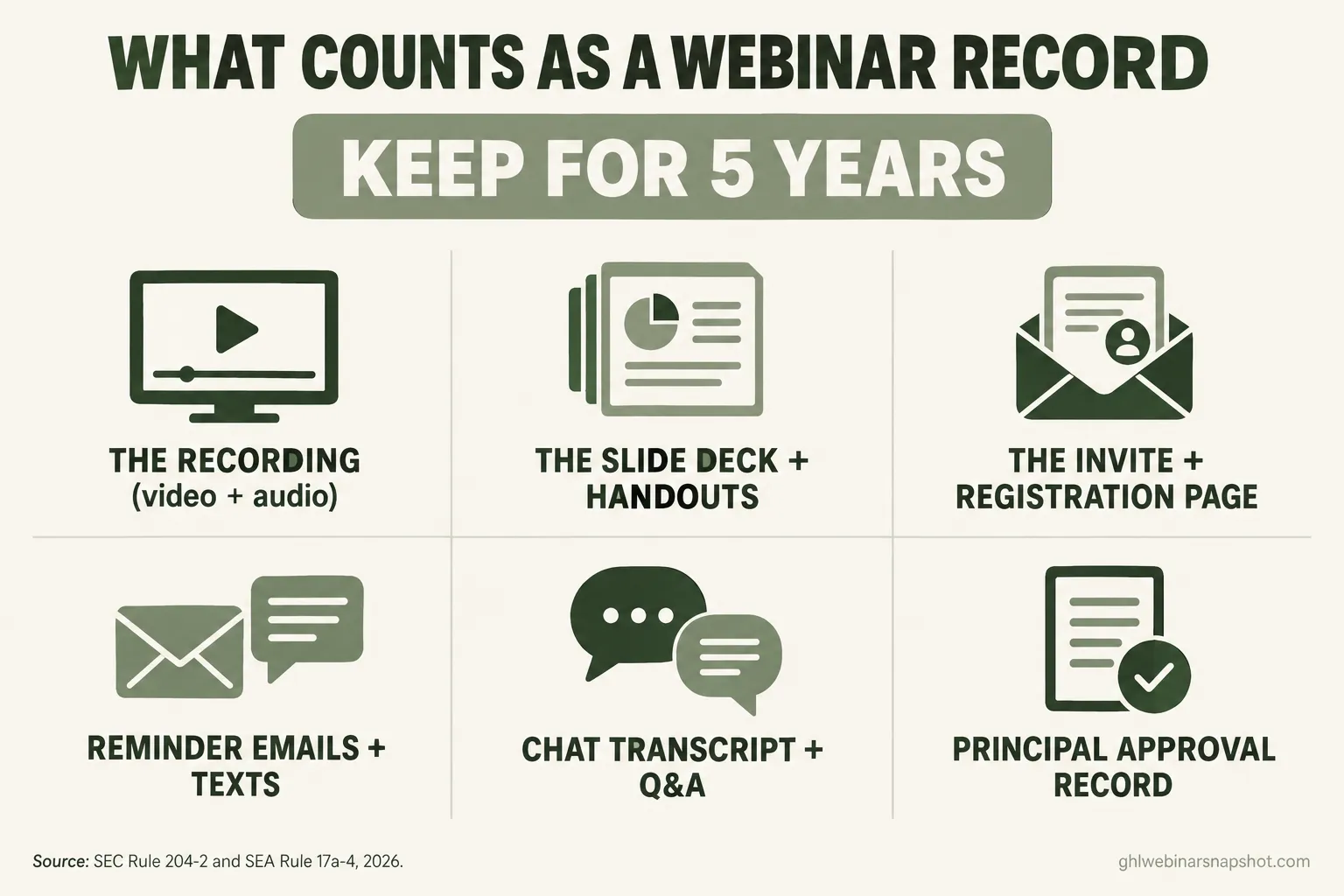
For RIAs, SEC Rule 204-2 requires copies of advertisements, including recorded material tied to an oral advertisement, for at least five years, the first two in an easily accessible place, plus documentation supporting any performance claims. For broker-dealer reps, SEA Rule 17a-4 sets the regime that FINRA Rule 2210(b)(4) points to, and the approval record travels with the communication.
So the webinar video, deck, invite, registration page, chat transcript, and Q&A all need to be captured and stored, not left to expire inside a webinar platform’s short retention. A chat question you answer with specific advice may be a record too.
Rule 5: The reminder layer still applies
The securities rules sit on top of the same communication laws every webinar host faces.
Your SMS reminders fall under the TCPA, which wants prior express written consent for marketing texts at $500 to $1,500 per message, plus A2P 10DLC registration or carriers filter your texts. Reminder emails fall under CAN-SPAM: real postal address, honest subject line, working opt-out. And because you handle nonpublic financial information, your registrant data sits under Regulation S-P and GLBA safeguards, so that list is not data to treat casually.
We go deep on texts in the SMS compliance guide and on email in the webinar email sequence breakdown, with the general-operator version of these laws in our webinar compliance overview. For advisors: capture consent cleanly, register your A2P campaign, honor STOP instantly, and protect the registrant list.
Disclosure: the link above is an affiliate link, and we may earn a commission at no extra cost to you. GoHighLevel is a marketing and CRM tool, not a certified SEC or FINRA recordkeeping archive, so confirm your retention with your firm.
The same rules at three sizes
The rulebook does not change with size, but which part bites hardest does.
The solo RIA or financial coach. Exposure is concentrated in testimonials and performance language, because you are the face making every claim. Prioritize clean testimonial disclosures, a ban on projected returns in open webinars, and a real place to store recordings for five years. A financial coach who is not a registered adviser sidesteps the securities rules, but the FTC still polices deceptive earnings claims, so the “fair and balanced” habit still protects you.
The advisor at a broker-dealer, or a small RIA with a few reps. Exposure widens to the approval workflow. Every invite, deck, and replay needs principal sign-off before use, and that is the step people skip under deadline pressure. Prioritize a 72-hour principal review window on the calendar, a documented approval record on every piece, and a shared archive compliance can reach.
The enterprise wealth or advisory marketing team. Everything is a volume and oversight problem now. Running webinars across many advisors multiplies the chance one unapproved deck or undisclosed testimonial slips through. Prioritize a pre-approved template library, promoter agreements for paid referral channels, audited consent capture with timestamps, and legal review of any evergreen webinar whose “live” performance language goes unchecked.
Across all three the throughline is the same: compliance cannot be a person remembering the right thing eight minutes before showtime. It is a system that approves before use, discloses at display, and archives automatically.
Objections, answered
“I’m a tiny shop. Do examiners really care about my webinar?” Size is not the shield you want. The 2024 sweep and the 2025 risk alert both targeted ordinary advisers, and the deficiencies cited are exactly the ones a small advisor makes on a webinar. At your size the fixes are cheap and mostly one-time.
“My webinar is live and spontaneous. Isn’t that a public appearance with no pre-approval?” The live talk, yes. But the invite, registration page, and slides are separate retail communications that still need approval before use. You can speak extemporaneously and still owe a principal review on everything scripted.
“Can I even use client testimonials, or is that still banned?” You can, since November 2022, but only with the required disclosures shown clearly and at the same time as the testimonial. The ban is gone; the disclosure obligation replaced it, and that is where advisors keep getting caught.
“Isn’t this my compliance department’s job, not mine?” Compliance supervises, but presenting fairly and routing material for approval is on you. A principal cannot approve a deck they never received. Make their job easy: send everything early.
FAQ
Does a financial advisor need compliance approval for a webinar?
The live, unscripted talk is generally a public appearance under FINRA Rule 2210, which needs supervision but not pre-use approval. The invite, registration page, deck, handouts, and replay are retail communications when shown to more than 25 retail investors in 30 days, and a principal must approve those before use. RIAs follow the SEC Marketing Rule, which treats most client-attracting webinars as advertisements.
Can RIAs use client testimonials in a webinar?
Yes, since the Marketing Rule compliance date of November 4, 2022. But any testimonial, including a praise comment in your live chat that you display or reuse, needs a clear and prominent disclosure of whether the speaker is a client and whether they were paid. The SEC's 2025 risk alert found missing or buried disclosures the most common violation.
How long do I have to keep a webinar recording?
For RIAs, SEC Rule 204-2 requires advertisements, including recorded material, to be kept at least five years. Broker-dealers follow the SEA Rule 17a-4 regime that FINRA Rule 2210 points to. Keep the video, deck, invite, chat, and approval record, not just the recording.
What is the difference between a public appearance and a retail communication?
A public appearance is a live, unscripted talk. It must meet content standards but needs no pre-use approval. A retail communication is written or recorded material, like a deck, invite, script, or replay, shown to more than 25 retail investors in 30 days, and it needs principal approval before first use.
Do TCPA and CAN-SPAM apply to advisor webinars too?
Yes. The securities rules sit on top of the usual communication laws. SMS reminders need TCPA consent and A2P 10DLC registration, reminder emails need CAN-SPAM compliance, and your registrant list falls under Regulation S-P and GLBA safeguards.
I'm a financial coach, not a licensed advisor. Do these rules apply to me?
If you are not a registered adviser or broker-dealer rep, FINRA Rule 2210 and the SEC Marketing Rule do not apply. But the FTC still prohibits deceptive earnings claims, so the fair-and-balanced habit still protects you. If your content crosses into specific investment advice, get a legal read.
By the time your webinar starts, the compliance work should be done: deck approved, disclosures on the slides, archive ready for the recording. Then you run the webinar you planned, not the one your compliance officer dreads.
About the author
Derek Haywood is a GoHighLevel Automation Engineer based in Denver, CO. A former B2B SaaS sales engineer, he builds the plumbing behind webinar funnels: the triggers, tags, consent capture, approval routing, and reminder cadences that keep a launch running on its own. He is not an attorney and nothing here is legal advice.
Related reading
- Webinar Compliance in 2026: The 5 Laws That Can Bite You
- SMS Reminder Compliance for Webinars (TCPA + A2P 10DLC, Plain English)
- The Webinar Email Sequence That Fills the Room
- What Webinar Software Actually Costs in 2026: A Pricing Teardown
- Multi-Touch Attribution for Webinars: Track What Actually Books the Call
Sources
- FINRA, Rule 2210: Communications with the Public.
- FINRA, Advertising Regulation FAQ.
- U.S. Securities and Exchange Commission, Investment Adviser Marketing: Small Entity Compliance Guide.
- Cornell Legal Information Institute, 17 CFR § 275.206(4)-1 (Marketing Rule).
- U.S. SEC, Additional Observations Regarding Advisers’ Compliance with the Marketing Rule (December 16, 2025 risk alert).
- U.S. SEC, SEC Charges 9 Advisers for Marketing Rule Violations ($1.24 million in penalties, 2024).
- Cornell Legal Information Institute, 17 CFR § 275.204-2 (adviser records, five years).
- Cornell Legal Information Institute, 17 CFR § 240.17a-4 (broker-dealer records).
- Cornell Legal Information Institute, 47 U.S.C. § 227 (TCPA).
- U.S. Federal Trade Commission, CAN-SPAM Act: A Compliance Guide for Business.
- Content Marketing Institute / MarketingProfs, B2B Content Marketing 2026.