
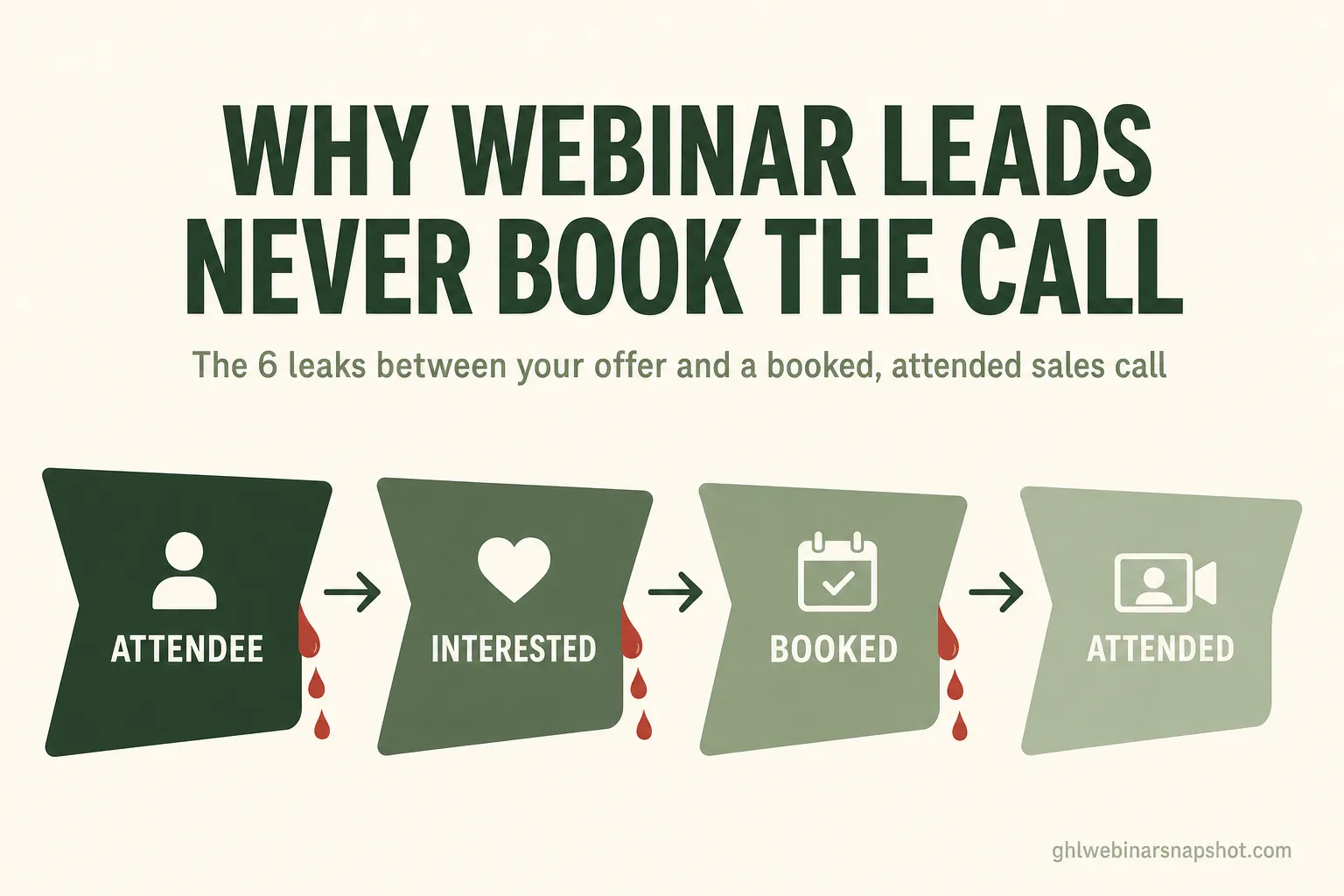
It is Wednesday night and the webinar just ended. People stayed past the hour, the chat kept scrolling, and one even asked about pricing out loud. You close your laptop sure the calendar will fill by morning. Then it’s Friday, and your booking page has two new calls on it, maybe. One will reschedule. The dozen people who sounded ready on Wednesday have gone quiet. You did the hard part, got them to show up and watch the whole thing, and the easy part, where they click a link and pick a time, somehow did not happen.
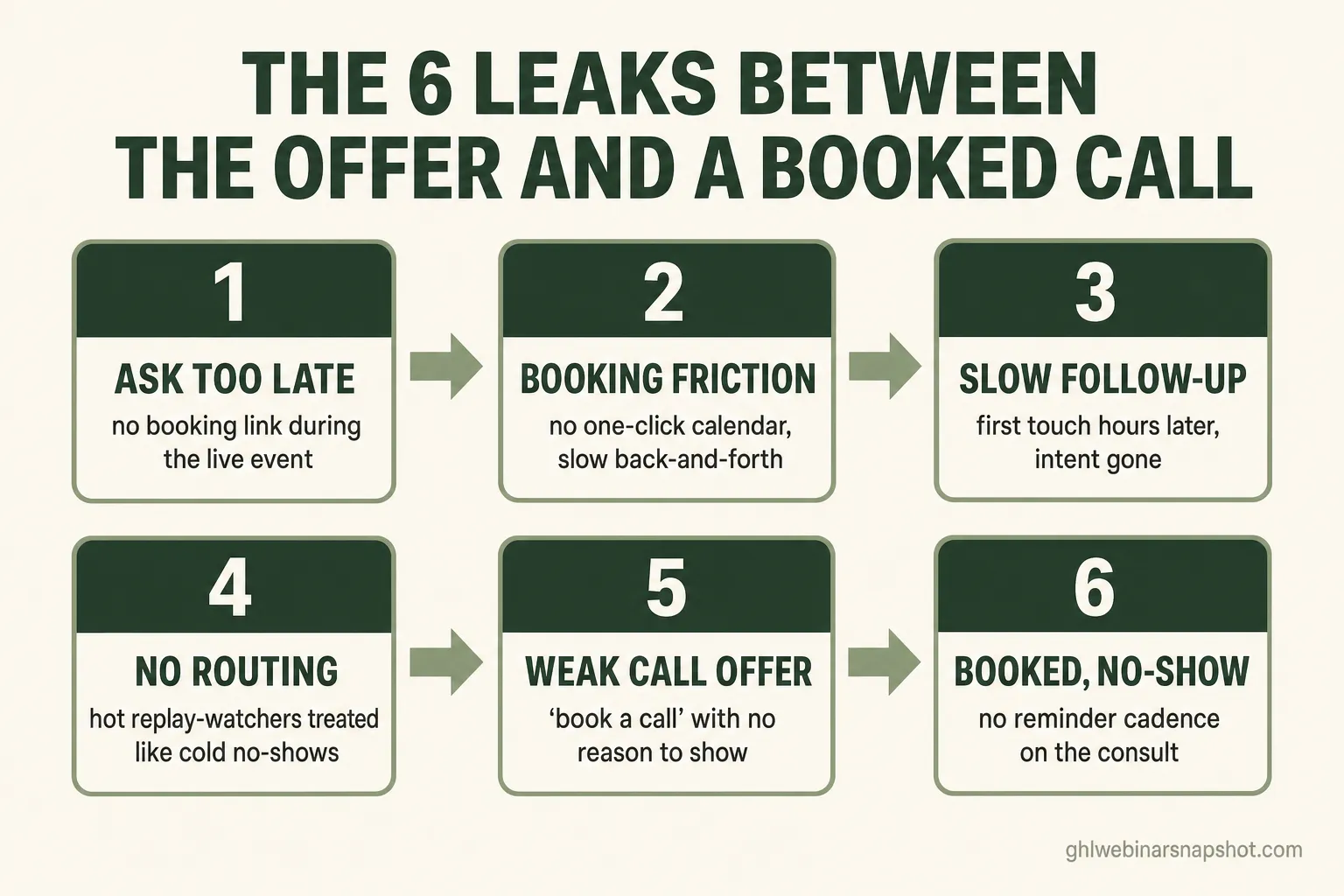
Here is the short answer: your leads don’t book because the path from “I’m interested” to “call confirmed” is too long, too slow, and too easy to abandon. Interest is perishable. The moment someone feels it is the moment they’ll act, and if you make them wait until a follow-up email the next day, you collect them at a fraction of the intent they had live. This guide walks the six leaks between your offer and a booked, attended call, with the fix and the steal-this copy for each.
Table of contents
- What it costs you when leads don’t book
- Why the booking window closes
- Leak 1: You wait until after the webinar to ask
- Leak 2: The path to the calendar has friction
- Leak 3: Your follow-up is too slow
- Leak 4: You treat every attendee the same
- Leak 5: The call has no reason to exist
- Leak 6: The booked call never happens
- The same problem at three sizes
- The compliance line you cannot skip
- Objections, answered
- FAQ
What it costs you when leads don’t book
Put real numbers on it and the leak stops looking small. Say you spend $2,000 to fill a room, 200 people register, and around half show up live, so 100 hear your offer. Every attendee who leaves without a call on the calendar is a piece of that $2,000 walking out the door.
These are not cold leads. They are the warmest people you will touch all month, and they cost far more to create. Webinars are not a side channel either. In the 2026 B2B content research, 52% of marketers rated speaking events and webinars among their three most effective channels, behind only LinkedIn and email. When your best channel leaks its best leads at the final step, that is the business bleeding out.
Why the booking window closes
Buying intent spikes when you move from teaching to the offer, and from that peak it decays fast. The person who felt “I need this” at minute 48 barely feels it by the weekend.
The hard data comes from sales response research. In a study of more than 15,000 leads, the odds of contacting a lead fell by more than 10 times within the first hour, and the odds of qualifying one by more than 6 times. Wait 30 minutes instead of 5 and the odds of contact drop 100 times, the odds of qualifying 21 times. A web form, not a webinar, but it transfers: a lead’s value is highest in the first minutes and collapses from there. The whole job is to shorten the distance between the intent spike and the booked call.
Relative odds of qualifying a lead by response speed, indexed to the 30-minute case. Source: Dr. James Oldroyd / InsideSales.com Lead Response Management Study, 2007.
Leak 1: You wait until after the webinar to ask
This is the big one. Most operators teach for an hour, make the offer, say “book a call, link’s in the follow-up email,” and end the stream. The email goes out that evening, by which point the spike is gone. You asked for the biggest action at the one moment the person could not take it.
The fix: make the call bookable while you are still live. Drop the booking link into the chat the moment you move to the offer, put it on screen, and say it out loud. People book during the Q&A, when intent peaks and there is dead air to fill.
Steal this in-event booking push (say it live, at the offer):
If what I just showed you is something you want help with, here’s your next step. There’s a link in the chat right now. It opens my calendar and you pick a time, takes thirty seconds. Do it while we’re still here, because the people who book live are the ones who follow through. I’ll keep answering questions while you grab a slot.
How this breaks: the link goes to a page that asks for ten fields or makes them “request a time.” The ask has to resolve inside the webinar’s attention span, or you have reintroduced the delay.
Leak 2: The path to the calendar has friction
Even when operators ask at the right time, they route the yes through a slow door. “Reply to this email and we’ll find a time” turns a thirty-second decision into a three-day negotiation that dies in two busy inboxes. Every extra step between “yes” and “confirmed” is a place the lead falls out.
The fix: one link, real open slots, instant confirmation. The attendee clicks, picks from your real availability, and gets a confirmation on the spot with the call on both calendars. Tools like Calendly do this, and a GoHighLevel calendar does it while keeping the booking, the contact record, and the reminders in one place. Our playbook on booking sales calls from webinars covers the full flow.
How this breaks: the calendar shows no availability for eight days. A hot lead who clicks and sees “next Thursday” cools right back down. Keep same-week slots open.
Leak 3: Your follow-up is too slow
For attendees who did not book live, the follow-up is your second shot, and most operators waste it by being slow. The recap email goes out at 6pm “when I get a chance,” and the person who was ready at noon has moved on. You saw the numbers: waiting even 30 minutes cuts the odds of qualifying a lead 21 times.
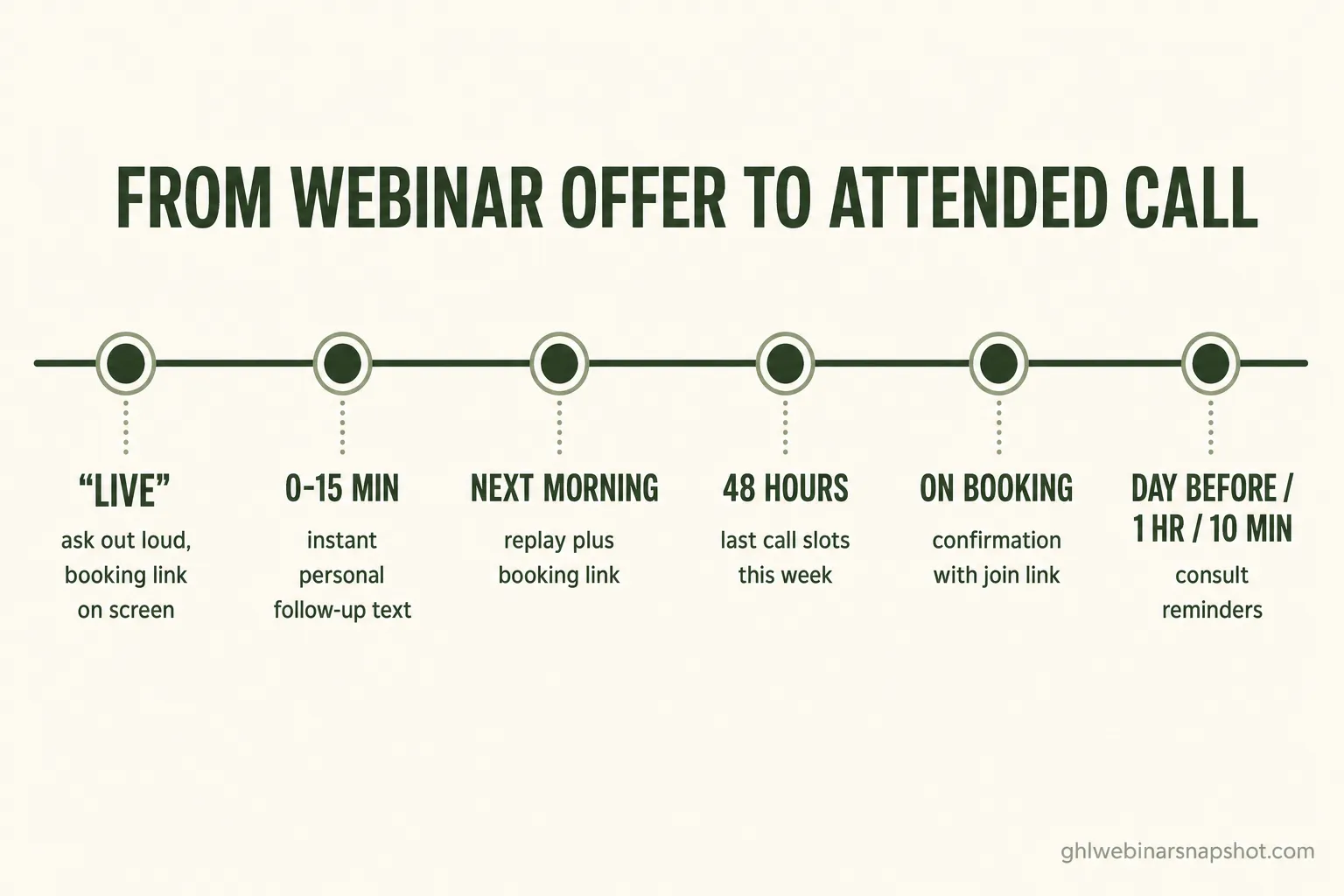
The fix: the first follow-up fires within minutes of the webinar ending, automatically, not when you get to it. It names what they just watched and gives them the same one-click link, then a short cadence catches the ones who did not act.
Steal this follow-up cadence (text, consented contacts only):
Within 15 minutes: “[First name], thanks for staying to the end of [webinar title]. If you want to map out [the specific outcome] for your business, here’s my calendar: [link]. Reply STOP to opt out.”
Next morning: “[First name], the replay and the [resource] from yesterday are here: [link]. If you’re weighing whether [the outcome] is doable, that’s what the call is for. Grab a time: [link].”
48 hours later: “[First name], I’m holding a couple of call slots this week for people from [webinar title]. After that my calendar is back to normal. Want one? [link].”
How this breaks: the fast follow-up reads like a mass blast. A text that lands in four minutes but opens with “Dear valued registrant” tells them a robot sent it, and kills the warmth you just built.
Leak 4: You treat every attendee the same
A webinar produces wildly different people. Someone who attended live, stayed to the end, and watched 90% of the replay is nothing like someone who registered, no-showed, and never opened an email. Send them the same nudge and you nag the cold ones into unsubscribing while failing to escalate the hot ones into a conversation.
The fix: tag behavior and route on it. Attendance, watch time, replay opens, and booking-link clicks should all mark the contact record. The hottest segment, long watch time plus a booking-link click but no booking, is where a human steps in today. The GoHighLevel build is behavioral tagging feeding a simple lead score, which our webinar lead scoring guide lays out step by step, and the replay-tag pipeline surfaces the replay watchers who are quietly your best buyers.
How this breaks: you score the leads and nobody acts on the score. A tag that says “hot, clicked but didn’t book” is worthless if it does not trigger a call. The routing is the point, not the tag.
Leak 5: The call has no reason to exist
“Book a call” is a terrible offer. It asks for thirty minutes and tells the attendee nothing about what they get for it. In their head a “call” means a pitch and an awkward exit, so even interested people decline because the downside feels bigger than the vague upside.
The fix: give the call a name, an outcome, and a reason to happen now. “Book a call” becomes “grab your 20-minute [topic] game plan, where we map the exact next three steps for your situation.” ON24’s engagement research found personalized, relevant webinar experiences drove roughly four times more demo requests and a 48% higher call-to-action conversion rate. Relevance turns a watcher into a booker.
Steal this reframed offer (say it live and put it in the follow-up):
This isn’t a sales call. It’s a 20-minute [outcome] session. You tell me where you’re stuck, I’ll map the three moves that matter most for your situation, and you walk away with a plan whether or not we work together. I’ve got a handful open this week for people who were here live.
How this breaks: you promise a “free plan” and then run a hard pitch. Do that once and your show rate collapses. Name it a planning session and deliver one.
Leak 6: The booked call never happens
This is the leak nobody counts because it hides as a win. The call got booked, so the dashboard looks healthy, and then the prospect does not show. A booked call with no reminder cadence is the same no-show problem you solved for the webinar, one step later.
The fix: the consult gets its own reminder machine, every reminder carrying the join link: a confirmation when they book, a reminder the day before, the morning of, an hour out, and ten minutes before. When someone misses it anyway, an instant, warm rebooking message beats a cold “you missed your call” every time.
Steal this booked-call reminder cadence and no-show recovery:
On booking: “You’re confirmed for [day] at [time + time zone]. Here’s your link: [link]. Add it to your calendar: [calendar link].”
1 hour before (SMS): “[First name], our [outcome] session is in an hour, at [time]. Here’s the link: [link]. Reply STOP to opt out.”
No-show, within 10 minutes: “[First name], I had you down for [time] and didn’t want to miss you. Things come up. Here’s my calendar to grab another time this week: [link].”
Our guide to using AI for webinar follow-up covers how an AI assistant runs this rebooking in seconds, and the no-show recovery playbook extends the logic to registrants who never showed live.
How this breaks: the reminders stop once the call is booked, as if booking were the finish line. It isn’t. “Booked” to “attended” leaks exactly like “registered” to “live.”
The same problem at three sizes
The six leaks are universal. What changes is how you plug them.
The solo coach or course seller. You are the host, the sales team, and the ops department, so the in-event booking link and the automatic follow-up are the only way calls get booked at all. Wire them in once and let them run every launch. Your biggest single move is Leak 1: ask for the call live, out loud, every time. You’ll book more from a 60-person room with a live ask than a 200-person room you chase on Monday.
The coach or creator with a small team. You can afford a human on the hot segment, so Leak 4 is where your money is. Automate the tagging and the base cadence, then put a real person on the “watched a lot, clicked, didn’t book” list the same day, in lead-score order.
The B2B demand-gen team. Your calls feed a pipeline, so the leaks that hurt most are attribution and speed-to-lead. A registrant who books, shows, and later closes has to trace cleanly back to the webinar, or you under-fund your best channel. Route booking-link clicks to sales instantly and hold same-week slots. Our B2B webinar demand generation system and the multi-touch attribution guide connect the booked call to closed revenue.
The compliance line you cannot skip
The moment your follow-up and reminder cadence include text messages, you are in regulated territory, and “it’s just a booking reminder” is not a defense.
SMS needs documented consent. In the US, follow-up and reminder texts require express consent from each registrant, and for most senders a registered A2P 10DLC campaign to deliver them at scale. A webinar registration by itself is not consent to text unless your form captured it clearly, and every message must honor opt-outs like the STOP line above. The plain-English version lives in our SMS reminder compliance guide.
Email falls under CAN-SPAM. Your follow-up emails need accurate subject lines, honest sender details, a physical mailing address, and a working unsubscribe link, with no exception for business-to-business email. None of this is legal advice, so confirm your setup with a qualified source.
Objections, answered
“Won’t an instant text after the webinar feel pushy?” Only if it reads like a machine. A text that lands in four minutes, names the webinar they watched, and offers a concrete next step reads as attentive, not aggressive.
“I already use Calendly, isn’t that enough?” A booking tool solves Leak 2 and nothing else. It does not ask for the call live, fire the minutes-later follow-up, tag who watched the replay, or chase the booked call. Calendly is the door; the leaks are everything around it.
“My sales team handles follow-up, why automate it?” Because a human cannot text every attendee four minutes after the webinar ends while also running calls. Automate the instant touch and the base cadence, then point your humans at the hot segment.
“Do I need to be technical?” No. The pieces are a calendar with real availability, behavioral tags, and a reminder cadence, all off-the-shelf features in GoHighLevel and similar platforms. You wire them together once or import a prebuilt system. You are configuring, not coding.
FAQ
Why do my webinar leads watch the whole thing and then never book a call?
Buying intent peaks at the offer and decays fast, and most funnels ask for the call after it has cooled. If the link only appears in a follow-up email that evening, you collect leads at a fraction of their live intent. Ask while you are still on screen and follow up within minutes.
When should I ask attendees to book the sales call?
Live, the moment you move from teaching to the offer. Drop a one-click booking link in the chat and on screen and tell people to grab a slot during the Q&A, when intent is highest. Everyone who does not book live goes into a fast cadence starting within 15 minutes of the end.
How fast does follow-up speed actually matter?
A lot. Research on more than 15,000 leads found the odds of qualifying a lead drop 21 times when you wait 30 minutes instead of 5. The first follow-up should fire automatically within minutes of the webinar ending, not when you get to it.
People book calls and then don't show up. How do I fix that?
Treat the booked call like the webinar: give it a reminder cadence. Confirm on booking, remind the day before, the morning of, an hour out, and ten minutes before with the join link. When someone still misses it, send a warm rebooking text within ten minutes.
Do I need consent to text webinar attendees a booking link?
Yes. In the US, follow-up and reminder texts require express consent captured clearly at registration, and most senders need a registered A2P 10DLC campaign to deliver them. Every message must honor opt-outs. This is general information, not legal advice, so confirm your setup with a qualified source.
About the author
Priya Shankar is a Course Launch and Conversion Coach based in Seattle, WA. She works with course creators and founders who teach to sell, and thinks as much about the offer and the room energy as the automation underneath it. She writes about turning webinar attendees into booked, attended sales calls.
Related reading
- How to Book Sales Calls From Webinars: The Attendee-to-Consult Playbook
- Webinar Lead Scoring: How to Call the Right Buyers First
- The Replay-Tag Pipeline: Surface Hot Buyers Without Scrubbing CSVs
- Webinar No-Show Recovery: Win Back the Registrants Who Didn’t Attend
- How to Use AI for Webinar Follow-Up (2026 Playbook)
Sources
- Dr. James Oldroyd / InsideSales.com, Lead Response Management Study (2007; 100x contact and 21x qualify drop at 30 min vs 5 min).
- Livestorm, 2026 Webinar Benchmark Report (51.3% average live show-up rate).
- Content Marketing Institute and MarketingProfs, B2B Content and Marketing Trends for 2026 (52% rate speaking events and webinars a top-three channel).
- ON24, Digital Engagement Benchmarks Report (personalized webinars: ~4x demo requests, 48% higher CTA conversion).
- U.S. Federal Trade Commission, CAN-SPAM Act: A Compliance Guide for Business.