
It is 2:15pm and your product webinar just wrapped. Four hundred people registered, a little over two hundred showed, and the chat was loud. Your marketing lead drops a thumbs-up in Slack: “great turnout.” Then nothing happens. The recording goes out the next morning, a CSV of registrants lands in someone’s inbox, and three weeks later a rep asks where the pipeline from that webinar is. Nobody has a clean answer.
That gap, between a full room and a filled pipeline, is where most B2B webinar programs quietly lose their budget.
Here is the short answer: a B2B webinar is a demand-generation engine, not an event, and the engine has seven stages. A registration page that qualifies, a reminder cadence busy buyers answer, a live session built to produce buying signals, scoring that sorts attendees by fit and behavior, a handoff that reaches hot leads in minutes instead of days, a recovery loop for the half who never showed, and attribution that ties a name on the form to a closed deal. Miss any stage and the whole thing leaks. This guide walks all seven, with the copy and routing rules to put to work before your next session.
Table of contents
- What a broken handoff costs you
- The seven-stage system
- Stage 1: A registration page that qualifies
- Stage 2: The reminder cadence buyers answer
- Stage 3: A live session that produces signals
- Stage 4: Score attendees by fit and behavior
- Stage 5: The minutes-fast handoff
- Stage 6: The no-show and replay loop
- Stage 7: Attribution to closed pipeline
- The same system at three company sizes
- Compliance for the reminder layer
- Objections, answered
- FAQ
What a broken handoff costs you
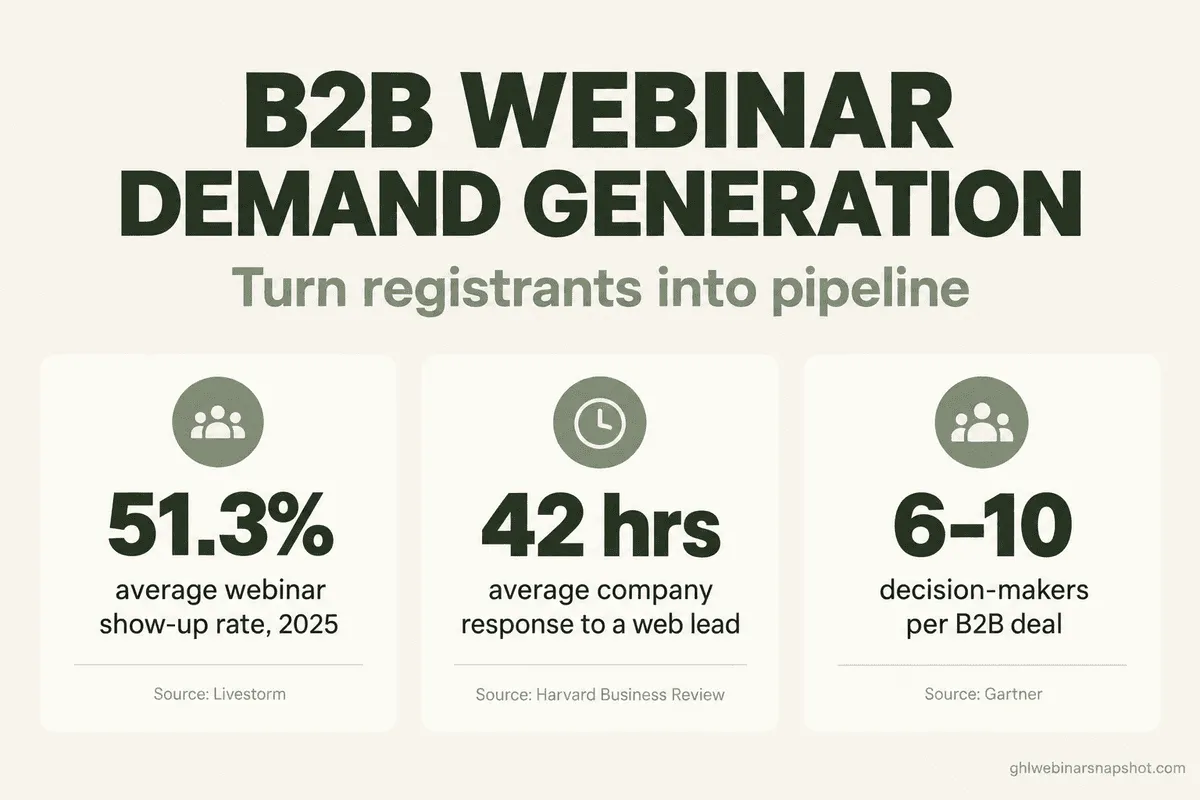
Four hundred register, about half show up live (the 2025 benchmark is 51.3%), and say forty attendees are a real fit who showed obvious interest. If your follow-up is a next-day email and a CSV handed to sales, those forty moments of intent expire while they sit in the list. The HBR number works against you: the average company takes 42 hours to respond to an inbound lead, and nearly a quarter never respond. Add the committee problem: Gartner puts a typical buying group at six to ten people, so treating a registrant as “a lead in a CSV” rather than “an account in motion” misses the timing that matters most.
How fast companies respond to inbound web leads. Source: Harvard Business Review, “The Short Life of Online Sales Leads” (audit of 2,241 U.S. companies).
The seven-stage system
A demand-generation webinar treats the live event as the middle of the process, not the end. Here is the whole path, with the one job each stage owns.
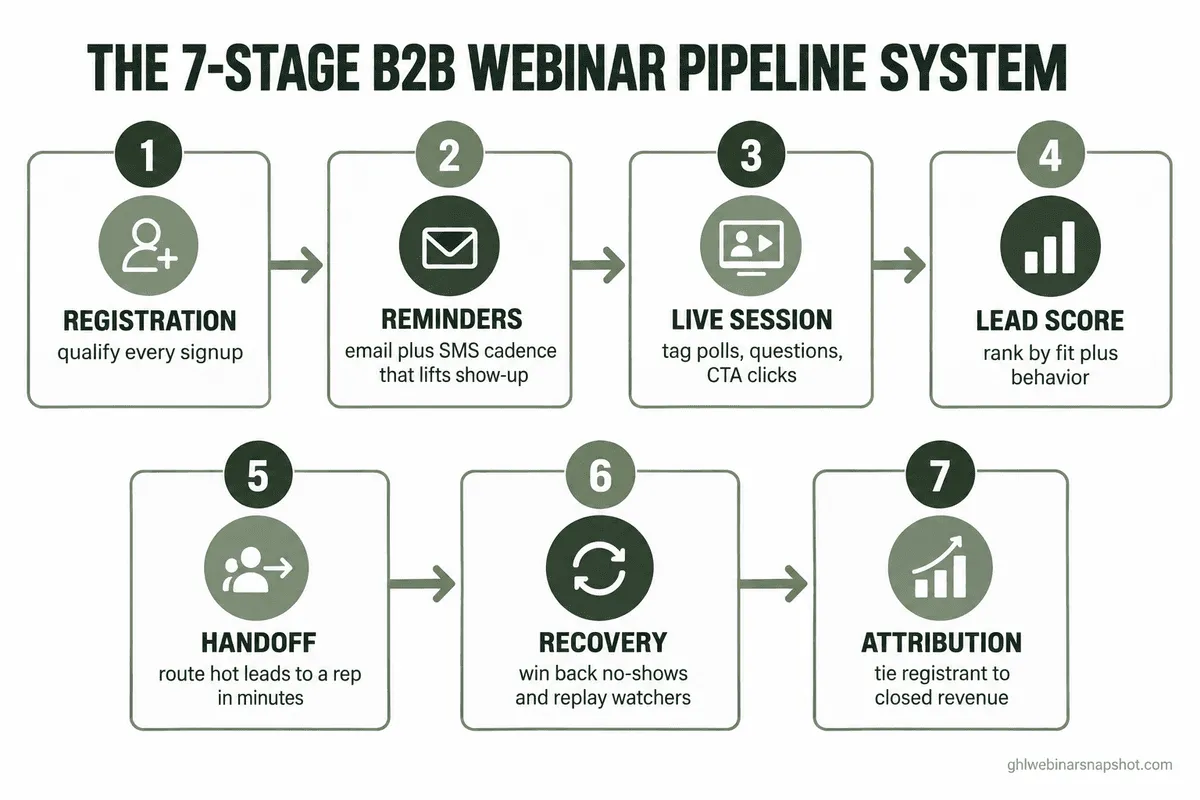
The stages run in order, and the data flows through all of them in one place. On our side that place is GoHighLevel, which holds the forms, workflows, behavior tags, lead score, routing, and booking calendar together, so a signal captured in stage three can fire a routing rule in stage five without a CSV leaving the building. You can wire the same logic across a stack of point tools; it is just more plumbing.
Stage 1: A registration page that qualifies
The registration page does two jobs: it converts a visitor into a registrant, and it tells you who that registrant is. Most B2B pages do the first and skip the second.
Ask for a work email and company name, then add one or two qualifying fields that map to how you score fit: company size, role, or the problem they came to solve. Those fields become the raw material for stage four.
Steal this field set for a B2B product webinar:
- Work email (block free inboxes if your motion requires it)
- Company name
- Role (dropdown: IC / Manager / Director / VP+ / Founder)
- Team size (dropdown: 1-20 / 21-100 / 101-500 / 500+)
- “What are you hoping to solve?” (optional, gold for the rep)
How it breaks: you ask for ten fields and conversion falls off a cliff, or you ask for nothing and cannot tell a student from a VP of Sales. Keep three to five fields that each earn their place in scoring. See our webinar conversion funnel breakdown for where registrants leak.
Stage 2: The reminder cadence buyers answer
A B2B buyer registers on Monday and forgets by Thursday. The reminder cadence beats that, and it is the highest-return move you can make for show-up rate. A cadence that respects a working professional’s inbox:
- Instant: confirmation email with the calendar file and a one-line “here is what you’ll walk away with.”
- 1 day before: short email reminding them why they signed up.
- 1 hour before: email plus SMS (only to people who opted in), with the join link front and center.
- At go-live: SMS, “we’re live, here’s your link.” Often your biggest show-up lever.
Steal this go-live SMS:
You’re in. [Webinar name] is live now. Join here: [link]. Reply STOP to opt out.
For the full email side, including no-show and replay messages, see our nine-email webinar sequence.
How it breaks: teams send one reminder and call it done, or blast SMS to people who never consented, which gets numbers blocked by carriers and breaks the law. Reminders and compliance are the same project, covered below.
Stage 3: A live session that produces signals
This is where demand-gen webinars diverge hardest from educational ones. Attendance is a weak signal, because someone can leave a webinar running in a background tab. Engagement separates a tire-kicker from a buyer, so instrument the session so every meaningful action becomes a tag:
- Watched past the midpoint
- Answered a poll
- Asked a question in chat or Q&A
- Clicked the in-session CTA (a demo link, pricing page, resource)
- Stayed to the end
Steal this poll question to surface intent without feeling like a sales screen:
Where are you with solving [problem] today? (a) Just researching (b) Comparing tools (c) Ready to move this quarter
Answer (c) is a buying signal you route differently from answer (a). That one poll sorts better than a dozen form fields.
How it breaks: the webinar is a pure lecture, so you leave with attendance data and nothing else. Or the signals stay inside the webinar platform and never reach your CRM. Build two or three interaction points on purpose, each writing back to the record.
Stage 4: Score attendees by fit and behavior
Combine what you learned at registration (fit) with what you saw live (behavior) into one number that tells a rep who to call first. A VP who answered “ready to move this quarter” and clicked the demo link is not the same lead as a freelancer who half-watched the replay. A simple additive model works.
A starter webinar lead score
| Feature | Signal | Points |
|---|---|---|
| Target role (Director / VP+ / Founder) | Fit | +20 |
| Team size 101-500 or 500+ | Fit | +15 |
| Poll: 'ready to move this quarter' | Behavior | +25 |
| Clicked the in-session demo CTA | Behavior | +20 |
| Stayed past the midpoint | Behavior | +10 |
| Free email / student / competitor | Fit | -20 |
Route on the total: 50+ goes straight to a rep as hot, 25 to 49 to an SDR-worked nurture, under 25 stays in marketing nurture. The numbers are yours to tune; the discipline is one score applied the same way every time. Our webinar lead scoring guide extends it.
How it breaks: the score lives in a spreadsheet a human updates by hand, so it is stale before anyone acts. Or every attendee is treated as equally hot, so reps burn their best hours on people who were never going to buy. The score must be automatic and drive the next stage.
Stage 5: The minutes-fast handoff
This stage makes or breaks the system, and most teams do it worst. The only question is how many minutes pass before a human reaches out to a scored, ready-to-buy attendee. The HBR audit is the warning: the average firm takes 42 hours, and nearly a quarter never respond. Being fast is a real edge your competition is handing you.
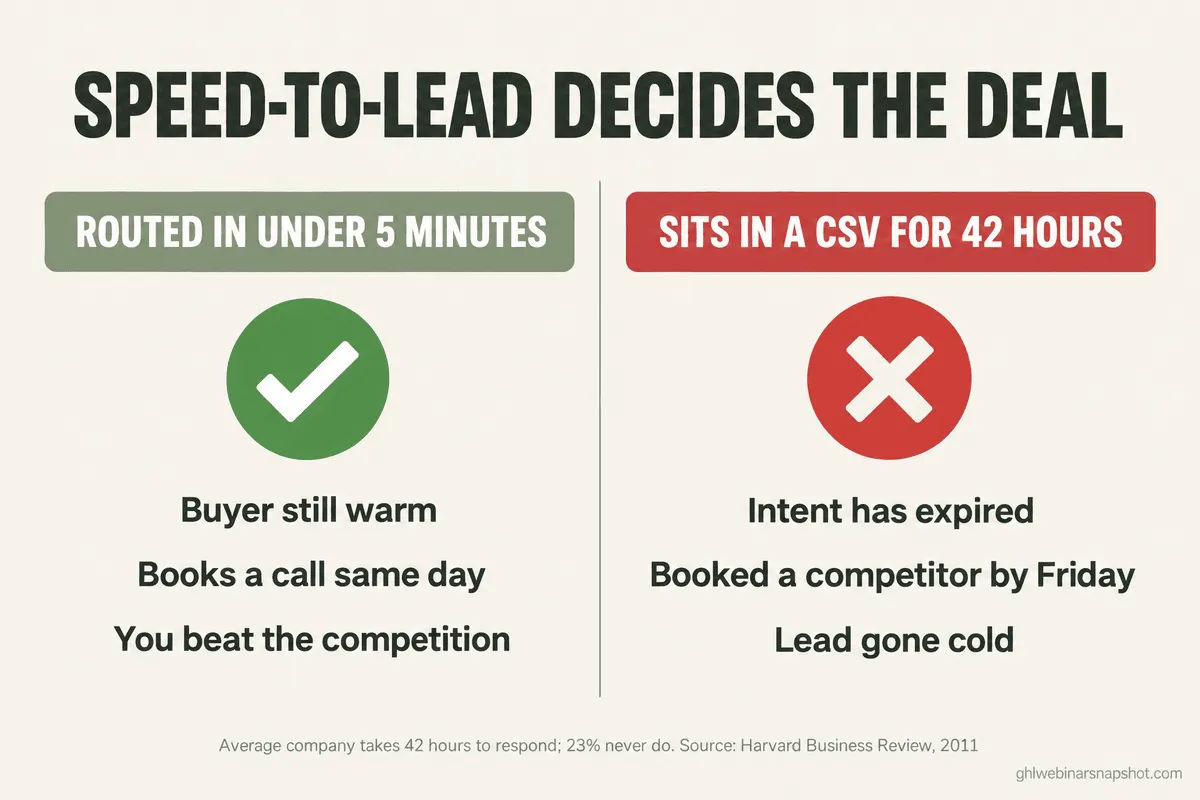
The handoff is a routing rule, not a meeting. When a contact crosses the hot threshold, the system should, within seconds:
- Assign the lead to the right rep (round-robin, by territory, or by named account for ABM).
- Notify that rep where they work: a Slack or SMS alert, not a buried CRM task.
- Hand over the context: registration answers, poll response, what they clicked.
- Offer the attendee a booking link while warm, in the session and in the first follow-up.
Steal this internal rep alert:
🔥 Hot webinar lead: Jordan Lee, VP Sales @ Northwind (210 employees). Answered “ready to move this quarter,” clicked the demo CTA. Score 75. Call within 5 min. Context + booking link in CRM.
Steal this attendee follow-up, sent in minutes, not tomorrow:
Hi Jordan, thanks for the great question about [topic] today. You mentioned you’re looking to move this quarter. Grab 20 minutes here and I’ll show you exactly how [product] handles that: [booking link].
How it breaks: the lead sits in a list until someone exports it, or there is no assignment rule so a hot lead bounces between reps and nobody owns it. The full playbook: booking sales calls from webinars.
Stage 6: The no-show and replay loop
With the 2025 show-up rate at 51.3%, no-shows are the larger half who cared enough to sign up. Treat them as a second pipeline, not a lost cause. The recovery loop runs automatically off the attended-or-not tag:
- No-show, within an hour: “Sorry we missed you, here’s the replay,” with the same booking link attendees got.
- Replay watchers get scored too. A no-show who watches 60% of the replay and clicks the CTA is a buying signal; route them like a warm attendee.
- One more nudge at 48 hours for people who opened but did not watch, then standard nurture.
Instrument the replay like the live session, so a watch becomes a tag and the tag fires a rule. That is the replay-tag pipeline, where a lot of quiet pipeline hides. For the full win-back system, see webinar no-show recovery.
How it breaks: the replay goes out as a one-and-done email with no tracking, so you never learn who watched, or no-shows get dumped into the same nurture as a cold signup.
Stage 7: Attribution to closed pipeline
The last stage keeps your budget. If you cannot show which closed deals touched a webinar, finance treats the program as a cost with no return.
Stamp every registrant with their source (which ad, email, or campaign drove them) and carry it forward from registrant to attendee to booked call to opportunity to closed deal. When a deal closes, you trace it back and say, honestly, “this webinar touched X opportunities worth Y.” That is the sentence that renews your budget.
How it breaks: the webinar platform knows who registered, the CRM knows who became a deal, and nothing connects the two, so the contribution is invisible. Or last-touch attribution hands all the credit to the final demo and erases the webinar that started it. Use a multi-touch view for a format that sits mid-cycle. See multi-touch attribution for webinars.
The same system at three company sizes
The seven stages do not change. How much machinery you put behind each one does.
The founder-led startup (you are marketer and half the sales team)
You run the webinar, answer the chat, and make the calls yourself, so your edge is speed with no handoff to slow you down. Keep scoring simple (fit plus “did they ask for a demo”), route every hot lead to your own phone, and book calls inside the session. Skip the enterprise routing matrix. Nail the reminder cadence and fast personal follow-up, and you will out-convert companies ten times your size.
The mid-size demand-gen team (20 to 500 people, a few SDRs and AEs)
This is where the full system pays off and most leaks live. Build real lead scoring, round-robin assignment with an SLA (“hot leads called within 5 minutes during business hours”), Slack alerts to the assigned rep, and multi-touch attribution to defend the budget. The no-show loop alone adds pipeline you were throwing away.
The enterprise ABM program (named accounts, a committee per deal)
Now the committee problem, six to ten decision-makers per deal, moves to the center, so you watch accounts more than individuals. Three registrants from one target account is a louder signal than thirty from random companies. Route by account owner, fold webinar engagement into account scoring, and roll attribution up to the account. The reminders and instrumentation are identical; only the scoring and routing gain an account layer.
Compliance for the reminder layer
The SMS reminders that lift show-up are regulated, with real teeth. This is operational guidance, not legal advice, so clear anything real with counsel.
TCPA and consent. The Telephone Consumer Protection Act requires express written consent before marketing texts, a clear standalone opt-in, and a working opt-out on every message. In practice, a specific checkbox on the registration form, not a pre-ticked box buried in your terms. The FCC’s guidance on unwanted texts is the plain-English start.
A2P 10DLC registration. To send business SMS to U.S. phones at scale, carriers require your campaign to be registered under the A2P 10DLC framework. Skip it and your reminders get filtered or blocked with no error message. Our webinar SMS compliance primer walks the setup.
CAN-SPAM on the emails. Every reminder and follow-up email needs a real physical address and a working unsubscribe you honor promptly, per the FTC’s CAN-SPAM guide.
Objections, answered
“We already get decent turnout. Isn’t follow-up the part that doesn’t matter?” Backwards. Turnout is the cheap win. The pipeline-shaped win lives in the four stages after the live session: scoring, the handoff, the recovery loop, and attribution. Great turnout with no follow-up system is a party you paid to throw.
“Won’t a text and a five-minute call feel pushy to a B2B buyer?” Not if the message references why they were there. “Thanks for the question about X, here’s 20 minutes to go deeper” continues a conversation the buyer started. Someone who answered “ready to move this quarter” wants you to reach out fast; speed reads as competence, not pressure.
“We run webinars on Zoom or GoTo. Do we have to switch platforms?” No. The room and the system are different layers, so keep whatever room you like. The system lives in your CRM and marketing automation. Our webinar tech stack guide compares the rooms.
“We’re a two-person startup. Is this overkill?” No. The machinery scales down, as the founder-led scenario shows: a small team needs the reminder cadence and fast personal follow-up, and nothing else.
The last word
Go back to the webinar from the top. Nothing was wrong with it; the system stopped at the applause. Build the seven stages, instrument the live session so engagement becomes data, and make the handoff a rule that fires in minutes. Then the next time a rep asks where the pipeline is, you will have a clean answer with names and numbers on it.
FAQ
What is B2B webinar demand generation?
Treating a webinar as a pipeline engine, not a one-off event. The system has seven stages: a registration page that qualifies, a reminder cadence that lifts show-up, a live session instrumented for buying signals, lead scoring, a fast sales handoff, a no-show recovery loop, and attribution that connects a registrant to closed revenue.
How fast should I follow up with a webinar lead?
Minutes, not days, for your hottest leads. A Harvard Business Review audit of 2,241 companies found the average firm took 42 hours to respond and 23% never did. Build an assignment rule and rep alert that fire automatically when a lead crosses your score threshold.
How do I score webinar attendees?
Combine fit (role and company size, from registration fields) with behavior (answering a poll, clicking the in-session CTA, staying to the end). Give each signal points and route on the total: high to a rep, medium to an SDR nurture, low to marketing nurture. The score must be automatic.
Is it legal to text webinar registrants reminders?
Yes, with consent and registration. The TCPA requires express written consent (a clear, standalone opt-in, best as a checkbox on the registration form) and a working opt-out on every message. Carriers also require A2P 10DLC registration to send business SMS at scale, or texts get filtered. Emails must follow CAN-SPAM. This is operational guidance, not legal advice.
What should I measure to prove a webinar drove pipeline?
Stamp every registrant with their source and carry it forward through attendee, booked call, opportunity, and closed deal, so you can trace revenue back to the webinar. Use multi-touch rather than last-touch attribution, because webinars usually sit mid-cycle.