
You ran the same webinar live for a year. Same slides, same offer, same close. It booked calls and it sold. So you turned it into an evergreen funnel, because you were tired of showing up at 2:00pm every Tuesday to say the same forty minutes out loud. You pointed ads at it, watched the registrations climb, and checked the sales number after three weeks. It was down. Not a little. The automated version of the webinar that paid your rent was closing at maybe half the rate of the live one.
You did not break the webinar. You broke the thing around the webinar that made people buy, and almost nobody tells you which thing it was.
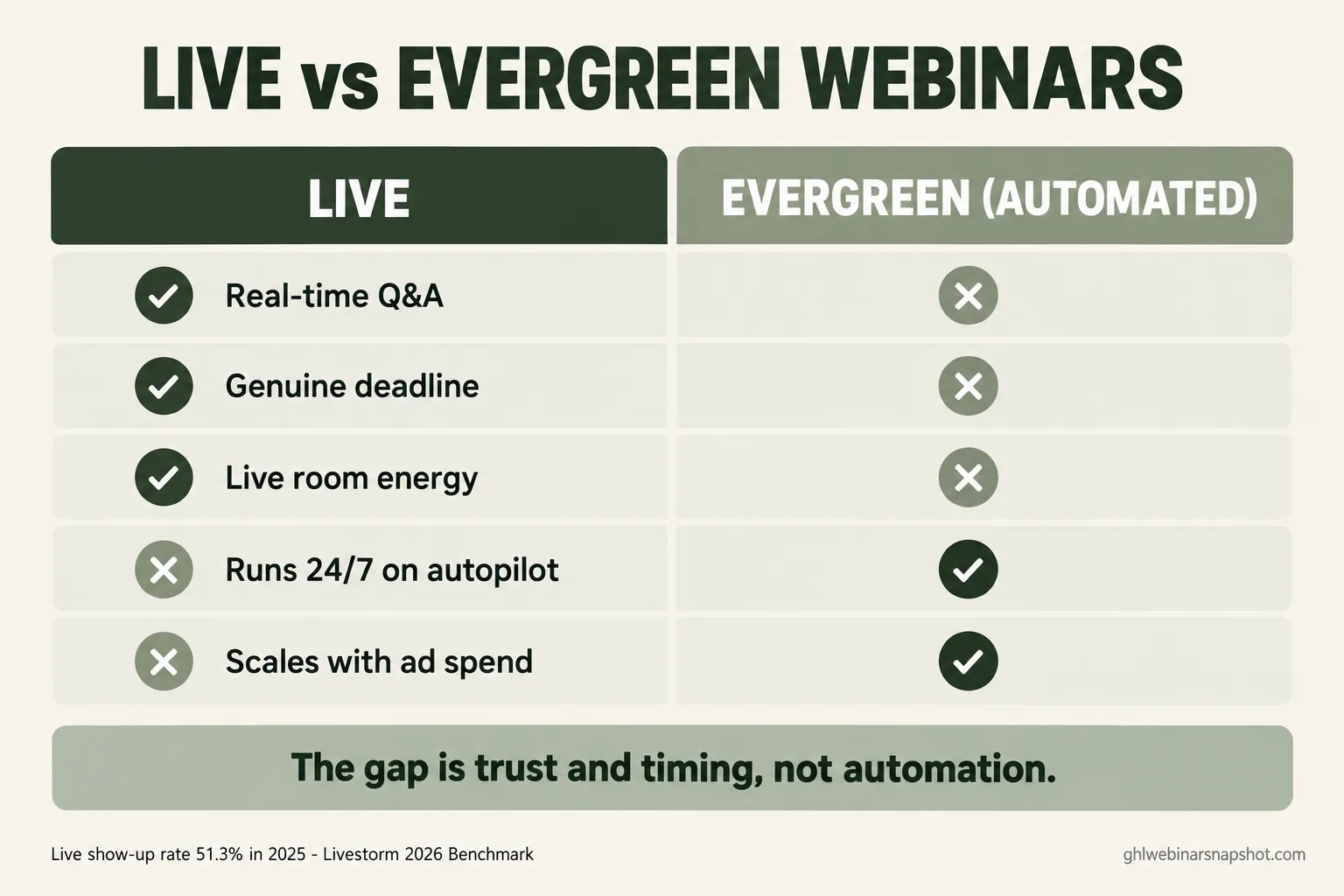
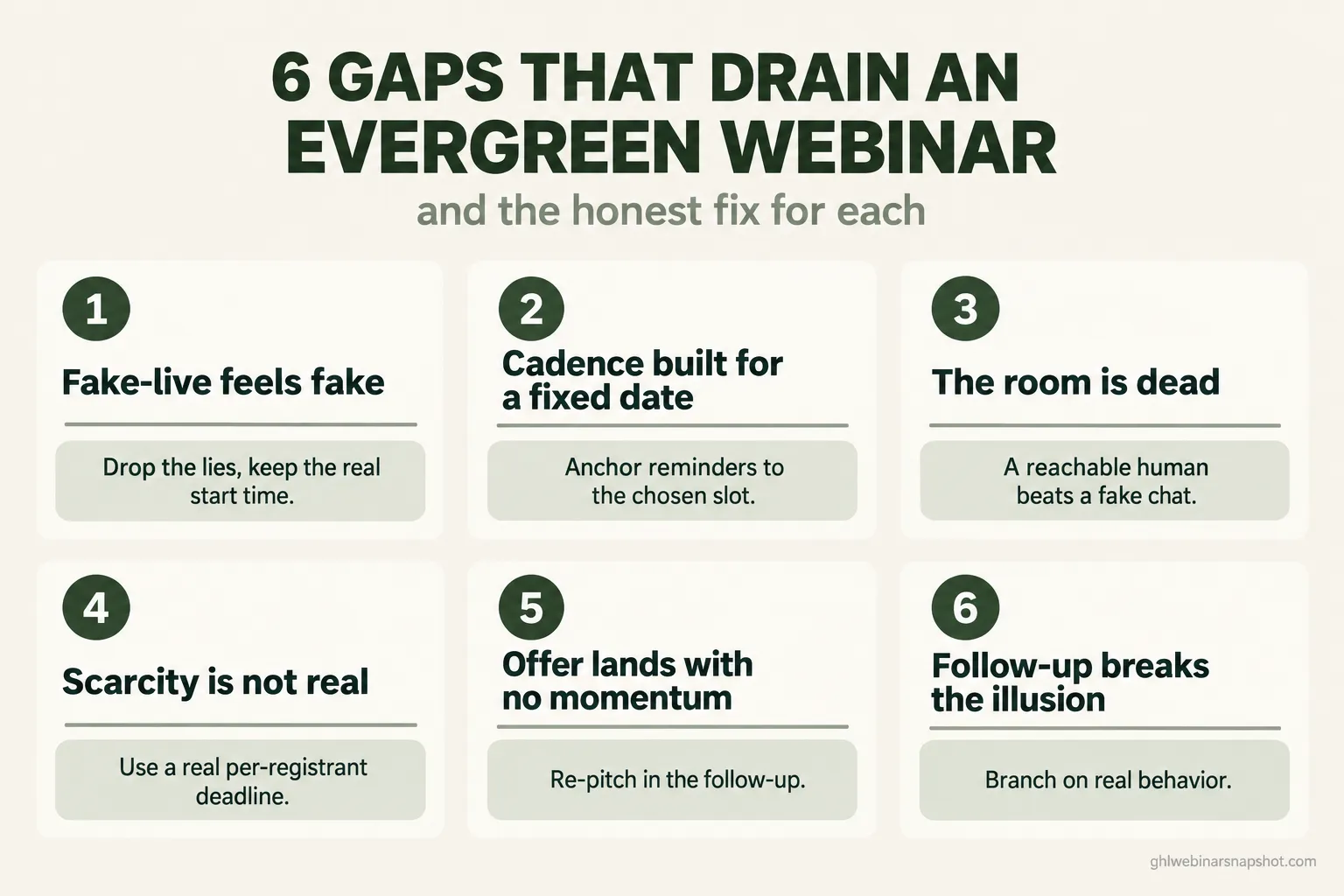
Here is the short answer: an evergreen webinar converts worse than live not because it is automated, but because the automation strips out the signals that made people trust you and act now, then usually replaces them with fake ones that make it worse. The room energy, the real-time answer to the exact objection in someone’s head, a deadline that is actually real, the sense that other people are deciding too. Take those away and you are left with a video and a buy button. Fake them badly and you poison the trust you had. Rebuild those signals honestly and most operators get back within shouting distance of their live numbers. This guide walks the six gaps that drain an evergreen webinar, with the fix and the copy to steal for each.
Table of contents
- What the conversion gap actually costs you
- Why evergreen converts below live
- Gap 1: Your fake-live feels fake
- Gap 2: The reminder cadence is built for a fixed date
- Gap 3: The room is dead
- Gap 4: Your scarcity is not real
- Gap 5: The offer lands with no momentum
- Gap 6: Your follow-up breaks the illusion
- The same gap at three sizes
- The compliance line you cannot skip
- Objections, answered
- FAQ
What the conversion gap actually costs you
Run the math once and you will stop treating this as a rounding error. Say your live webinar booked 4% of attendees onto a sales call. Move to evergreen, attendance holds, but booked calls slide to 2%. Same traffic, same spend, and you just halved the output of the asset you built the business on. On 1,000 attendees a month that is 40 booked calls versus 20. One number, cut in half, quietly.
The tempting read is that evergreen is simply worse and you should go back to live. That is the wrong lesson. The upside is real: it runs while you sleep, it scales with ad spend instead of your calendar, and the software is cheap next to enterprise tools. EverWebinar lists $199 a month billed monthly, or an effective $99 a month on the annual plan at $1,188 a year. The problem is never the format. It is that the live version carried a dozen trust signals you got for free, and the automated version shipped without them.
Why evergreen converts below live
A live webinar is a shared event. People register for a time, clear their calendar, and show up knowing the host is really there and the offer really closes. That context does a lot of selling before anyone says a word. The host answers the one objection killing the sale. The chat fills with people reacting, which tells a hesitant buyer that others like them are leaning in. And when the host says “the doors close Friday,” it is true, so the deadline moves people.
Evergreen keeps the forty-minute video and loses almost all of that. The sale now has to survive without room energy, without the real-time answer, without a live chat, and often without a deadline that means anything. Some of that you cannot fully recreate, and the honest benchmark data cuts both ways: older ON24 data showed on-demand viewing converting higher than live in some verticals and lower in others, so format alone does not decide the outcome. How much of the liveness you rebuild does. The six gaps below are the signals worth rebuilding, in the order they usually cost you most.
Gap 1: Your fake-live feels fake
Most evergreen tools ship with a “just like live” mode: a countdown that pretends the session started two minutes ago, a running attendee counter, chat messages scheduled to drop at the same timestamps every time. In practice it is the fastest way to lose a modern buyer, because they have seen it a hundred times. The “412 people watching” number identical on every replay. The “wow this is gold!!” comment that lands at exactly 12 minutes in, every time. The countdown that resets the moment you refresh.
The fix: drop the parts of fake-live that lie, keep the parts that are honestly useful. A scheduled start time the viewer picked is fine, because they chose 2:00pm and you are starting then. A fabricated live attendee count is not, so turn it off. If your tool lets you seed chat, use real questions from past sessions framed as “a question we get a lot,” not a fake stranger gushing on cue.
Steal this reframe for your registration confirmation: instead of “join 400+ people live,” write: You picked 2:00pm, so that is when your session starts. It runs straight through, so block the 45 minutes. I will answer the questions people ask most right inside the session.
How this breaks: leaving the default fake counter on because “it converts better in the demo.” It converts worse the moment a buyer catches it, and one caught lie taints the offer. Turn it off.
Gap 2: The reminder cadence is built for a fixed date
Your live reminder sequence was built around a date everyone shared: three days out, one day out, an hour out, go live. Drop that same cadence onto evergreen and it falls apart, because every registrant picked a different slot. A “see you Thursday” email makes no sense to someone who registered for Monday. Worse, most operators disable reminders entirely on evergreen because the fixed-date copy does not fit, and show-up to the automated session craters.
The fix: key every reminder off each person’s chosen session time, not a shared date. The logic is the same as a live sequence, just anchored to a variable: a confirmation at signup, a reminder the day before the chosen slot, a morning-of note, and the ten-minute “your session starts now” push that does the heavy lifting. Our webinar SMS reminders playbook has the full timing, and the no-show recovery system covers the back half.
Steal this ten-minute push (consented registrants only): [First name], your [webinar title] session starts in 10 minutes. Here is your link: [link]. It runs straight through with the offer and Q&A at the end, so grab a quiet spot. Reply STOP to opt out.
How this breaks: sending a reminder for the wrong time because the funnel stored the registration time but not the session time the person selected. Test the merge field with a real signup before you trust it.
Gap 3: The room is dead
In a live webinar, the chat does quiet work the whole time. A hesitant buyer sees others asking smart questions and reacting to the offer, and that social proof carries them. On a silent replay, the buyer is alone in a dark room watching a video, a different emotional state when the price comes up. The absence of other humans makes the offer feel riskier than it did live.
The fix: rebuild presence honestly. The best version is a real person monitoring an evergreen chat or SMS thread during popular slots, which GoHighLevel’s AI tools or a VA can handle so you are not chained to the funnel. Short of that, a pinned, honest note (“I am not live right now, but reply to the email and I read every one”) beats a fake chat, and real attributed testimonials at the offer moment beat a fabricated crowd.
Steal this pinned message: Heads up: this session is a recording so I can run it every day, but I am a real person and I answer every reply. Hit reply on the confirmation email with any question and you will hear back from me, usually same day.
How this breaks: promising a reply you never send. If you say you answer, answer, or the one honest promise on the page becomes the lie that sinks it.
Gap 4: Your scarcity is not real
This gap costs the most money and the most trust at once. The live webinar had a real deadline, because the cart or bonus genuinely closed. The evergreen version usually fakes it with a countdown that resets every page load, or a “doors close at midnight” that is still open next week. Buyers have been burned by this so often that a visible fake timer now reads as a reason to distrust the whole offer. And it is the pattern the FTC called out, describing countdown timers “designed to make consumers believe they only have a limited time to purchase” as a deceptive dark pattern in its 2022 report.
The fix: make the scarcity real per registrant. A genuine deadline that starts when a person watches and actually closes for them is honest and it works, because the offer really expires. Most serious evergreen funnels run a per-contact window, say 72 hours from when someone finishes the webinar, with the cart link genuinely dead after it. When it hits zero the price or bonus is actually gone.
Steal this deadline email, sent as the window closes: [First name], your bonus from [webinar title] comes off the table tonight at midnight your time. This is a real deadline tied to your session, not a page gimmick, so after that the [specific bonus] is gone and the price goes back to [full price]. Link while it is open: [link].
How this breaks: running a “real” deadline and then quietly honoring the price for stragglers who email you. Do that twice and your list learns the deadline is theater. Hold the line or do not set one.
Gap 5: The offer lands with no momentum
Live, you build to the offer. You read the energy, slow down, handle the objection you can feel in the room, and make the ask when the room is warm. Evergreen plays the same audio at the same pace to everyone, so the offer arrives with no run-up and no adjustment. If the pitch depended on the host’s timing, the recording loses it. This is why a webinar that killed live can feel flat on replay even when every word is identical.
The fix: tighten the recording for the format. Cut the live dead air, the “can everyone see my screen” fumbling, and the long waits for questions, because on a recording those just leak attention. Then do the work live could not: use the post-webinar sequence to re-make the offer in writing, one objection per email. The recording plants the offer; the follow-up is where an evergreen funnel actually closes. The webinar conversion funnel guide maps where those people drop and how to catch them.
Steal this objection-handling follow-up (day after the session): [First name], the question I get most after this session is “will this work for someone at [their stage]?” Short answer: it is actually built for that stage, and here is the exact reason. [One concrete sentence.] Your enrollment window is open until [real deadline]: [link].
How this breaks: treating the follow-up as a reminder instead of a second pitch. “Just checking in” sells nothing. Each follow-up should remove one real reason not to buy.
Gap 6: Your follow-up breaks the illusion
You can do everything above right and still blow it in the follow-up. The classic mistake is a canned “sorry we missed you live!” email to someone who watched the whole replay, or a “the replay is up” note to someone who just wanted the slides. Nothing shatters trust faster than proof the system does not know what the person did. It tells them the whole thing was a conveyor belt, which makes the offer feel like one too.
The fix: branch the follow-up on real behavior. You need attendance and watch tracking so the system knows who showed, who watched to the offer, who bailed early, and who never joined. Then the no-show gets a genuine “here is your replay link,” the person who watched to the offer gets the deadline push, and the early-bail gets “here is the 3-minute version of what you missed.” The replay-tag pipeline is how you wire that tagging without scrubbing CSVs by hand.
Steal this no-show replay email: [First name], you registered for [webinar title] and did not make your session, which happens. Your replay is good for 48 hours: [link]. The part worth your time is the last 15 minutes, where I cover [the offer and the one result it drives].
How this breaks: no behavioral tags, so everyone gets the same email. Without tracking, your “personalized” follow-up is a blast, and your sharpest buyers are the ones who notice first.
The same gap at three sizes
The six gaps are universal, but how you close them depends on the shape of your business. Here is how the fix changes across three common operators.
| Feature | Solo coach, low-ticket course | High-ticket coaching / B2B SaaS demo |
|---|---|---|
| Main leak | Fake-live and dead scarcity | Dead room + follow-up that ignores behavior |
| Scarcity fix | Real 72-hour cart close per registrant | Real enrollment window + a sales call to close |
| Presence fix | Honest 'I reply to every email' note | Live human or AI monitoring popular slots |
| Follow-up | Behavior-branched email sequence | Branch to SDR routing + speed-to-lead on hot watchers |
| Tooling | EverWebinar or eWebinar + GHL | GHL behavior tags + CRM + calendar booking |
The solo coach selling a $200 to $1,000 course should not try to recreate a live room. The money is in a real per-registrant deadline and a clean behavior-branched email sequence: a genuine cart-close window and five follow-up emails beat any fake chat. Low-ticket tools like eWebinar start around $99 a month, which is plenty here.
The high-ticket coach selling $3,000 to $15,000 programs cannot close on the webinar alone, so the session’s job is to book a call, not take a card. The biggest leak is a dead room plus follow-up that ignores who watched the pitch. Put a real person or AI assistant on the popular slots, and route anyone who watched past the offer straight to a booking page with fast follow-up.
The B2B SaaS team running an evergreen demo has the same six gaps plus a pipeline problem: behavior tags have to flow into the CRM, hot watchers need speed-to-lead routing to an SDR, and attribution has to survive the handoff. 52% of B2B marketers call webinars one of their most effective channels, but only if the leads land somewhere that acts on them.
Illustrative attendee-to-booked-call conversion (%) as you rebuild liveness signals honestly. Figures are directional to show the relative lift from each fix, not a benchmark; your own conversion by format is the number to trust.
The compliance line you cannot skip
Evergreen adds two compliance exposures live does not, and both are easy to trip.
First, the fake-deadline problem is a legal risk, not just a trust risk. The FTC’s 2022 dark patterns report flags countdown timers that mislead buyers about how long they have, and a timer that resets per visit or a deadline you never enforce fits that description. Use real, enforced deadlines and you are clear. Use theater and you are exposed.
Second, the SMS layer carries the same rules as live. Any text reminder to a registrant requires prior express written consent under the TCPA, and your business number has to be registered through A2P 10DLC or carriers block it. Our 2026 webinar compliance guide covers the consent language and registration steps. Evergreen tightens this, because an always-on funnel texts around the clock without you watching, so consent and opt-out handling have to be airtight before you turn it on. And if your webinar makes any claim about results or earnings, the substantiation rules apply to the recording exactly as they would live. A recorded claim is still a claim.
Objections, answered
“Isn’t ‘fake live’ just standard practice?” A lot of funnels do it, and a lot convert worse because of it. The question is not whether it is common, it is whether your buyer catches it, and high-ticket and B2B buyers catch it fast. A real deadline and an honest signal that a human is reachable give you the urgency and presence without the downside.
“I already pay for EverWebinar. Do I have to switch tools?” No. EverWebinar, eWebinar, and the automated modes in WebinarJam or Demio can all run an honest session. The gaps here are not about the player, they are about the system around it: the reminder cadence, the per-registrant deadline, the behavior tags, the branched follow-up. Keep your player and build the system in your CRM.
“Do I need to be technical to set this up?” You need the logic, not the code. The hard part is the behavioral branching: tagging who watched what and sending the right follow-up to each. That is workflow configuration in a tool like GoHighLevel, not programming. If you would rather not wire it yourself, that is what a done-for-you system installs.
“Won’t people be annoyed that it’s automated?” They are not annoyed that it is a recording. They are annoyed when they are lied to about it being live. Tell them plainly it is a session you run every day so you can help more people, and the vast majority do not care. Honesty about the format is a feature, not a confession.
FAQ
Why does my evergreen webinar convert worse than the live version?
Automation removes the trust-and-timing signals live gave you for free: room energy, real-time answers, visible social proof, and a genuine deadline. Most tools then replace them with fake versions that buyers recognize and distrust. Rebuild the signals honestly, with a real per-registrant deadline, a reachable human, and behavior-branched follow-up, and conversion climbs back toward your live number.
How do I create real urgency on an evergreen funnel?
Use a per-registrant deadline: a genuine window, often 24 to 72 hours from when someone finishes the webinar, with the cart link or bonus actually closing when it expires. It is true for that person, so it moves them, and it is not deceptive because the offer really ends. The one rule is you have to honor it and not quietly reopen for stragglers.
Is fake-live mode worth using?
Keep the honest parts, drop the dishonest ones. A start time the viewer chose is fine. A fabricated attendee counter, a chat of fake strangers, and a countdown that resets on refresh are not, because buyers catch them and the caught lie taints the offer. The FTC has flagged misleading countdown timers as a deceptive practice.
Do SMS and compliance rules change for evergreen?
The rules are the same, but exposure is higher because the funnel runs unattended around the clock. You still need prior express written consent under the TCPA for any text reminder, and your number still has to be registered through A2P 10DLC. Make sure consent capture and STOP handling are solid before you turn an always-on funnel loose.
Can an evergreen webinar ever convert as well as live?
It can get close, and sometimes match it, especially for lower-ticket offers where a clean deadline and a strong follow-up sequence do most of the work. For high-ticket offers the session usually books a call rather than closing directly, and the human on that call makes up the distance. The format is not the ceiling; the system around it is.
The evergreen webinar is not a worse asset. It is the same asset with the trust signals quietly removed, and your job is to put the honest ones back. Real deadlines instead of resetting timers. A reachable human instead of a fake chat. Reminders tied to the slot each person picked. Follow-up that knows what they actually did. Do that and the funnel that runs while you sleep stops costing you half your sales and earns most of them back. Look at your own funnel against the six gaps above, find the one bleeding most, and fix that one first.