
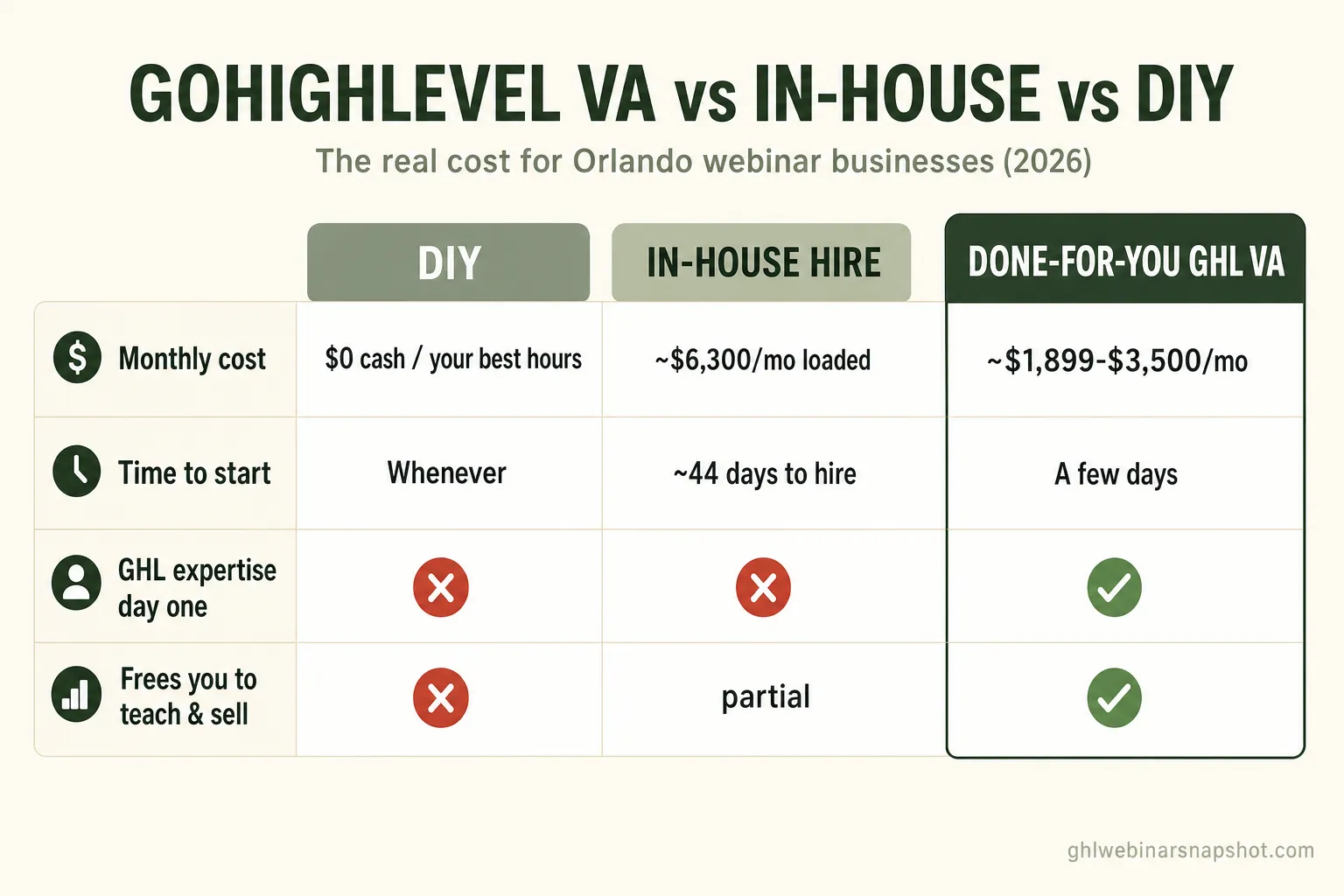
For most Orlando webinar businesses, a done-for-you GoHighLevel VA is the lowest-total-cost way to run the back office — because doing it yourself (DIY) spends your single most valuable and most expensive resource, your own selling and teaching hours, and hiring in-house adds a fully-loaded salary of roughly $72,000–$77,000 a year plus about 44 days and $4,700 just to fill the seat (SHRM), long before anyone touches a workflow. A trained GHL VA sits between those two extremes: expert coverage across your whole funnel for a predictable monthly fee, starting in days — no payroll, no ramp, no learning curve on your dime.
That’s the headline. But “cheapest” depends on where your business actually is, so this is a decision guide, not a sales pitch. Below is the real 2026 math for a Central Florida coach, course creator, or B2B founder — the true cost of each option, the hidden costs that never show up on a bank statement, and a 10-minute framework to pick the right one. Every figure is sourced.
Table of contents
- The short answer: which should you choose?
- What “running your GoHighLevel” actually involves
- Option 1: Do it yourself (DIY)
- Option 2: Hire an in-house employee
- Option 3: Hire a done-for-you GoHighLevel VA
- The real cost, side by side
- The hidden cost DIY and slow hiring share: speed
- Which one fits an Orlando webinar business?
- How to decide in the next 10 minutes
- Frequently asked questions
The short answer: which should you choose?
Pick by the constraint that hurts most right now:
- Cash is tight and volume is low (one webinar a quarter, small list). Stay DIY for now — but time-box it. The moment funnel work starts eating your teaching and selling hours, that “free” option has become your most expensive one.
- You want maximum control and have steady, high volume plus real budget. An in-house hire can make sense — if you can afford ~$72K–$77K all-in, absorb ~44 days of hiring, and manage the person once they start.
- You want expert coverage across the whole stack, fast, without payroll. A done-for-you GoHighLevel VA is the middle path most lean webinar operators land on: predictable monthly cost, webinar-niche expertise on day one, and no management overhead.
The rest of this guide shows the numbers behind those calls.
What “running your GoHighLevel” actually involves
Before you can compare costs, be honest about the scope. “Running GoHighLevel” for a webinar business is not one job — it’s five, and they’re the difference between a full room and an empty one:
- Registration funnels and pages — high-converting sign-up, thank-you, and replay pages that turn ad clicks and organic traffic into confirmed seats.
- Reminder and recovery automations — the multi-touch email/SMS cadence before the event, plus no-show recovery and replay nudges after it. This is what protects the 52% of registrants who never show live.
- CRM, tags, and lead scoring — a registrant pipeline (registered → attended → no-show → customer), behavioral tags, and scoring so the hottest replay-watchers surface for a call.
- AI chat, voice, and follow-up — chat widgets and an AI receptionist that answer and register 24/7, plus fast post-webinar follow-up that books calls while intent is hot.
- Compliance and integrations — A2P 10DLC registration and TCPA-aware SMS setup, plus connecting Zoom, WebinarJam, Stripe, or a calendar into GHL.
Whoever owns your GoHighLevel owns all five. That’s the yardstick for every option below — not “can they log in,” but “can they keep all five running without you.”
Option 1: Do it yourself (DIY)
Cash cost: $0. Real cost: your best hours — the ones you’d otherwise spend teaching and selling.
DIY feels free because nothing leaves your bank account. But your time is the most expensive labor in the business, and system work quietly consumes it. Across US small businesses, owners report losing about 25 hours a week to manual data entry and reconciling information across apps (Intuit QuickBooks, 2024) — and a webinar stack of registration pages, reminder flows, and a CRM is exactly that kind of app-wrangling.
There’s a growth cost on top of the time cost. Founders who stay the bottleneck grow slower than those who delegate: Gallup found CEOs with high “Delegator” talent produce 33% more revenue than low-delegation CEOs. Every hour you spend rebuilding a broken workflow at 11pm is an hour not spent on your offer, your content, and your calls — the work only you can do.
Option 2: Hire an in-house employee
Cash cost: far more than the salary — and it starts before day one.
Say you hire a marketing or CRM coordinator here in Orlando. The base salary averages around $55,300 a year (Indeed, 2025). But base is not what an employee costs. Benefits and payroll taxes make up 29.8% of total employer compensation for private-industry workers (BLS, 2025), which is why the standard planning convention is that a role runs 1.25–1.4× base once you add benefits, taxes, and overhead (QuickBooks). That turns ~$55,300 into roughly $72,000–$77,000 a year fully loaded.
Then there’s the part that happens before they’re productive. The average US role takes about 44 days to fill and roughly $4,700 to hire, and if the hire doesn’t work out, replacing them can cost 50% to 200% of annual salary (SHRM). And a general marketing coordinator is rarely a GoHighLevel expert — so you’re also paying for the weeks it takes them to learn your stack.
In-house isn’t wrong. For a high-volume operation with steady webinars and the budget to carry a salary plus management time, an employee gives you the most control and the most availability. It’s simply the highest-cost, slowest-to-start, highest-risk option — a real commitment, not a quick fix.
Option 3: Hire a done-for-you GoHighLevel VA
Cash cost: a predictable monthly fee, a fraction of a fully-loaded salary — and it starts in days.
A GoHighLevel VA is a trained specialist who owns all five jobs above inside your account. Because they’re already webinar-niche trained, there’s no GoHighLevel learning curve on your dime and no recruiting cycle. You’re hiring proven execution, not a role you have to build.
On price, VA staffing is a market, not a government statistic, so treat these as directional ranges reported by staffing firms: US-based virtual assistants typically run $15–$40 an hour, and managed specialist plans roughly $1,899–$3,500 a month (Wishup/Wing, 2026). That’s a fraction of the ~$6,300/month a fully-loaded in-house coordinator costs — for coverage across funnels, automations, CRM, AI, and compliance instead of a single generalist.
The talent pool is deep and normal to hire from: about 1 in 4 US skilled knowledge workers now freelance (Upwork, 2024). Outsourcing your GHL operations isn’t a compromise — it’s how a lean webinar business gets specialist depth without specialist payroll. (If you’d rather own the underlying system outright, a heavier build or a full migration into GoHighLevel is a custom GHL development question, not a staffing one.)
The real cost, side by side
Here’s the head-to-head that matters most: the done-for-you VA against a full in-house hire, on the criteria that actually decide the outcome. (DIY is covered above — its cost is your time, and it doesn’t scale.)
Done-for-you GHL VA vs. an in-house hire
| Feature | Done-for-you GHL VA | In-house employee |
|---|---|---|
| Monthly cost | ~$1,899–$3,500 managed plan (market range) | ~$6,300/mo fully loaded + management time |
| Upfront cost to start | None | ~$4,700 and ~44 days to hire (SHRM) |
| GHL expertise on day one | Yes — webinar-niche trained | Usually not; weeks of ramp on your stack |
| Scope covered | Funnels + automations + CRM + AI + compliance | One generalist; may need several roles |
| Time to a working funnel | Days | Weeks to hire, then more to ramp |
| If it doesn't work out | Swap or cancel, no severance | Replacement costs 50–200% of salary (SHRM) |
| Management overhead | None — reports to you | You manage, review, and retain them |
| Commitment | White-label, no contracts | Salary, payroll, benefits, HR |
The in-house column buys you control and dedicated availability. The VA column buys you the same expert coverage for roughly half the monthly cost, none of the hiring risk, and none of the management load — which is why most solo and small-team webinar operators land there.
The hidden cost DIY and slow hiring share: speed
Cost per month is the obvious axis. The one that quietly decides revenue is speed — and both DIY and a slow in-house hire lose on it.
Two numbers set the stakes. First, only 47.7% of people who register for a webinar actually attend live (Livestorm, 2026) — the other half are recovered only by automations that fire on time, every time. Second, when a lead does raise their hand, the average business takes 42 hours to respond, and only 37% respond within an hour (HBR). A registrant who asks a question, or a hot replay-watcher who’s ready for a call, goes cold long before a busy founder or a still-ramping new hire gets to them.
That’s where “time to a working system” becomes real money, not a scheduling detail:
A done-for-you VA is running your reminder cadence and follow-up in the first week. A new hire is still being interviewed. DIY is whenever you next find a free evening. When half your registrants only come back if the automation nudges them, and leads decay in hours, the fastest-to-live option protects revenue the other two leak.
Which one fits an Orlando webinar business?
Orlando and Central Florida are a dense, competitive market for coaches and creators. Florida is home to about 3.5 million small businesses — 99.8% of all businesses in the state, employing 3.8 million people (SBA Office of Advocacy, 2025). And the audience you’re selling to is expanding fast: the global creator economy is projected to grow from roughly $250 billion in 2024 toward nearly $480 billion by 2027 (Goldman Sachs).
Two implications for an Orlando operator:
- You’re competing on execution, not just offer. In a field this crowded, the webinar business that captures every registrant, reminds relentlessly, and follows up in minutes wins the seat — regardless of who has the flashier slides. That execution is exactly what a trained GHL operator industrializes.
- You probably don’t need a Florida-salaried employee to get it. A managed VA gives you enterprise-grade execution without an enterprise-grade payroll, which is the right shape for the lean, high-margin businesses that dominate this market. For the deeper “when your tools stop scaling” version of this question, our GoHighLevel custom development guide for Houston breaks down the build-vs-buy line, and the San Diego take on hiring a GHL VA covers the founder-burnout angle in depth.
How to decide in the next 10 minutes
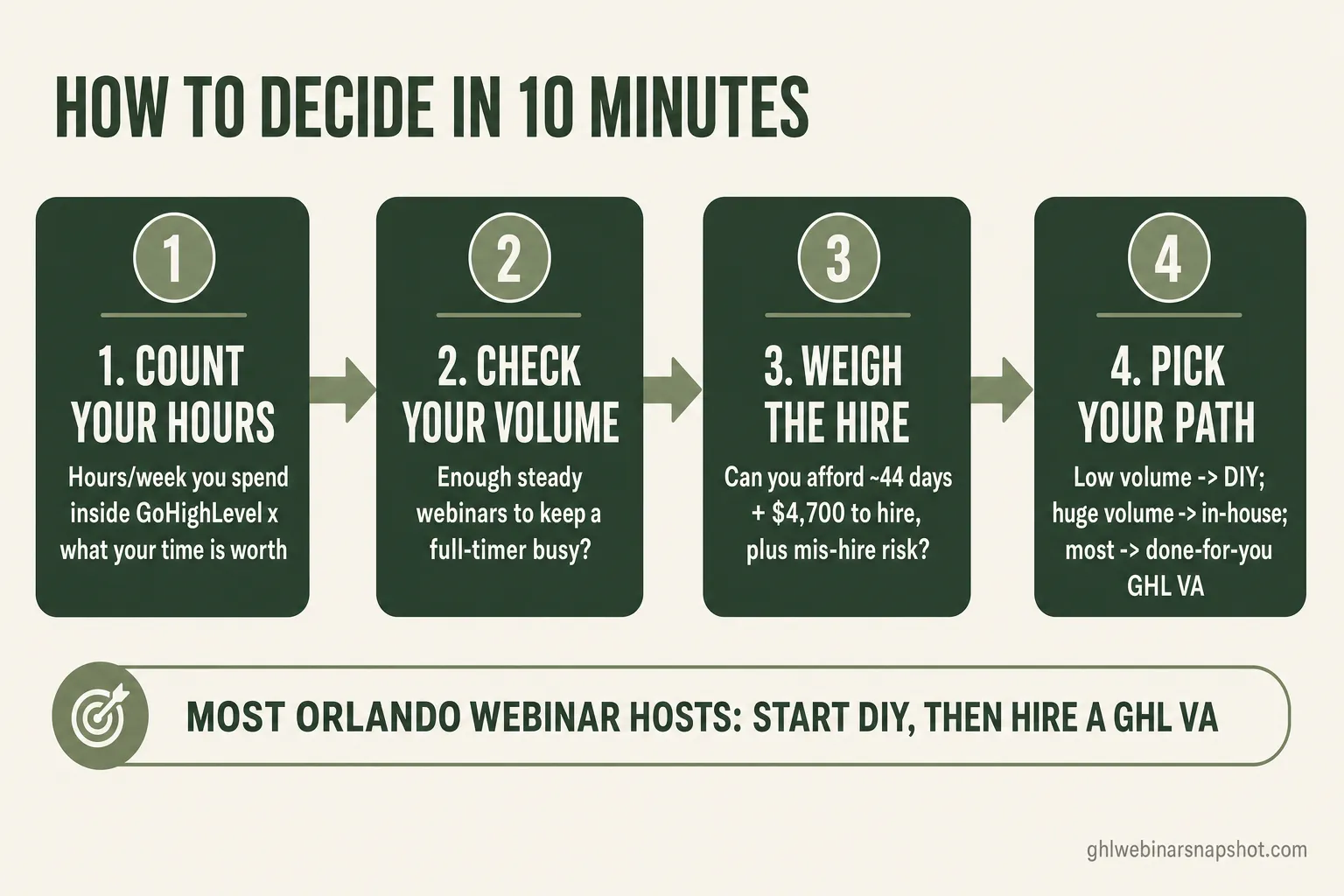
Answer these four questions honestly:
- How many hours a week do you personally spend inside GoHighLevel? Multiply by what your time is worth. If that number rivals a managed VA plan (~$1,899–$3,500/mo), DIY is already the expensive option.
- Is your webinar volume steady and high enough to keep a full-time employee busy? If not, an in-house hire is over-built for your load — you’d pay $72K–$77K for part-time work.
- Can you afford ~44 days and ~$4,700 to hire, plus the risk of a mis-hire, right now? If that timeline or risk makes you wince, a VA that starts in days is the lower-risk path.
- What do you actually want to spend your week doing? If the honest answer is “teaching and selling,” then owning the GHL back office yourself is a choice to do the wrong job well.
For most Orlando coaches and course creators, the math points the same way: DIY until volume justifies help, then a done-for-you GHL VA — reserving an in-house hire for when you’re running webinars at a scale that genuinely needs a dedicated, full-time, on-payroll operator.
Frequently asked questions
Is a GoHighLevel VA really cheaper than hiring in-house?
For most webinar businesses, yes — on total cost. An in-house marketing coordinator in Orlando averages about $55,300 in base salary (Indeed, 2025), but benefits and payroll taxes alone are 29.8% of employer cost (BLS, 2025), pushing the fully loaded figure to roughly $72,000–$77,000 a year, or about $6,300 a month, before management time. A managed GHL VA plan typically runs a fraction of that per month for coverage across funnels, automations, CRM, AI, and compliance. In-house can still win on control and dedicated availability at high volume — it's simply the higher-cost, higher-commitment option.
What does a done-for-you GoHighLevel VA actually run for a webinar business?
The whole back office: registration funnels and replay pages, the pre-webinar reminder cadence, no-show recovery and replay nudges, CRM pipelines with tagging and lead scoring, AI chat widgets and an AI receptionist, integrations with tools like Zoom, WebinarJam, and Stripe, and A2P 10DLC plus TCPA-aware SMS setup. The point is that one trained specialist owns all of it so the operator can focus on teaching and selling.
How fast can each option start?
A done-for-you GHL VA can typically start within days, because they're already webinar-niche trained and there's no recruiting cycle. An in-house hire takes about 44 days on average just to fill the role (SHRM), plus more time to ramp on your specific stack. DIY 'starts' whenever you next carve out the hours — which, for a busy founder, is the slowest path of all.
When does hiring in-house make more sense than a VA?
When your webinar volume is steady and high enough to keep a full-time person genuinely busy, you have the budget to carry a $72K–$77K fully loaded salary plus management time, and you want maximum control and dedicated, always-on availability. At that scale the per-hour economics of an employee improve and the control is worth it. Below that scale, a full-time salary is usually over-built for the actual workload.
Why does Orlando specifically matter to this decision?
Florida has about 3.5 million small businesses — 99.8% of all businesses in the state (SBA, 2025) — so an Orlando coach or course creator competes for attention against a dense field of local experts. In that environment, execution speed wins the seat: capturing every registrant, reminding relentlessly, and following up in minutes. A trained GHL VA gives a local operator that execution advantage without a Florida-level salary or a 44-day hiring cycle.
Can I start with the snapshot and add a VA later?
Yes, and many operators do exactly that. The done-for-you webinar snapshot installs the funnels, reminder cadence, and booking automations into your GoHighLevel in about 24 hours, giving you a working system immediately. A GHL VA then runs, monitors, and customizes that system over time. Starting with the snapshot for speed and layering a VA for ongoing coverage is a common, cost-effective hybrid.
Related reading
- Why San Diego Coaches Are Hiring a GoHighLevel VA to Run Their Webinar Funnels
- GoHighLevel Custom Development for Houston Webinar Businesses: When Your Tool Stack Stops Scaling
- How to Migrate Your Webinar Funnel to GoHighLevel (2026 Step-by-Step)
- AI Webinar Follow-Up: Book Calls While Intent Is Still Hot
- Ready to hand it off? See hire a GoHighLevel VA, custom GHL development, or book a strategy call.