
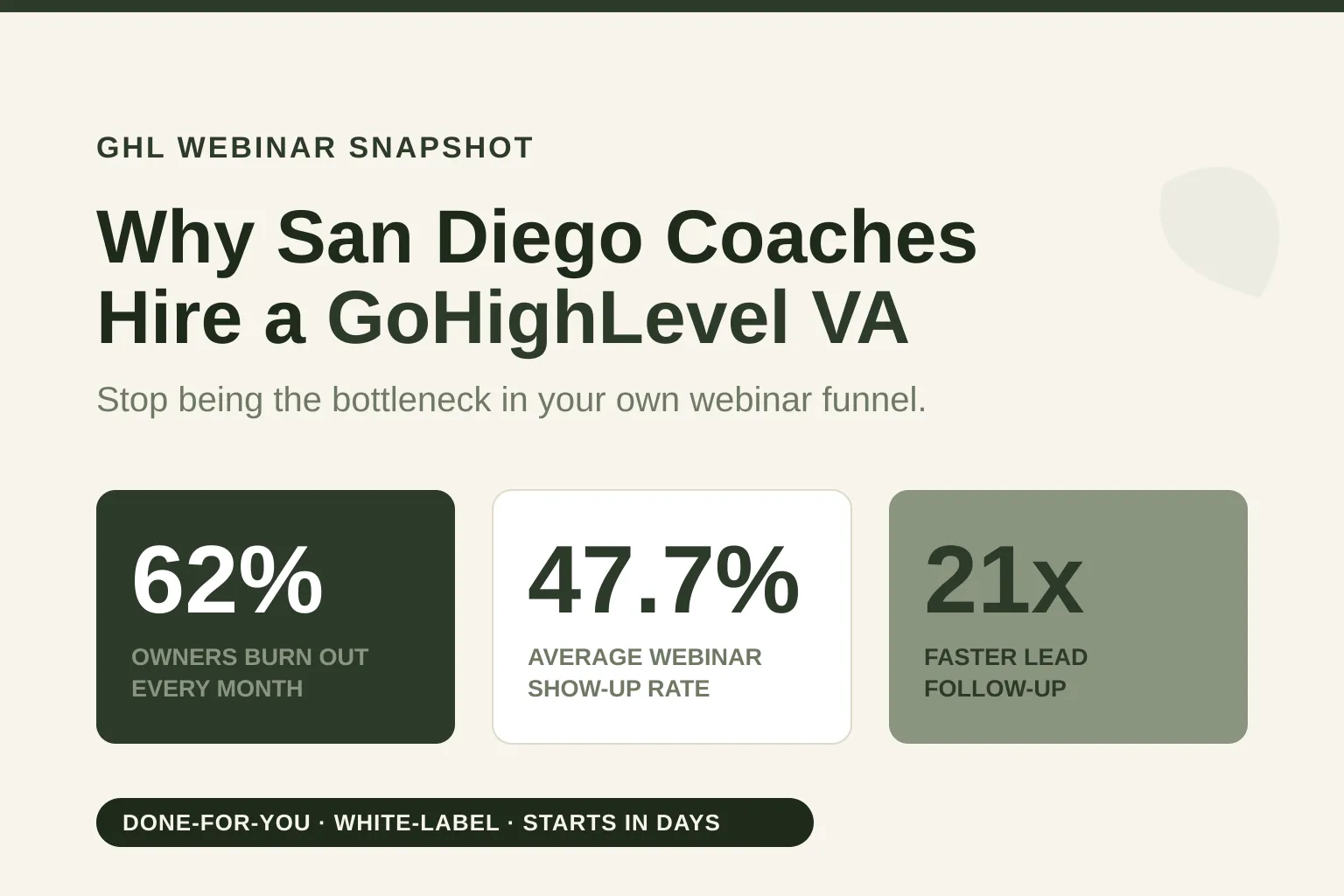
For a San Diego coach or course creator running webinars, hiring a GoHighLevel VA is the fastest way to stop being the bottleneck in your own funnel — because the person building your registration pages, wiring your reminder cadence, and chasing your no-shows is currently you, and that is the most expensive labor in your business. You didn’t start a coaching or course business to spend Tuesday night rebuilding a broken workflow at 11pm. But that’s where most solo operators end up: the funnel only moves when you touch it, so the funnel mostly doesn’t move.
A GoHighLevel virtual assistant is a trained GHL specialist who takes the entire back office off your plate — funnels, automations, CRM, follow-up, compliance — so you can spend your hours on the two things that actually grow the business: teaching great webinars and talking to buyers. This post lays out the real, hidden cost of doing it all yourself, and why delegation is quietly becoming the default move for webinar operators here in San Diego — with every figure sourced.
Table of contents
- What does a GoHighLevel VA actually do for a webinar business?
- The hidden cost of running your webinar funnel alone
- Pain #1: You’re the most expensive labor in your funnel
- Pain #2: Burnout is the default, not the exception
- Pain #3: Slow follow-up quietly kills your best leads
- Pain #4: Broken automations you don’t have time to fix
- The delegation math: GHL VA vs in-house vs DIY
- Why this matters for San Diego coaches and course creators
- How to know it’s time to hire a GHL VA
- FAQ
What does a GoHighLevel VA actually do for a webinar business?
A GoHighLevel VA is a trained GHL specialist who builds and runs the technical backbone of your webinar business — registration funnels, reminder and no-show workflows, CRM pipelines, AI chat and voice, integrations, and compliance — so you never touch the plumbing again. It’s not generic “admin help.” It’s someone who lives inside GoHighLevel every day and knows the webinar funnel patterns cold, so there’s no learning curve on your dime.
For a webinar operator, the job usually covers:
- Registration funnels and websites — high-converting registration, thank-you, and replay pages that turn cold ad traffic into confirmed seats.
- Webinar workflow automation — the 7-touch reminder cadence, no-show recovery, replay nudges, and post-webinar sales follow-up, all firing on autopilot.
- CRM setup and attendee pipelines — registered → attended → no-show → customer, with tags, lead scoring, and clean reporting.
- AI chat widgets and an AI receptionist — website and phone coverage that registers attendees and books calls 24/7.
- A2P 10DLC and TCPA compliance — brand verification and SMS campaign setup done right, not as an afterthought.
- Integrations — connecting GHL to Zoom, WebinarJam, Stripe, and the rest of your stack for clean two-way data flow.
Put simply: the VA does the work that keeps you off the stage. Now let’s look at what that work is actually costing you today.
The hidden cost of running your webinar funnel alone
Every solo webinar operator makes the same quiet bet: “It’s cheaper to just do it myself.” On the invoice, that’s true — there’s no line item for the funnel you built. But the cost didn’t disappear; it moved somewhere you can’t see it. It moved into your calendar, your energy, and the leads that slipped through while you were heads-down in the builder.
There are four places that hidden cost shows up. None of them appear on a bank statement, and together they’re usually far more expensive than a VA.
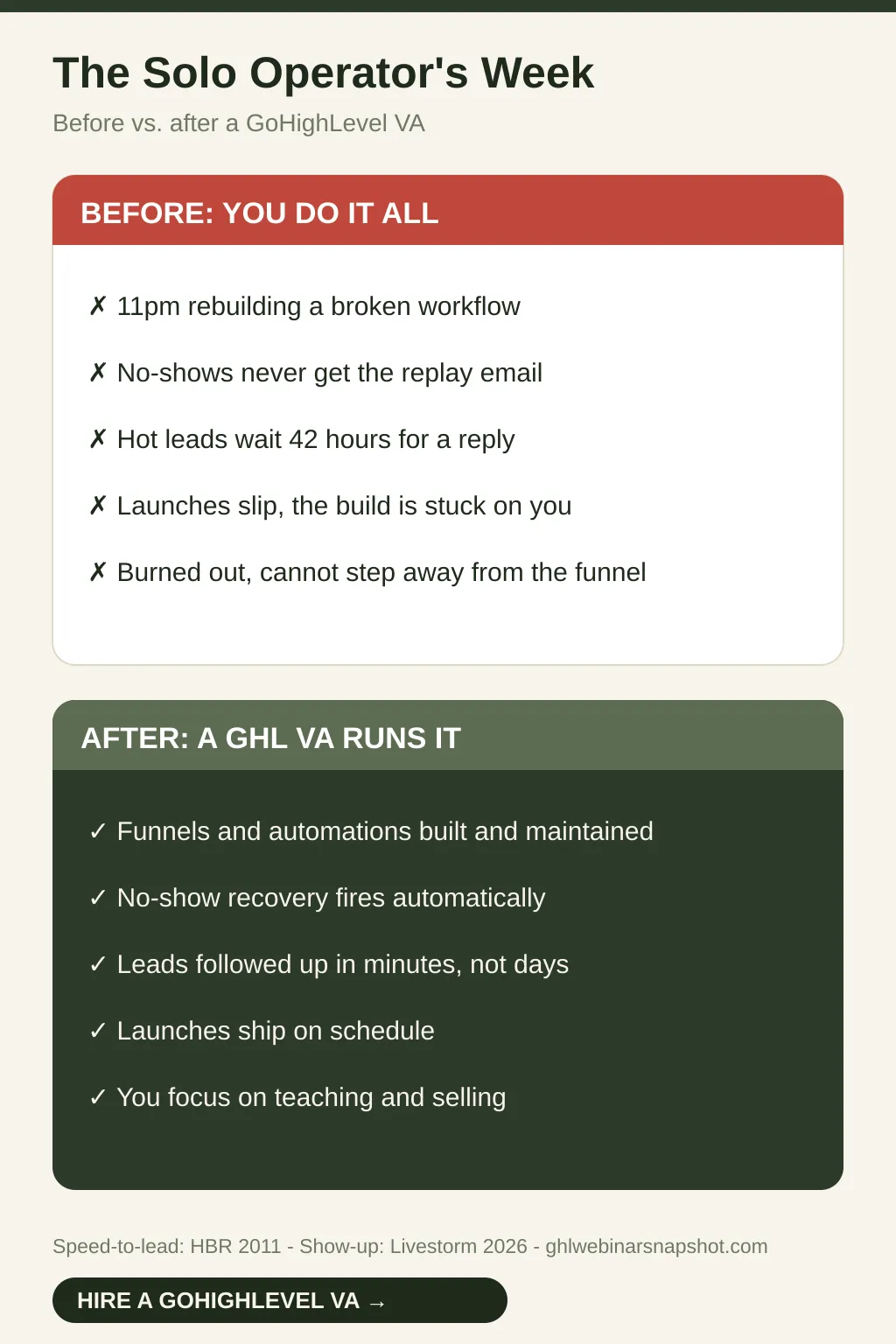
Pain #1: You’re the most expensive labor in your funnel
Here’s the uncomfortable accounting. If you had to hire someone to do what you currently do inside GoHighLevel — build funnels, wire automations, manage the CRM, run reporting — the US market rate for that role is not small. The Bureau of Labor Statistics puts the median wage for a market research analyst / marketing specialist at $76,950 a year, and a full marketing manager at $161,030 (May 2024).
You’re doing that job for free — except it isn’t free. You’re paying with the hours you’d otherwise spend selling, coaching, or building the next offer. Those are your highest-value hours, and you’re spending them on $30/hour work. A US virtual assistant averages about $22–$25 an hour (Indeed, 2025), and a specialized GHL VA on a managed plan costs less per hour than that — a fraction of an in-house salary for the same output.
The chart below shows the monthly cost of running your GHL back office three ways.
And that comparison is generous to the in-house option — it ignores benefits, payroll taxes, software seats, recruiting, and the management time it takes to keep an employee productive. The DIY option looks cheapest of all on paper, right up until you price your own hour honestly.
Pain #2: Burnout is the default, not the exception
The second cost is the one operators are least willing to say out loud. Running the whole machine yourself is exhausting, and the data says most owners are already past the line. A Walmart Business survey found 62% of small business owners experience burnout at least once a month, and that 41% feel they need to be physically at work for the business to run at all.
That last number is the trap. When you’re the only person who knows how the funnel works, you can never actually step away — because the moment you do, registrations stop, reminders don’t get fixed, and no-shows go unrecovered. The business is load-bearing on your attention.
Add to that the roughly 1.5 hours a day small business owners lose to low-value, repetitive tasks (Salesforce/Slack, 2024) — that’s about 7 to 8 hours a week, a full workday, spent on work a trained VA could own entirely.
Pain #3: Slow follow-up quietly kills your best leads
The third cost is the one that shows up in your revenue, not your calendar. Webinar funnels live and die on speed and consistency of follow-up — and those are exactly the things that fall apart when one overloaded person is doing them by hand.
Start with the show-up reality: the average webinar has a 47.7% show-up rate (Livestorm, 2026). More than half of the people who registered — people you paid to acquire — never attend live. The money isn’t in the live room; it’s in what happens to the other half through reminders, replay nudges, and a follow-up sequence that keeps working the list.
Then there’s speed. When a hot lead does raise a hand — books a call, replies to a reminder, asks a question in chat — the window to win them is measured in minutes. Harvard Business Review’s audit of 2,241 US companies found that responding within an hour made a firm 7x more likely to have a qualifying conversation than waiting just 60 minutes longer — yet the average first response took 42 hours, and 23% of companies never responded at all. The MIT / InsideSales lead-response study put an even finer point on it: contacting a lead within 5 minutes versus 30 made you about 21x more likely to qualify them.
No solo operator hits a 5-minute window while teaching a live webinar. Automation does — but only if someone built it correctly and keeps it running. That someone is your VA.
Pain #4: Broken automations you don’t have time to fix
The fourth cost is subtle and corrosive: the automation that silently breaks. A tag stops firing, so no-shows never get the replay email. An A2P registration lapses, so your SMS reminders quietly fail to deliver. A calendar integration drops, so booked calls don’t sync. Nothing throws an error — the funnel just leaks, and you find out weeks later when a launch underperforms and you can’t say why.
Solo operators almost never catch these in time, because monitoring workflows isn’t a task you schedule — it’s a thing you’d only do if you had spare hours, which is the one thing you don’t have. A GHL VA runs daily and weekly audits as part of the job: checking that workflows fired, deliverability held, and pipelines moved. That maintenance layer is invisible when it works, and expensive every time it doesn’t.
The delegation math: GHL VA vs in-house vs DIY
So how do the three real options compare? The slide below sums up the trade-off at a glance, and the table beneath it has the detail.
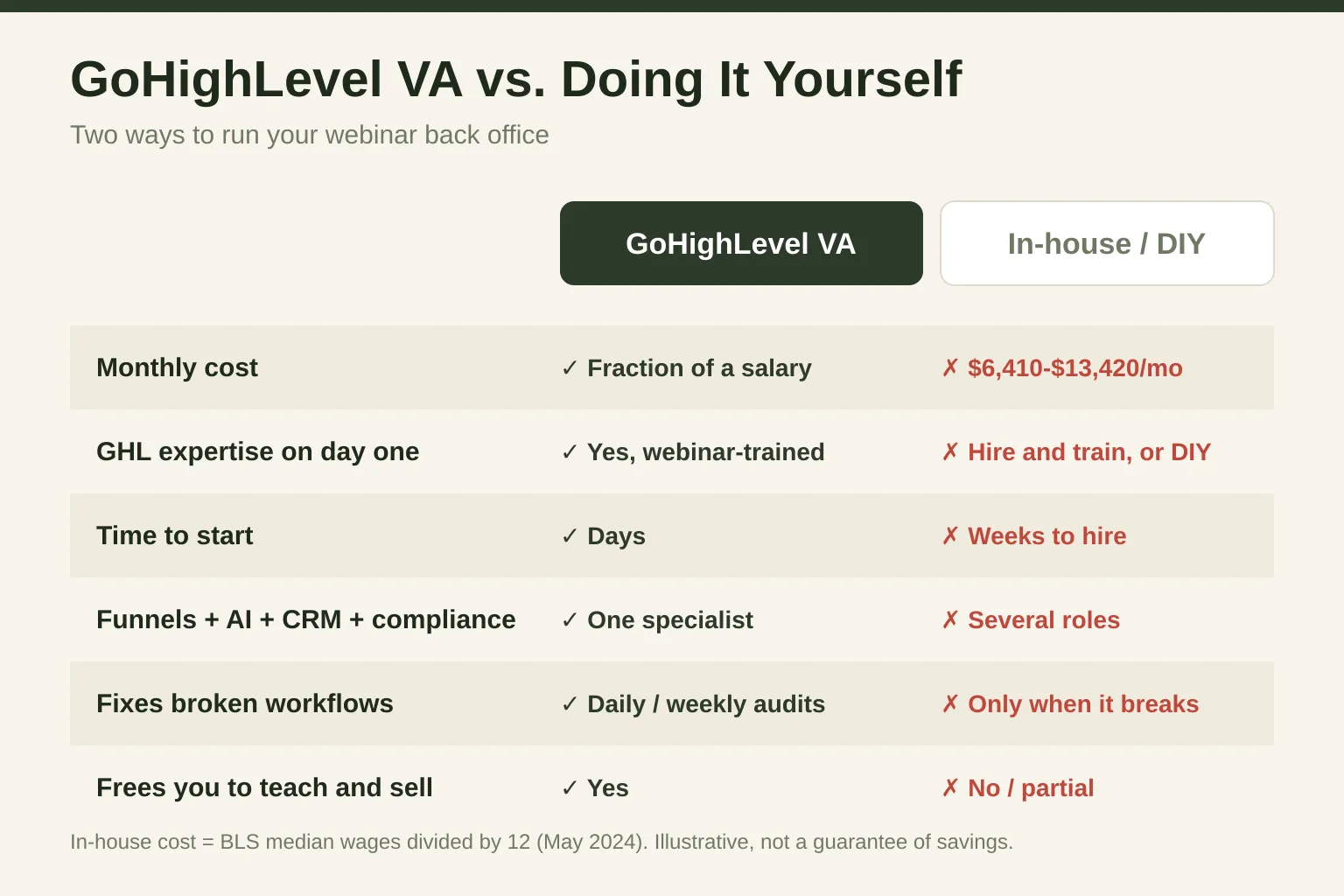
Three ways to run your GoHighLevel webinar back office
| Feature | GoHighLevel VA | In-house hire / DIY |
|---|---|---|
| Monthly cost | Fraction of a salary; managed plans | In-house: $6,410–$13,420/mo + benefits · DIY: your best hours |
| GHL expertise on day one | Yes — webinar-niche trained | In-house: hire + train · DIY: you learn on the job |
| Time to start | Days | In-house: weeks to hire · DIY: never really starts |
| Covers funnels + automations + CRM + AI + compliance | Yes, one specialist | Usually needs several roles |
| Fixes broken workflows proactively | Daily/weekly audits | Only when something visibly fails |
| Frees you to teach and sell | Yes — that's the point | DIY: no · In-house: partially |
| Commitment | White-label, no contracts | In-house: salary, payroll, management |
The DIY column is where most San Diego operators sit today, and it’s the one with the cost you can’t see. The in-house column solves the expertise problem but adds salary, payroll, and management overhead most solo coaches aren’t ready for. The VA column is the middle path that fits how a lean webinar business actually runs: expert coverage across the whole stack, for a predictable monthly cost, without hiring.
Why this matters for San Diego coaches and course creators
San Diego is one of the densest small-business markets in the country. California is home to roughly 4.2 million small businesses — about 99.9% of all businesses in the state (SBA Office of Advocacy, 2024), and San Diego County anchors a regional economy with a gross regional product near $267 billion in 2024 (San Diego Regional EDC). That means two things for a webinar operator here.
First, the market is crowded. A San Diego coach, consultant, or course creator is competing for attention against a huge field of other local experts running their own webinars and challenges. The operators who win aren’t necessarily the best teachers — they’re the ones whose funnel captures every registrant, reminds them relentlessly, and follows up in minutes. That’s an execution advantage, and execution is exactly what a GHL VA industrializes.
Second, San Diego’s talent and cost of living make a full in-house marketing hire expensive and slow. A managed GoHighLevel VA gives a local operator the same technical horsepower — funnels, automations, AI, compliance — without a California salary, a recruiting cycle, or a long-term commitment. For a solo coach or a small course business, that’s often the difference between scaling and stalling.
If you’re also weighing whether your public pages are fast enough to keep the registrants your ads are buying, our breakdown of webinar landing page speed for local hosts pairs naturally with the delegation question — speed keeps them, and the VA-built follow-up converts them.
How to know it’s time to hire a GHL VA
You don’t need to be at a breaking point. The clearest signals are mundane:
- Your funnel only moves when you touch it. Launches slip because the build is stuck in your queue.
- You’re doing $30/hour work with your $300/hour time. You’re in the workflow builder instead of on sales calls.
- Follow-up is inconsistent. Some no-shows get chased, some don’t, depending on how your week went.
- You’ve stopped trusting your automations. You’re not sure they’re firing, and you don’t have time to check.
- You dread the technical side of a launch more than the teaching — a quiet sign of burnout setting in.
If two or more of those sound familiar, the math has already tipped. The question isn’t whether you can afford a GHL VA; it’s whether you can afford to keep being one. If you’d rather buy the whole system outright first, our done-for-you webinar snapshot installs the funnels and automations in 24 hours — and a VA can run and evolve it from there. Or book a free call and we’ll map out exactly what to hand off first.
FAQ
What is a GoHighLevel VA?
A GoHighLevel VA is a trained virtual assistant who specializes in GoHighLevel and runs the technical side of your business inside it: registration funnels, reminder and no-show workflows, CRM pipelines and tagging, AI chat widgets and receptionists, integrations with tools like Zoom and Stripe, and A2P/TCPA compliance. For a webinar business, they own the whole back office so the operator can focus on teaching and selling instead of building and fixing automations.
How much does a GoHighLevel VA cost compared to hiring in-house?
A US in-house marketing specialist runs a median wage of about $76,950 a year and a marketing manager about $161,030 (BLS, May 2024), before benefits, payroll taxes, and management time. A US virtual assistant averages roughly $22–$25 an hour (Indeed, 2025), and a managed GHL VA plan typically costs a fraction of an in-house salary for comparable coverage across funnels, automations, and CRM. The exact figure depends on hours and scope — see our hire-a-VA page for current plans.
Why do San Diego coaches specifically benefit from a GHL VA?
San Diego sits in one of the country's densest small-business markets — California has roughly 4.2 million small businesses (SBA, 2024) — so webinar operators here compete for attention against a huge field of local experts. A GHL VA industrializes the execution advantage that actually wins in a crowded market: capturing every registrant, reminding relentlessly, and following up in minutes. It also gives a local operator technical coverage without a California-level salary or a long hiring cycle.
Will a GHL VA handle SMS compliance and A2P registration?
Yes. A trained GoHighLevel VA handles A2P 10DLC brand and campaign registration and sets up SMS reminder flows with proper consent capture and opt-out handling, so your webinar texts are built to respect TCPA and A2P rules from the start. Final messaging and compliance posture always remain the operator's responsibility, but the technical setup and monitoring are exactly the kind of work a VA owns.
How fast can a GoHighLevel VA start?
A managed GHL VA can typically start within days rather than the weeks it takes to recruit and onboard an in-house hire — and because the VA is already webinar-niche trained, there's essentially no GoHighLevel learning curve on your dime. Most engagements begin by auditing what you already have, fixing what's broken, and then taking over the recurring build-and-maintain work.
Should I buy the webinar snapshot or hire a VA — or both?
They solve different problems. The done-for-you webinar snapshot installs the funnels, reminder cadence, and booking automations into your GoHighLevel in about 24 hours, giving you a working system fast. A GHL VA then runs, monitors, and evolves that system over time — customizing funnels per launch, fixing broken workflows, and handling follow-up. Many operators start with the snapshot for speed and add a VA to keep it running without touching it themselves.
About the author
Mara Delgado is a Webinar Funnel Strategist based in Austin, TX. She has spent the better part of a decade turning empty registration pages into packed live rooms, first producing launch webinars for coaches and then going all-in on GoHighLevel automation. She writes about reminder cadences, replay windows, and the operational decisions — like when to stop doing it all yourself — that move a webinar business from stuck to scaling.
Related reading
- How to Migrate Your Webinar Funnel to GoHighLevel (2026 Step-by-Step)
- AI Receptionist for Coaches & Course Creators: Why Missed Calls Are Costing You Webinar Sales
- Webinar No-Show Recovery: Win Back the Registrants Who Didn’t Attend
- Webinar Lead Scoring: Call the Right Buyers First
- DIY vs Done-For-You Social Media: Which Fills More Webinar Seats?
Sources
- U.S. Bureau of Labor Statistics — Market Research Analysts & Marketing Specialists ($76,950 median, May 2024)
- U.S. Bureau of Labor Statistics — Advertising, Promotions & Marketing Managers ($161,030 median, May 2024)
- Entrepreneur — Small Business Burnout (Walmart Business survey: 62% burn out monthly; 41% must be at work)
- Intuit QuickBooks — Small Business Mental Health 2024 (7 in 10 vs 38% growing)
- Salesforce / Slack — Small Business Productivity Trends 2024 (~1.5 hours/day lost)
- Harvard Business Review — The Short Life of Online Sales Leads (7x within 1 hour; 42-hour average)
- MIT / InsideSales — Lead Response Management Study (21x within 5 minutes)
- Livestorm — 2026 Webinar Benchmark Report (47.7% average show-up rate)
- Indeed — Virtual Assistant Salaries (~$22–$25/hr US average)
- SBA Office of Advocacy — 2024 California Small Business Profile (4.2M small businesses)
- San Diego Regional EDC — Annual Report 2024 (~$267B gross regional product)